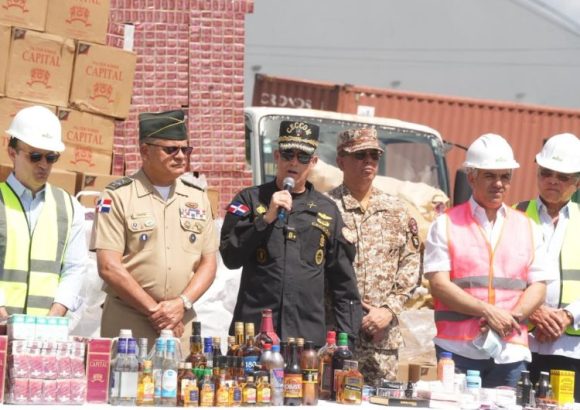
In a sweeping coordinated crackdown on illegal cross-border trade and regulatory noncompliance, Dominican authorities have destroyed more than 28 million units of contraband goods valued at 362.8 million Dominican pesos (RD$), carried out jointly by the nation’s Ministry of Industry, Commerce and Micro, Small and Medium Enterprises (MICM) and the Specialized Corps for Fuel and Commercial Goods Control (Ceccom).
The large-scale destruction operation was hosted at the facilities of local recycling firm Recicla, and brought together the full force of the country’s inter-agency Illicit Activities Task Force. Participating agencies included the national consumer protection agency ProConsumidor, the Dominican Geological and Mining Survey Digemaps, the Attorney General’s Office, the General Directorate of Customs (DGA), the Directorate General of Internal Revenue (DGII), the General Directorate of Migration (DGM), the National Police, and multiple military units. This cross-agency collaboration underscores the government’s priority of rooting out illicit trade networks that operate across multiple sectors of the economy.
All of the destroyed merchandise had been previously seized from commercial markets for violating Dominican trade, tax, and public health regulations. Common violations uncovered included unreported smuggling across national borders, failure to pay required import and consumption taxes, intellectual property counterfeiting, product adulteration, and lack of mandatory sanitary registration that ensures goods are safe for consumer use.
The newly completed destruction is just one part of a far broader national enforcement campaign that has already yielded significant results in the first nine months of 2026. Official data released by MICM shows that between January and September 2026, Dominican enforcement agencies have seized a total of 63,864,856 units of irregular goods, with a combined estimated market value of 1.03 billion Dominican pesos. Of this total haul, 52,862,414 units valued at RD$905.9 million have already been secured by authorities, while the remaining 11,003,442 items worth RD$124.2 million remain in judicial custody under Ceccom control, pending final rulings from Dominican courts on their legal status.
Beyond consumer goods, the campaign has also targeted illegal activity in the strategic hydrocarbon sector. Authorities report that inspections along the fuel distribution chain have led to the seizure of 275,302 gallons of unregulated fuel, including diesel, liquefied petroleum gas (LPG), gasoline, and kerosene. The seized fuel has an estimated market value of RD$68.6 million. In total, the nine-month enforcement effort has included 8,006 targeted control operations across every region of the country, ranging from checkpoint inspections of transportation networks to audits of commercial distribution hubs. These operations have also resulted in the seizure of 77 vehicles used to transport contraband goods.
The recent destruction operation highlighted the particularly large impact of illicit cigarette trade on government revenues. Of the 28.3 million units destroyed in the latest operation, 24,382,117 were contraband cigarettes. As a highly taxed consumer product, illicit cigarette trade represents one of the largest sources of potential tax loss for the Dominican government.
Analysis cited by MICM estimates that if all of the recently seized contraband had entered the country’s informal market, the Dominican government would have lost approximately RD$185.3 million in internal tax revenue, including the Selective Consumption Tax (ISC) and the Value-Added Tax (ITBIS). When required import duties are added to this calculation, the total estimated potential tax loss climbs to RD$233.4 million — a sum that would have otherwise funded public services and infrastructure projects across the country.
In a statement following the destruction operation, MICM officials emphasized that ongoing seizures and systematic destruction of contraband form a core pillar of the government’s broader national strategy. The strategy has three core goals: protecting critical government tax revenue that funds public services, creating a level playing field for law-abiding businesses by eliminating unfair competition from unregulated illicit actors, and ensuring that all products sold to Dominican consumers meet the country’s legal and safety standards.