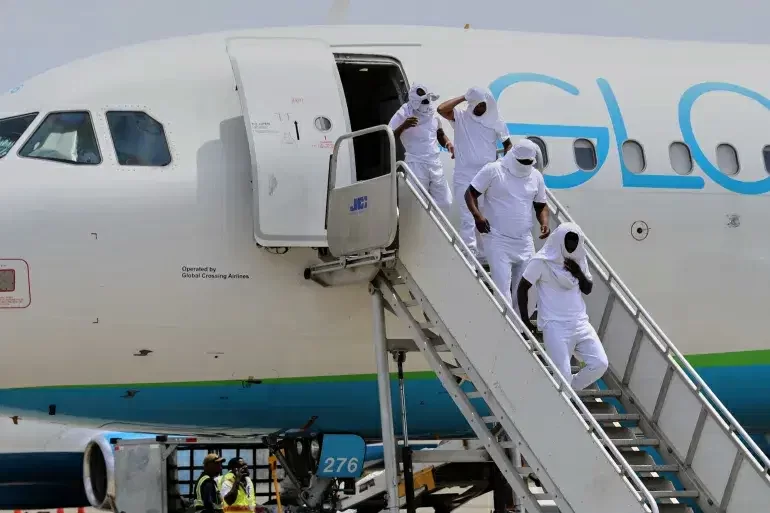
During an on-site interview with Al Jazeera in Doha, Qatar on September 14, Guyanese President Irfaan Ali pushed back against growing criticism of a newly emerging deportation reception arrangement with the United States, stressing that Guyana will retain full sovereign control over all entries to its territory regardless of the bilateral deal.
The agreement, which has not yet been fully detailed publicly, would see Guyana accept third-country nationals that the U.S. government has ordered deported. Critics have raised alarms that the deal would turn the small South American nation into a dumping ground for deportees expelled from the U.S., with no sufficient safeguards for the rights of deported individuals or Guyana’s national security. Addressing these concerns directly, Ali emphasized that the U.S. does not have the authority to unilaterally deport individuals to Guyana without prior approval from Guyanese authorities.
“This is not a scenario where the U.S. shows up with a plane and just dumps people on your shores,” Ali told reporters. He laid out the formal two-step process that governs any planned deportations under the arrangement: first, U.S. authorities are required to share the full list of proposed deportees with Guyana before any travel is arranged. Guyanese officials will then conduct independent screenings and vetting of each individual on the list, and only after the process is completed to Guyana’s full satisfaction will the country approve the names. If Guyana rejects any individual, that person will not be accepted into the country.
Ali added that the agreement does not set a binding precedent for future cases, meaning Guyana retains the full right to turn away any proposed deportee at any time, regardless of past approvals. He also confirmed that the International Organization for Migration (IOM) is involved in implementing the arrangement, though he did not elaborate on the organization’s exact role. The interview took place during Ali’s diplomatic visit to Doha, a major hub that has increasingly hosted high-level international diplomatic talks for parties across the Middle East and beyond, giving the Guyanese leader a platform to clarify his government’s position to a global audience.
Human rights organizations have already raised multiple red flags about the deal, warning that Guyana lacks sufficient oversight mechanisms to ensure that deportees are not sent to the country without adequate due process, and that the arrangement could open the door to large-scale deportations that strain Guyana’s resources. In his comments, Ali rejected claims that Guyana has ceded sovereign control over its border policies, but he declined to provide key details that critics have called for. These missing details include the specific criteria Guyana uses to approve or reject proposed deportees, the exact nature of security and human rights screenings carried out by officials, whether an independent appeal mechanism exists for rejected or approved deportation decisions, and whether Guyana has already rejected any deportation proposals from the U.S. to date.
While Ali reiterated that Guyana’s sovereignty remains fully intact because of the country’s final say over who enters its borders, the practical implementation of this commitment and the question of whether the agreement will eventually be expanded to accommodate much larger numbers of deportees remain unanswered for the time being.