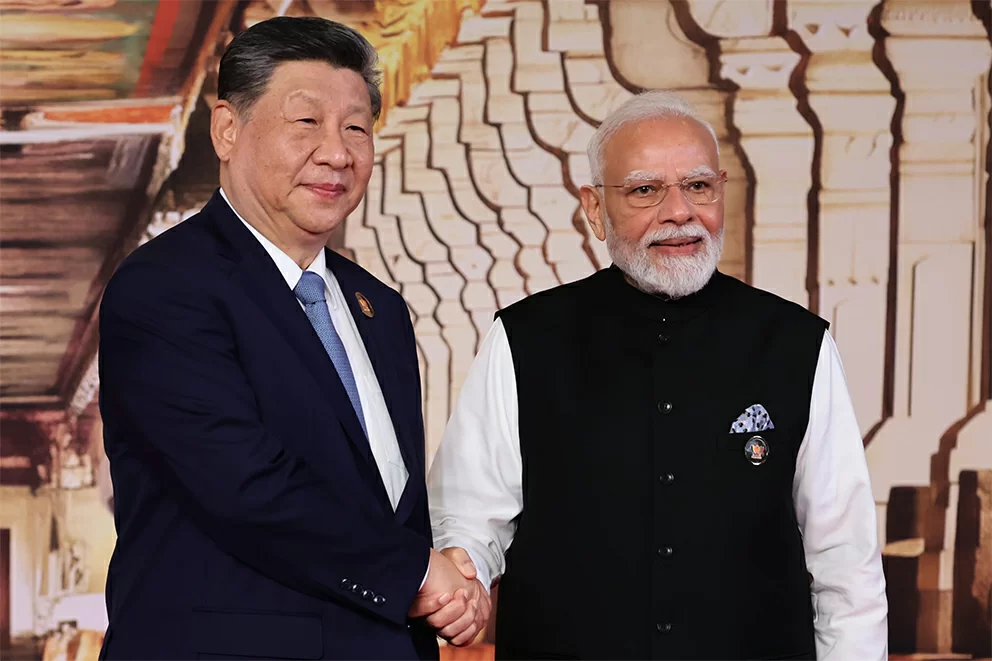
On the sidelines of the BRICS Summit held in New Delhi, Chinese President Xi Jinping and Indian Prime Minister Narendra Modi held a landmark bilateral meeting on Saturday, aimed at mending fractured relations between the world’s two most populous nations. This encounter represents the latest milestone in a gradual rapprochement process that began after a deadly 2020 border confrontation that left dozens of soldiers dead from both sides.
This summit marks President Xi’s first visit to India since 2019, a symbolic step that underscores the cautious warming of ties between the two neighboring rivals. In his opening remarks, President Xi emphasized that China approaches its relationship with India from a long-term, strategic perspective, according to statements carried by China’s state news agency Xinhua. He called for deeper bilateral collaboration, noting that both nations can leverage their respective complementary strengths to support shared development. As two major powers of the Global South, Xi added, China and India bear a collective responsibility to advance the formation of a multipolar world and uphold global peace and stability.
For his part, Prime Minister Modi thanked China for its cooperation in preparations for the 2025 BRICS Summit, which is scheduled to be hosted in China next year. Modi stressed that maintaining peace and tranquility along the disputed border region is a foundational requirement for expanding broader bilateral cooperation. A statement from India’s Ministry of External Affairs confirmed that both leaders reaffirmed their shared commitment to reaching a fair, mutually acceptable resolution to the long-running border dispute.
“Differences must not be allowed to turn into disputes,” Modi said, outlining three core guiding principles for bilateral engagement: mutual respect, mutual sensitivity to each other’s core interests, and a focus on mutual benefit.
Beyond border issues, the two leaders held wide-ranging talks on strengthening people-to-people ties and bilateral trade, addressing persistent trade imbalances, resolving supply chain disruptions, and expanding reciprocal market access. This meeting follows high-level talks held last year on the sidelines of the Shanghai Cooperation Organization summit during Modi’s attendance at the event, a China-founded regional bloc focused on political, economic, and security cooperation.
Tensions remain high across the remote, mountainous Ladakh border region, where the 2020 clash killed at least 20 Indian soldiers and four Chinese service members. To this day, both sides maintain thousands of troops and heavy military deployments along the disputed line of control, and have ramped up infrastructure construction along their respective sides of the border. Despite incremental steps to reduce friction, deep-seated strategic mistrust continues to overshadow bilateral relations, with multiple long-standing sticking points remaining unresolved.
Outstanding points of contention include the unresolved border dispute, India’s large and growing trade deficit with China, New Delhi’s restrictions on Chinese investment and technology firms, and broader strategic rivalry across the Indo-Pacific region. Economically, China has maintained a significant lead over India since the two nations’ 1962 border war, holding a substantial trade surplus that has fueled growing economic competition. India has sought to position itself as an alternative manufacturing hub for foreign firms, capitalizing on rising labor costs in China and growing Western geopolitical tensions with Beijing, while also maintaining deep skepticism of China’s Belt and Road Initiative, which it has firmly opposed over sovereignty concerns.
In recent years, India has also deepened its strategic partnership with the United States, a shift that has sparked growing concern in Beijing, which views the alignment as part of a broader Western strategy to counter China’s regional rise. Saturday’s high-profile meeting is widely seen as a key test of whether the recent softening of tensions between the two powers can translate into lasting broader stability across the bilateral relationship.