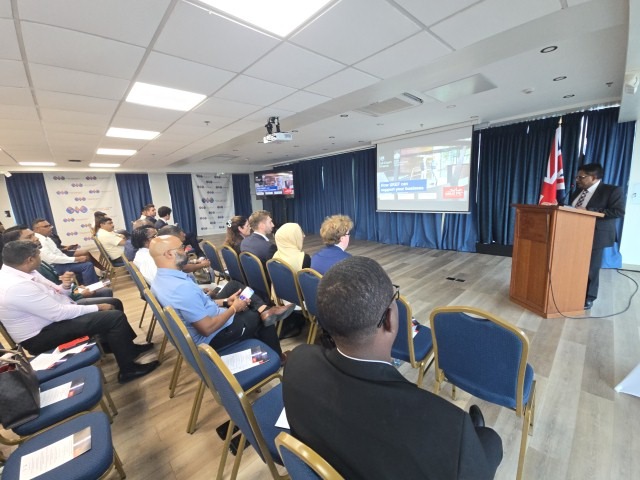
In an announcement made during a private sector-focused workshop in Georgetown on Wednesday, the United Kingdom Export Finance (UKEF), Britain’s official export credit agency, outlined new financing terms for Guyanese imports that carve out a clear exception for non-oil sector activity while adhering to the UK government’s formal fossil fuel financing policy.
Senior UKEF officials emphasized that while direct financing for oil and gas sector contracts is off the table in line with national climate policy, the agency will not impose blanket restrictions on Guyanese companies active in the country’s growing hydrocarbon supply chain. George Hames, UKEF’s regional head of business origination for the Americas, clarified the key distinction between targeted policy and broad exclusion at the event. “Whilst, unfortunately, we’re not able to help you necessarily in procuring very specific oil and gas equipment, we’re not looking to penalise companies that are active in the wider Guyanese oil and gas supply chain. That’s a really important distinction for us,” Hames explained. He added that no blanket “purity test” will be applied to local firms operating in the oil sector, allowing most Guyanese businesses to still access UKEF-backed financing for non-hydrocarbon purchases from the UK and third-party nations.
The new financing framework includes a notably flexible UK local content requirement, which has drawn praise from Guyana’s top finance official. Unlike most export credit agencies that demand a far higher share of domestic content to qualify for support, UKEF only requires that at least 20 percent of a contract’s total value come from UK suppliers. Guyana’s Finance Minister Dr. Ashni Singh called the terms unprecedented during his opening address to the workshop, held at Georgetown’s World Trade Centre. “That formula makes UKEF the most flexible export credit agency that I have encountered across the entire spectrum of export credit agencies,” Singh noted, highlighting that most peer agencies require significantly higher domestic content thresholds.
Hames expanded on the reasoning behind the 20 percent rule, explaining it is designed to combine the strengths of UK industrial supply chains with local Guyanese goods, services, and employment. The goal, he said, is to foster new downstream business opportunities for firms in both countries. A £3 billion financial window for Guyana’s public and private sectors was already opened by UKEF several months prior to the workshop, giving eligible projects substantial capital to draw from.
Judith Huijnen, head of the Commonwealth Caribbean section at UKEF, detailed the full range of financing products available to eligible applicants. The agency works through commercial banks and insurers to fill market gaps in lending, offering everything from short-term working capital solutions and bond support to export insurance and long-term buyer credit facilities. For priority sectors including renewable energy, transport infrastructure, healthcare, agriculture, and airport development, UKEF even provides direct fixed-rate lending. Huijnen outlined the risk-mitigation structure of the agency’s guarantees: once a UK exporter signs a commercial contract with a Guyanese buyer, the buyer’s bank issues a loan to pay the exporter, and UKEF provides an unconditional 100 percent repayment guarantee. “The credit risk sits with UKEF,” Huijnen explained. “UKEF de-risks a transaction and unlocks financing. There’s no longer a project risk. The risk sits with the [UK] government.”
UK High Commissioner to Guyana Joseph Fisher underscored the growing economic ties between the two nations at the workshop, noting that Guyana is now the UK’s largest trading partner in the Commonwealth Caribbean. Current trade figures reflect a booming bilateral relationship: total UK-Guyana trade hit a record high of more than £2.2 billion in the 12-month period ending the first quarter of 2026, representing a 35 percent year-on-year increase, and accounting for nearly 44 percent of the UK’s total trade with the Commonwealth Caribbean region.