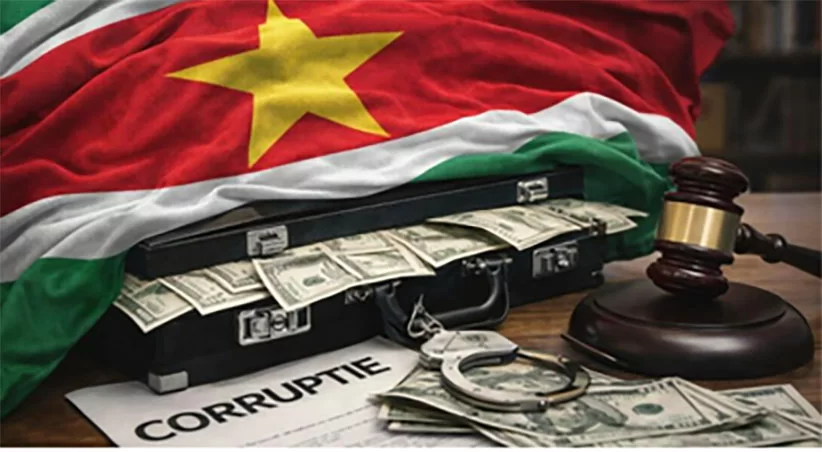
As Suriname prepares to receive billions in new revenue from its emerging oil and gas sector, a leading Surinamese economist has sounded a urgent alarm: systemic corruption already erodes the nation’s governance, and without immediate, targeted institutional reform, the coming resource windfall risks becoming a curse rather than a catalyst for long-term prosperity.
In a new article titled *Kot A Keti; Why Suriname Must Break the Chain of Corruption Now*, published in the journal of the Association of Economists of Suriname (VES), economist Winston Ramautarsing lays out a comprehensive case for reform, drawing on insights from his recent masterclass presentation at August’s national Compliance Congress. Ramautarsing argues that corruption is far more than a scattered series of isolated bribes or bad acts — it has become a structural flaw embedded in Suriname’s governance system, one that blocks citizen trust, undermines effective public administration and derails sustainable economic growth.
Against common perceptions that frame corruption only as large-scale bribery schemes, Ramautarsing redefines the issue at its core: the abuse of entrusted public power for personal or factional gain, a practice that can take hold across government agencies, private enterprises and civil society organizations alike. He particularly warns against the dangerous social normalization of “petty corruption” — small bribes to speed up administrative processes, nepotism in hiring, favoritism for friends and political allies that is often dismissed as harmless.
“This normalization is where the rot begins,” Ramautarsing argues. When citizens, business owners and public officials come to accept rule-breaking as normal, a cultural shift occurs that makes large-scale corruption far easier to hide and justify. Corruption does not start with multi-million dollar public contracts; it starts with the widespread belief that rules only apply to other people.
Data from Transparency International’s 2025 Corruption Perceptions Index underscores the severity of the trend. Suriname scored just 38 out of 100, ranking 96th out of 182 countries — well below the global average score of 42. Worse, the nation has seen a steady decline in its score over the past decade: it held a 45-point score as recently as 2016. This consistent downward trend, Ramautarsing says, is a clear red flag for declining integrity across the entire public sector.
The economic and social costs of this corruption are far from abstract. For international investors, who weigh natural resource access against rule of law, transparent permitting, secure property rights and predictable regulation, systemic corruption raises operational risk and drives up the cost of doing business, discouraging the outside investment Suriname needs to diversify its economy. For ordinary Surinamese citizens, the costs are even more direct: inflated public project costs from kickbacks and siphoned tax revenues leave less public funding for critical sectors including healthcare, education, and infrastructure. When access to jobs and business opportunities depends on personal connections rather than merit, economic inequality widens and the nation wastes critical talent that could drive growth.
While Suriname enacted a national Anti-Corruption Act in 2017 and established an official Anti-Corruption Commission (ACC) in 2023, Ramautarsing says the body is currently too under-resourced to tackle complex corruption cases effectively. The ACC lacks sufficient numbers of specialized investigators, forensic experts, data analysts and IT infrastructure, leaving it functioning more as a weak integrity office than a powerful, independent anti-corruption enforcement authority.
Using Singapore’s Corrupt Practices Investigation Bureau as a model, Ramautarsing notes that the city-state’s anti-corruption agency has hundreds of specialized staff, broad investigative powers and substantial independent funding. While Suriname does not need to copy Singapore’s system exactly, he argues it must learn a core lesson: anti-corruption efforts without professional capacity and political independence remain little more than symbolic gestures. To build an effective ACC in Suriname, Ramautarsing proposes expanding the body’s investigative powers, staffing it with roughly 30 full-time professional employees, and allocating an annual budget of approximately $5 million USD.
The coming oil and gas revenue boom makes this reform exponentially more urgent, Ramautarsing stresses. Future resource revenues offer Suriname an unprecedented opportunity to invest in long-term development across education, healthcare, infrastructure and climate action — but massive new capital flows also bring severe integrity risks. Every step of the oil and gas supply chain, from permit granting and public contracting to royalty collection and regulation, is vulnerable to conflicts of interest and corrupt exploitation.
To mitigate these risks, Ramautarsing calls for full public disclosure of all major oil and gas contracts, independent auditing of all state revenues and capital flows from the sector, and transparent public reporting of all royalties and profit oil. “Citizens have a right to track how much money enters the state, and how it is spent,” he argues. Left unregulated, he warns, oil revenues could cement a new system of political patronage that entrench systemic corruption — a historic mistake that would waste the nation’s best chance for broad-based prosperity. He frames the choice clearly: will oil become a source of sustainable national welfare, or just “a new pot of honey” for corrupt actors to plunder?
Ramautarsing argues that effective reform does not require dozens of new overlapping laws. Instead, a small set of targeted changes can drive major progress. Digitalization of public services is one high-impact tool: corruption thrives on in-person interactions, discretionary decision-making and lack of auditable paper trails. By digitalizing core processes across customs, tax administration, construction permitting and public procurement, all decisions and transactions become far easier to trace and audit. Public contracting should also be fully transparent from the initial tender notice through the final invoice, so that the public can verify what is purchased, from whom, at what price, and under what procedures. Additionally, Ramautarsing calls for strong legal protections for whistleblowers, including confidential reporting channels, legal safeguards against retaliation such as firing or blacklisting, and independent investigation of all reported misconduct.
Crucially, Ramautarsing emphasizes that fighting corruption is not the sole responsibility of government, police and the courts. Businesses, civil society groups, independent media and individual citizens all play a role in maintaining the corrupt system. He questions the credibility of public outrage over large corruption scandals when many people are willing to accept small acts of nepotism, favoritism or conflict of interest when they personally benefit. The chain of corruption relies on multiple links: someone asks for a bribe, someone offers it, someone pays it, someone looks the other way, and someone profits.
Suriname stands at a critical crossroads, Ramautarsing concludes. Institutional strengthening must happen before large oil revenues begin to flow, not after billions have been lost to corruption and mismanagement. While fully eradicating corruption is not a realistic short-term goal, the nation can aim to build a system where corruption is no longer the easiest path to power, wealth and influence. That goal requires strong independent institutions, radical transparency, professional compliance frameworks and active public oversight. In the end, however, breaking the chain requires individual responsibility. The chain can only be broken when enough Surinamese citizens refuse to participate — a call to action captured in his article’s title, *Kot A Keti*, which means “cut the chain”.