A newly approved 15% across-the-board salary increase for public sector employees in Suriname has taken retroactive effect starting September 1, 2026, bringing substantial monthly pay bumps to the country’s top political leadership, while the judicial branch has opted out of the raise following consultations with President Jennifer Simons. The new salary structure, formalized via government resolution on September 8, also extends the 15% increase to public pension payments, with updated salaries scheduled to be disbursed to workers by the end of September. The pay adjustment emerged from collective negotiations between the government and national labor unions, extending to all public servants and equivalent positions across state institutions.
Under the revised pay scale, the highest base salary for a senior department director is set at SRD 37,480 per month. All political leadership pay is calculated as a percentage of this benchmark figure. The Surinamese president receives a base salary equal to 400% of the department director benchmark, totaling SRD 149,920 monthly. On top of this base, the president is eligible for multiple fixed-percentage allowances: a 55% representation allowance worth SRD 82,456 and a 45% management allowance of SRD 67,464, bringing the pre-conditional allowance total to SRD 299,840. Two additional conditional allowances may also apply: a 10% telecom allowance, granted if no state-provided telecom infrastructure is available, and a 10% security allowance offered as a cash alternative to state-funded electronic security. If both conditional allowances are applied, the president’s total monthly pay reaches SRD 329,824. This figure does not include the value of additional state-provided benefits the president is entitled to, including official housing and full transportation coverage (a state vehicle, fuel, and a professional driver); if the official residence is unavailable, the state covers all legally mandated housing costs.
For the vice president, base pay is set at 75% of the presidential base salary, totaling SRD 112,440 per month. The vice president receives a 40% representation allowance (SRD 44,976) and a 35% management allowance (SRD 39,354), for a pre-conditional total of SRD 196,770. Like the president, the vice president is eligible for 10% conditional telecom and security allowances, bringing the maximum total monthly pay to SRD 219,258. The vice president also receives state-funded housing and transportation benefits that are not included in the calculated cash total.
Cabinet ministers receive a base salary equal to 60% of the presidential base, coming out to SRD 89,952 per month. Additional fixed allowances include 25% for representation (SRD 22,488), 10% for management (SRD 8,995), and 25% for housing (SRD 22,488). Conditional allowances include a 30% transportation allowance (SRD 26,986) granted when no state vehicle is provided, a 7.5% telecom allowance (SRD 6,746), and a 10% cash security allowance (SRD 8,995). When all applicable allowances are included, the average minister’s total monthly pay reaches SRD 186,650, with slightly adjusted percentages applied for the Minister of Foreign Affairs for specific position-related benefits.
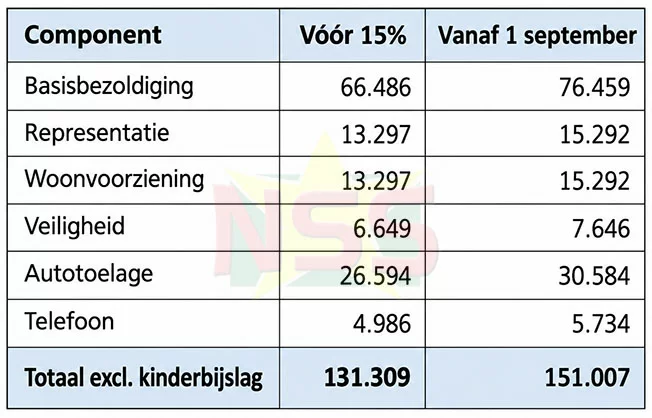
For members of the National Assembly (DNA), the 15% increase has pushed the average total monthly pay from approximately SRD 131,309 to SRD 151,007, a jump of just under SRD 19,700 per month. Prior to the adjustment, an ordinary DNA member received a base salary of SRD 66,486, with additional allowances for representation, housing, security, transportation, and telecommunications bringing the pre-hike total to SRD 131,309. The revised structure raises the average base salary for ordinary members to SRD 76,459, with all existing percentage-based allowances increasing proportionally to reach the new total.
Notably, the judicial branch of Suriname’s government has confirmed it will not accept the 15% salary increase, a decision reached through closed consultations with President Jennifer Simons.