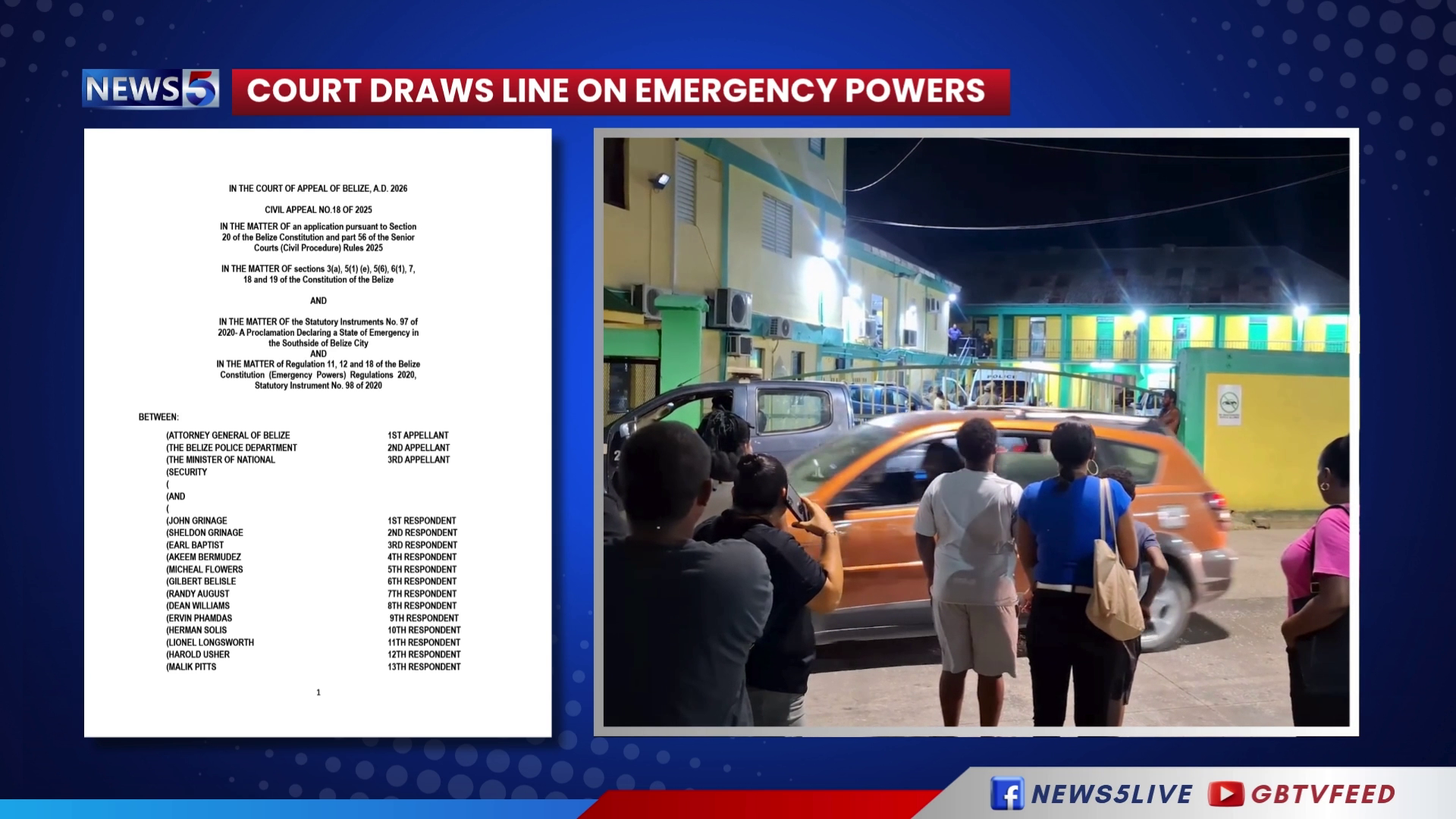
On September 7, 2026, Belize’s Court of Appeal issued a landmark ruling that reaffirms the primacy of constitutional protections even amid a public safety crisis, striking down a 2020 state of emergency declared for southside Belize City as unconstitutional. The decision comes after the appellate court reviewed conflicting 2025 rulings from the nation’s High Court, ultimately resolving the legal dispute and setting a clear new precedent for how governments can respond to rising violent crime. The core holding of the ruling: a rising tide of crime and violence does not grant state authorities the right to suspend fundamental constitutional rights guaranteed to all people in Belize. Judges on the appellate panel found that government officials failed to meet the required legal standard to justify a state of emergency: they could not prove that criminal activity was so widespread and uncontrollable that ordinary criminal legislation and law enforcement procedures were incapable of addressing the crisis. The court further confirmed that all arrests and detentions carried out under the 2020 emergency declaration violated the constitutional rights of the people detained during that period. The ruling resolves consolidated claims brought by 18 men who were detained under the state of emergency, all of whom are now entitled to receive constitutional damages for the rights violations they experienced. The Court of Appeal upheld damage awards that had already been granted to 13 of the claimants, and added compensation awards for the remaining five appellants. Each detainee will receive $15,000 in compensatory damages and $7,000 in vindicatory damages, a standard structure for constitutional rights violation claims in Belize. Leslie Mendez, the lead attorney representing the group of appellants, explained the far-reaching implications of the court’s decision for future governance and emergency policy in the country. In an interview following the ruling, Mendez noted that the appellate court reconciled the two conflicting High Court rulings from 2025, ultimately endorsing the legal position previously set out by Justice Nadine Nabie. While the ruling establishes the current state of the law in Belize, Mendez confirmed that parties on either side retain the right to file a final appeal with the Caribbean Court of Justice, Belize’s highest judicial body, to seek further clarification on the legal standard for emergency declarations. When asked about the process for claimants to collect their awarded compensation, Mendez explained that while there is no formal statutory limitation period for constitutional claims, courts retain discretion to assess whether claims can proceed after significant delays. Whether detainees can immediately collect their awards will depend on court review once formal claims for payment are filed. Most notably, Mendez emphasized that the ruling creates a clear, enforceable legal threshold that any future government must meet to declare a state of emergency, preventing future overreach in the name of public safety and crime control. This report is adapted from a verbatim transcript of an evening television newscast originally published online.