A new joint analysis from Suriname’s Faculty of Social and Health Sciences (FMeW) has sounded the alarm over a rapidly worsening bottleneck in the clinical training stage of the country’s medical education programs, a gap that threatens training quality and student outcomes if left unaddressed.
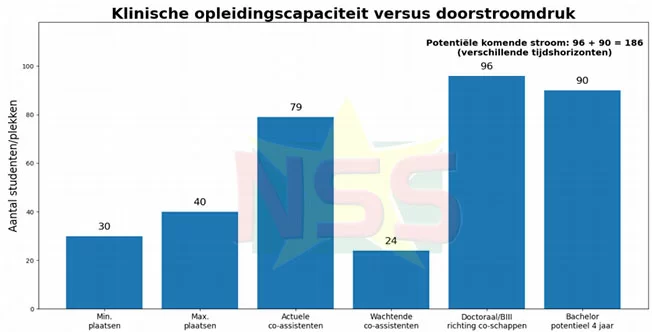
Currently, data shows the faculty only has between 30 and 40 available clinical placement (co-schap) spots for trainee doctors. To make matters worse, 79 trainees are already active in placements across the system, with an additional 24 candidates still waiting for an open position to become available. This existing backlog is only the start of the challenge: a far larger cohort of undergraduate medical students is currently progressing through their pre-clinical coursework and will soon require clinical placements of their own.
FMeW officials warn that expanding overall admission numbers for medical degrees without simultaneously expanding the available capacity for clinical training will only create cascading problems down the line. These risks include extended waiting periods for aspiring trainee doctors, measurable declines in training quality that put patient care at risk, and growing demotivation among students stuck in prolonged backlogs.
A breakdown of future demand makes the scale of the gap clear. Around 96 students from the existing doctoral/BIII training pathway are still waiting to move into clinical placements. Over the coming years, an estimated 90 additional students from the new bachelor-master curriculum track will also reach the point where they need clinical training. This adds up to a potential total of 186 future students requiring placements, even if the full cohort does not need spots at the exact same time.
Unlike pre-clinical coursework that can be expanded through online learning or larger lecture halls, clinical placement capacity cannot grow indefinitely without targeted investment and systemic change. During the clinical phase, trainees must gain hands-on experience delivering direct patient care under the close supervision of experienced medical professionals. This requires sufficient access to hospital departments, qualified supervisor time, steady patient volumes, and structured learning spaces that are already stretched thin across the current system.
To address the growing crisis, FMeW has put forward a series of targeted policy recommendations. The core proposal is to expand the national clinical training network beyond the existing hub at the Academic Hospital Paramaribo, by formally integrating other hospitals and independent care institutions into the training system. Additional recommendations include increased public and institutional investment in hiring and training more clinical supervisors, expanding access to simulation-based medical education to supplement hands-on training, and implementing digital planning tools to streamline placement allocation and reduce administrative backlogs.
The landmark analysis was compiled by a cross-institutional team led by FMeW Dean Fitzgerald Gopie, Vincent Lumsden, chair of the national Specialists Registration Committee, and former Director of the Suriname Health Fund Rick Kromodihardjo. The study emphasizes that any public debate about appropriate medical student admission numbers cannot be separated from discussions of clinical training capacity. Allowing more students into medical programs at the entry level without creating additional space for clinical training, the authors conclude, does not solve the country’s need for more qualified doctors — it simply shifts the crisis to a later stage of training, where it will create more harmful consequences for students and patients alike.