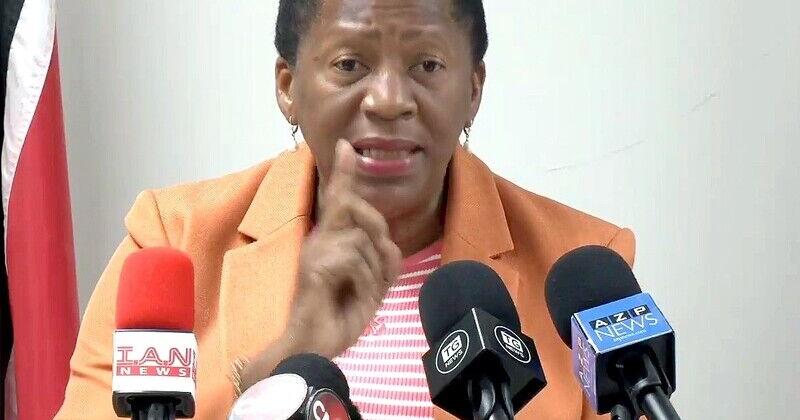
As Trinidad and Tobago marked its 64th year of independence, a sharp political rift has erupted over the prime minister’s holiday messages, with opposition leader Pennelope Beckles launching a blistering rebuke of Kamla Persad-Bissessar’s remarks, accusing the sitting prime minister of blending partisan politics with national office and spreading a distorted version of the country’s post-colonial history.
In a public statement shared across social media platforms on Monday, Beckles categorized Persad-Bissessar’s two separate Independence addresses as unresponsive to the lived experiences of the national public, disconnected from on-the-ground realities, and marked by a failure to draw a clear line between the prime minister’s duty to all citizens and her partisan obligations as leader of the United National Congress (UNC).
The core of Beckles’ criticism centers on the order of Persad-Bissessar’s communications: the prime minister first delivered an address exclusively to her “UNC family” in her capacity as party leader before releasing a formal message to the entire nation. Beckles argues that Persad-Bissessar exploited a unifying national milestone that belongs to all Trinidadians and Tobagonians to push a partisan agenda rooted in grievance and political polarization, rather than fostering cross-community unity.
“This is not the behavior one expects from a prime minister whose primary responsibility is bringing a divided country together,” Beckles noted in her statement.
Beyond the issue of misplaced partisanship, Beckles took particular issue with claims made in Persad-Bissessar’s formal national Independence address, released on Sunday. In that message, the prime minister urged the country to “grow up,” move past blaming contemporary social and economic challenges on the legacy of colonial rule, and claimed the nation experienced widespread prosperity during British colonial governance. Beckles flatly rejected this framing, calling it a blatant attempt to rewrite the country’s foundational national history.
“Trinidad and Tobago’s decades-long fight to win independence, and our decades of development as a sovereign nation since, cannot be condensed into a politically convenient retelling of history tailored to whatever audience the prime minister is seeking to win over,” Beckles asserted.
She went on to outline the flaws in Persad-Bissessar’s narrative, arguing: “The prime minister is incorrect to describe our colonial inheritance without acknowledging the deep systemic inequalities and harmful social conditions that shaped the country at the moment we gained independence. Just as wrong is her framing of our post-independence history as a partisan battle, casting one group as blameless victims and another as villains.”
Beckles emphasized that the Trinidadian and Tobagonian public deserves more thoughtful, honest leadership than what Persad-Bissessar delivered, noting that the country’s history is far more nuanced and meaningful than the distorted retelling presented by the prime minister.
“It should come as no surprise that a prime minister who has already failed to properly recognize the historical legacy of Dr. Eric Williams, the nation’s first prime minister, would now put forward such a warped account of our independence journey,” Beckles added.
She closed her statement with a sharp rebuke of Persad-Bissessar’s fitness for office: “A prime minister who cannot speak honestly about our nation’s history cannot credibly guide our nation forward.”