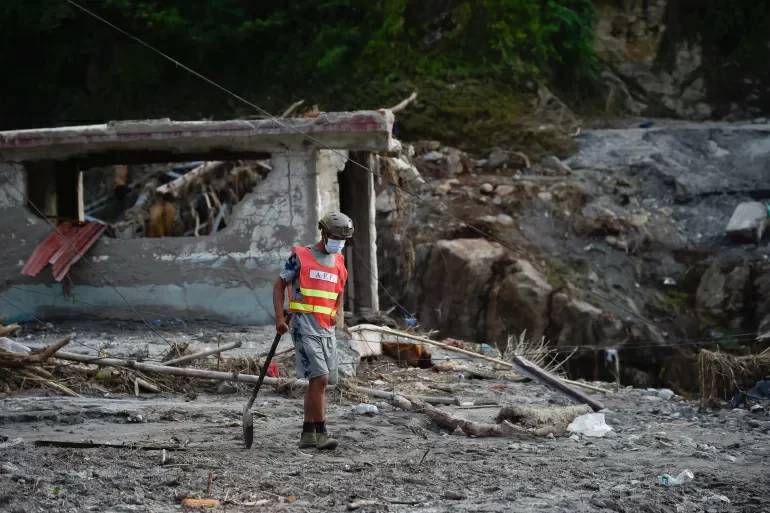
Rescue teams have resumed search and recovery efforts in flood-ravaged areas along the Nepal-China Tibet border, after a temporary pause triggered by fears of a second catastrophic glacial outburst. As of Saturday, the confirmed death toll from Wednesday’s disaster has climbed to 633, with close to 3,000 people still unaccounted for across both sides of the border.
Nepalese police reported 626 fatalities within Nepal’s territory, according to latest updates. The country’s national disaster management agency added that 2,426 people are registered as missing on Nepal’s side of the border, including 517 foreign nationals — a group that likely comprises international tourists and cross-border migrant workers. On the Chinese side of the border, regional authorities have confirmed at least seven deaths in Tibet and 555 people listed as missing.
Facing the urgent, large-scale scope of the disaster, the Nepalese government has formally requested specialized rescue support from both neighboring India and China. Teams with expertise including high-altitude tunnel rescue are scheduled to arrive in the affected region by Saturday evening. A spokesperson for Nepal’s Ministry of Foreign Affairs emphasized that the appeal for international assistance was made out of urgency, as hundreds of lives remain at stake in hard-to-reach affected areas.
The disaster unfolded on Wednesday, when a large section of a glacier located roughly 5,200 meters above sea level in the Himalayan mountain range collapsed. Debris from the collapsed glacier plunged more than 1,200 meters into the Lende River, triggering a massive flash flood that swept through Nepal’s Rasuwa, Nuwakot and Dhading districts. Official data shows the water level of the Trishuli River, a major waterway in the region, surged by 9 meters in just 30 minutes as the flood wave passed through. The United States Geological Survey has determined the collapse was caused by a pre-existing landslide, rather than being triggered by seismic activity.
In the wake of the initial collapse, a new glacial lake formed behind a natural dam of loose rock and glacial debris at the collapse site. This new formation forced authorities to temporarily halt all rescue operations over fears the unstable dam could fail and trigger a second devastating flood. Operations resumed after risk assessments concluded the current threat of a second outburst is manageable for search teams operating in lower-lying affected areas.
Alton Byers, a leading glacial hazard expert at the University of Colorado, warned that the earthen dam holding the new glacial lake is extremely unstable, as it is constructed entirely of loose unconsolidated debris. Byers noted that the safest outcome would be a gradual, natural drainage of the excess water from the new lake. He added that Chinese technical teams could also attempt to manually drain the lake using specialized equipment, a mitigation strategy that has been successfully deployed in response to similar glacial flood events in other mountain regions around the world.
On Thursday, Chinese Premier Li Qiang visited the affected disaster zone in Gyirong, while Chinese President Xi Jinping has called for evidence-based, scientific planning for rescue operations and stricter long-term monitoring of at-risk glacial lakes across the Himalayan region.
International aid and support have begun to arrive from a range of global actors, including India, the United Nations, the International Committee of the Red Cross, Australia, South Korea and the United States. Disaster response experts have warned that the final death toll is almost certain to rise further in the coming days, as rescue teams work to reach remote areas cut off by massive mudslides and washed-out road infrastructure that has made access extremely difficult.