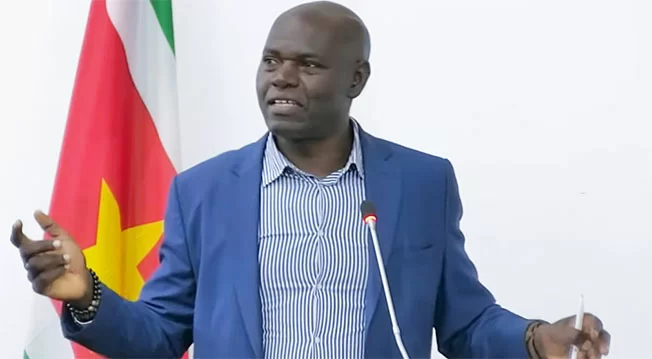
During parliamentary debates on Suriname’s new General Tax Law, Ronny Asabina, parliamentary faction leader of the BEP party, has made a urgent, high-stakes call for the Surinamese government to launch a comprehensive re-evaluation of all existing contracts between the state and large multinational gold mining operators operating in the country.
Asabina framed his demand within the broader context of ongoing national tax system reform, arguing that addressing tax avoidance and evasion cannot only target individual taxpayers and small local businesses. Long-standing fiscal agreements between Suriname and international mining giants must also be brought under rigorous scrutiny, he emphasized.
The BEP leader warned that complex cross-border corporate and accounting structures are commonly used by multinational firms to shift profits generated in Suriname to offshore jurisdictions, depriving the country of critical public revenue. Critically, Asabina noted that Suriname currently lacks clear data on how much tax income it loses to these practices, stating bluntly, “We have no idea how much revenue we are missing out on.” To close this gap, he pushed the government to conduct a full, in-depth audit of all existing gold sector contracts.
Asabina drew specific attention to fiscal clauses governing withholding tax on payments made by gold mining companies to foreign service providers. He pressed the government to confirm whether regular, rigorous audits are carried out to verify that required tax amounts are correctly withheld and remitted to the state treasury, and also called for clarity on how these existing special fiscal arrangements align with the new General Tax Law currently under parliamentary consideration.
While he acknowledged that attracting and retaining foreign direct investment remains a key priority for Suriname’s developing economy, Asabina rejected the long-standing practice of giving preferential, soft treatment to multinational corporations. He argued that investment promotion must never come at the cost of weak oversight of companies’ fiscal obligations.
Beyond tax compliance, Asabina also raised sharp questions about the Surinamese government’s failure to exercise its rights properly as a co-shareholder in major gold mining operations, pointing to Newmont Suriname as a key example. He argued that the state should not passively rely only on the public information published by the company, but must actively conduct independent, thorough reviews of the firm’s annual financial statements, full operating results, revenue streams, expenditure, investment plans and final profit distributions.
“As a shareholder, I don’t just sit back and listen to what the company tells me,” Asabina said, asking how many independent financial experts the state has actually deployed to audit the multinational miners’ annual reports. He added that the state must also exercise close oversight over large-scale investment projects announced by gold companies, because investment costs directly impact final financial results – and therefore the revenues the state is owed from its equity stake.
Asabina also linked the demand for greater oversight to tangible benefits for local communities living in mining regions. He cited the existing development fund for the Saramacca community, which has delivered tangible improvements including funding for education infrastructure in Brokopondo, as proof that fair, well-enforced natural resource contracts can deliver widespread public good.
Against this backdrop, Asabina argued that the ongoing process of national tax system reform presents an ideal, timely opportunity to re-examine all existing fiscal agreements between Suriname and multinational mining firms. The government, he said, must be able to clearly demonstrate that Suriname is actually collecting every cent of revenue it is legally entitled to under existing contracts and national tax legislation.