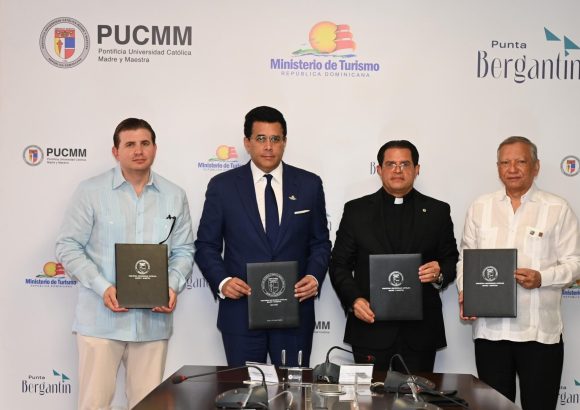
A new landmark partnership between academia, government, and a private development trust is set to launch a long-term research initiative to track the full impacts of the Punta Bergantín tourism and real estate development across northern Dominican Republic, centered in Villa Montellano, Puerto Plata.
The collaborative agreement brings together three key stakeholders: Pontificia Universidad Católica Madre y Maestra (PUCMM), the Dominican Republic’s Ministry of Tourism (Mitur), and the Trust for the Economic and Social Development of Punta Bergantín. The partnership will deliver two core outcomes: a permanent monitoring program measuring the project’s economic, social, and territorial changes across local communities, and tailored workforce training to meet the growing labor demands of the new tourism hub.
The rector of PUCMM emphasized that the cross-sector alliance serves as a powerful model for advancing inclusive national development. “This agreement is clear proof of what effective collaboration looks like: the state, academic institutions, and the private productive sector align their goals and build partnerships to drive meaningful development across the country,” he stated. Under the terms of the partnership, PUCMM will contribute specialized research capabilities, academic training programs, and community outreach initiatives to address the evolving needs of the emerging tourism pole.
Mitur Minister David Collado noted that the Dominican Republic’s successful tourism growth strategy has long depended on data-driven decision-making, rather than improvisation, to shape international promotion efforts and understand visitor demographics. “We have not improvised – we have worked hand in hand with data,” Collado said, adding that this evidence-based approach has been central to the sector’s sustained expansion and the successful diversification of international source markets.
Andrés Marranzini, executive director of the Punta Bergantín trust, framed the agreement as the official starting point for a long-term collaboration that will document and measure the project’s transformative impact across Puerto Plata and the broader northern region. Marranzini explained that the large-scale development is already delivering widespread economic benefits, and is positioned to act as a core catalyst for regional progress. He highlighted that PUCMM’s experienced faculty and engaged student body will play a critical role in collecting empirical evidence of the project’s community impacts and identifying untapped growth opportunities for the region.
A key component of the partnership is workforce development: the agreement includes plans to strengthen human capital training to meet the labor demands generated by new tourism growth, including a hotel school that will be managed by PUCMM’s hospitality students. Marranzini noted that investing in skilled labor creates benefits that extend far beyond local communities, pointing out that Dominican professionals already hold leading roles across the Caribbean hospitality industry. The first phase of the Punta Bergantín project will deliver 1,600 new hotel rooms, a development that Marranzini says will help establish a new driver of progress for the entire northern region.
### Study Framework and Scope
The permanent research program will track a core set of development indicators including new job creation, household income levels, local entrepreneurship growth, total investment inflows, and changes to community quality of life. Data will be organized in a longitudinal ongoing database, with interim analysis published in semi-annual reports and a comprehensive full annual report. PUCMM’s School of Economics will lead all work on research methodology, data collection, analysis, and report preparation.
The overarching goal of the initiative is to generate objective, actionable evidence that illustrates how large-scale tourism development transforms community livelihoods. These insights will then be used to refine public policy and advance the project’s core mission of driving sustainable, inclusive economic growth across the region. Additional components of the partnership include independent academic research opportunities, hands-on training for PUCMM students and local industry professionals, and potential participation from the university’s School of Tourism and Gastronomy in managing the new on-site hotel school.
The research program’s area of influence covers Villa Montellano, all communities directly or indirectly impacted by the project, and other key regions across the northern Dominican Republic, including Santiago when relevant. All three partnering institutions have reaffirmed their shared commitment to combining their unique capabilities, specialized knowledge, and collective efforts to advance sustainable development in the region, creating expanded opportunities that deliver broad, positive benefits for tourism activity, local economies, and communities across northern Dominican Republic.