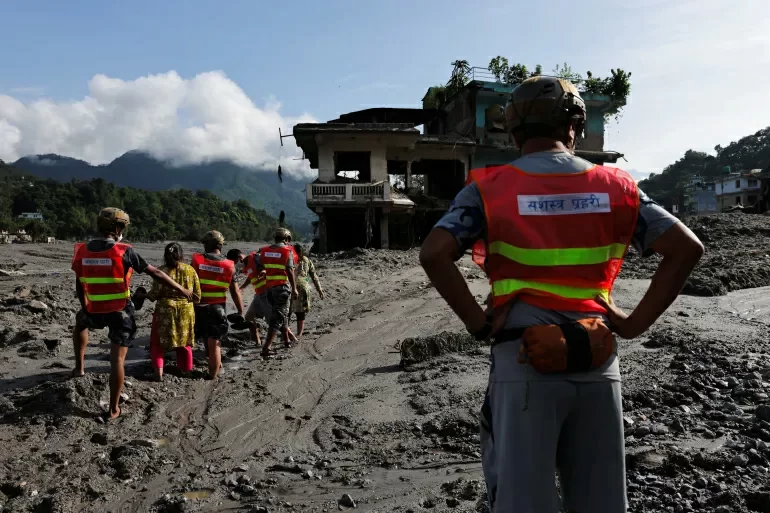
A devastating glacier collapse that unleashed a massive avalanche across the Nepal-China Himalayan border has killed more than 470 people and left hundreds more missing, forcing authorities to suspend critical search-and-rescue operations after the natural dam lake formed by the disaster began overflowing, raising urgent fears of a catastrophic secondary flood.
The disaster unfolded on Wednesday, when a large section of glacial ice gave way, sending a catastrophic surge of ice, meltwater, rock and debris roaring through high-altitude Himalayan valleys. The destructive flow swept away entire villages, critical infrastructure including bridges, highways and hydropower plants, and left a trail of destruction across both the Nepalese side of the border and China’s Tibet Autonomous Region. As debris from the avalanche piled up across a local river, it formed a natural barrier lake – an earthen dam trapping rising river water that now poses an imminent threat of a full outburst.
According to China’s state broadcaster CCTV, Chinese rescue teams have already been evacuated to safer higher ground amid the growing risk of the dam failing. Rescue operations have also been called off temporarily on the Nepalese side of the border, where thousands of residents in Rasuwa District, which sits adjacent to Tibet, have fled to nearby hills to escape potential flooding.
Satellite and aerial monitoring shows the volume of water trapped behind the debris dam is growing at an alarming rate. By Friday, the lake’s capacity exceeded 2.5 million cubic meters, a sharp jump from the 1.5 to 2 million cubic meters recorded just one day earlier. Chinese engineering teams are currently conducting aerial surveys and building 3D models of the site to continuously monitor changing conditions and assess outburst risks.
Downstream in Nepal, authorities have issued urgent warnings that rising water levels are expected to overtop river banks in the coming hours, though the exact size of the potential flood wave remains unclear. As of the latest update, the disaster has claimed 469 confirmed lives in Nepal and five more in Tibet, with hundreds still unaccounted for: 977 people are listed as missing in Nepal, while 558 remain missing across the Tibetan side of the border. To date, roughly 1,550 people have been rescued from disaster-hit areas, around 800 of them airlifted by helicopter and 700 evacuated over land.
Widespread destruction of road networks has cut off access to many remote communities, severely hampering the delivery of life-saving food, water and medical supplies to affected populations. The International Committee of the Red Cross estimates that more than 90,000 people have been impacted by the disaster across the region.
Nepal has deployed 30,000 security personnel to search hard-to-reach valley communities for survivors, while China has mobilized around 500 military and paramilitary personnel to lead response efforts in Tibet. Chinese Premier Li Qiang has traveled to the disaster zone to personally coordinate rescue and response operations.
The international community is closely monitoring the evolving situation, with particular attention focused on the risk of a secondary outburst flood that could compound existing damage and deepen the humanitarian crisis. David Fisher, a representative of the International Red Cross, voiced deep concern over the new and growing threat facing already vulnerable communities in the region.