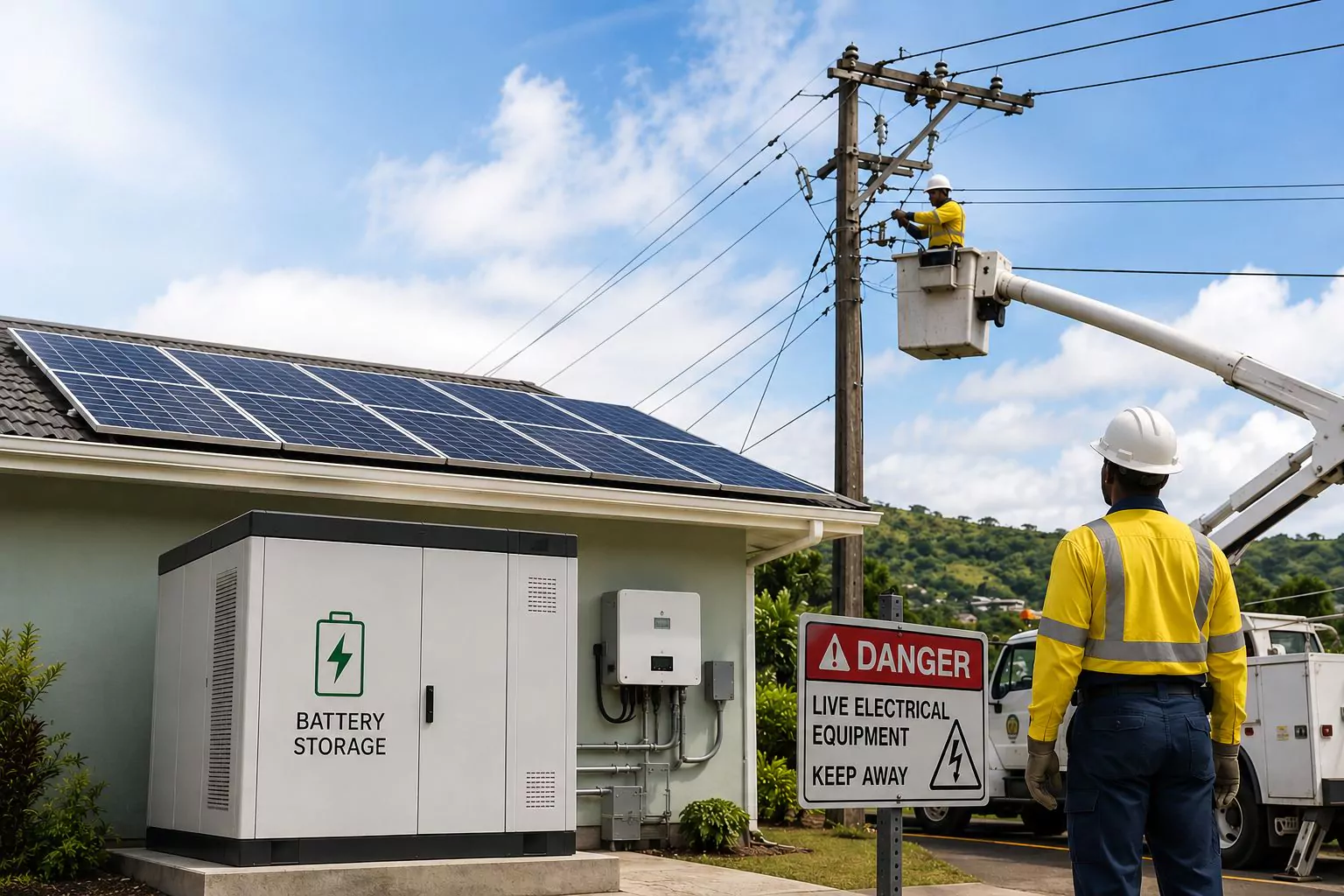
As the Caribbean nation continues to expand its adoption of residential and commercial rooftop solar energy, the Antigua Public Utilities Authority (APUA) is moving quickly to finalize a groundbreaking regulatory framework for battery storage integration with the national power grid. Andre Matthias, the head of APUA’s Electricity Business Unit, confirmed that the new policy is on track to be wrapped up in the coming weeks, with a focus on establishing clear mandatory technical and safety protocols that govern how energy storage batteries connect to the existing distribution network.
For months, solar-powered home and business owners across Antigua have pushed for regulatory changes that would classify battery storage systems the same as traditional standby generators. Under that proposed classification, battery owners would be able to use their stored energy to maintain power supply during widespread or local grid outages, a benefit many see as critical to increasing the value of their solar investments.
However, APUA has highlighted a unique and underdiscussed safety hazard that comes with grid-connected battery storage, distinguishing it from conventional backup generator setups. Matthias explained that unlike fossil fuel-powered generators that produce audible noise when operating, battery systems run completely silently. This creates a dangerous risk for frontline utility maintenance workers: a connected battery could continue injecting electricity into a section of the grid that linesmen have been told is fully de-energized for repair work. In such scenarios, the invisible live power can cause severe electric shock, leading to serious injury or even fatal outcomes.
The push for battery storage regulation comes more than a decade after APUA first opened the door to distributed solar generation. In 2011, the authority launched its first grid interconnection policy alongside a net-metering scheme, which let solar customers offset their overall electricity consumption by feeding excess power generated by their rooftop systems back into the grid. Years later, APUA transitioned from net-metering to a net billing model, a change that the agency justified by pointing to the hidden infrastructure costs associated with distributed energy, including ongoing grid maintenance, regular meter reading, and customer billing administration.
According to APUA, the upcoming battery storage policy is designed to strike a careful balance between two competing priorities. On one hand, it aims to create a clear, structured pathway that supports continued growth of renewable energy adoption across Antigua, helping the country advance its climate and clean energy goals. On the other hand, the new rules will embed critical safety guardrails to protect utility workers from preventable workplace hazards and preserve the overall stability and reliability of the national electricity network.