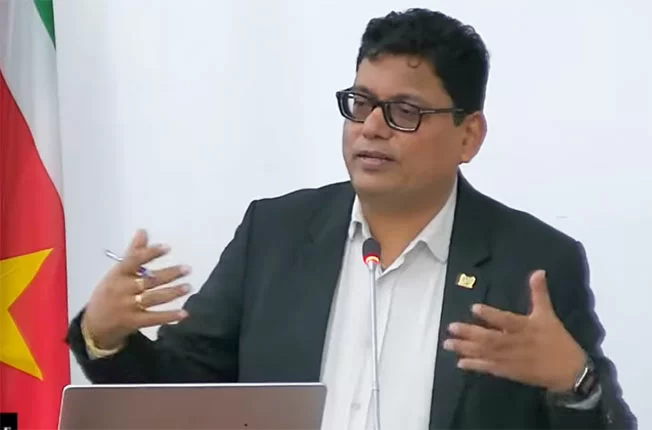
As Suriname moves forward with plans to modernize its national tax system, the leader of the country’s ruling VHP party has laid out a clear set of principles to guide reform, warning against prioritizing short-term state revenue gains over long-term economic growth and private sector competitiveness. Asis Gajadien, who also serves on the parliamentary committee of rapporteurs for the proposed General Tax Law (Algemene Wet Belastingen, AWB), made the remarks during plenary debate on the bill in Suriname’s National Assembly, with the imminent expansion of the country’s nascent oil and gas sector forming the core backdrop for his arguments.
Gajadien emphasized that while tax reform to update the country’s revenue framework is a necessary step for long-term governance, policymakers must strike a careful balance between meeting the state’s pressing revenue needs and preserving the private sector’s capacity to invest, grow and compete. He expressed full support for building a modern, effective tax authority capable of cracking down on tax evasion and improving compliance, but pushed back against the idea that tax policy should only be evaluated by how much revenue it delivers to the state in the near term.
Tax revenue is the critical foundation for funding core public services from education and healthcare to infrastructure, public safety and social welfare, Gajadien noted. But all public revenue is ultimately drawn from the same economy that needs sustained growth to thrive. Any capital extracted from businesses through taxation cannot be used for expansion, inventory, workforce development or new growth-driving investments, he explained. When businesses are forced to borrow at high interest rates to cover operating costs after heavy tax burdens, this raises their overall costs and erodes their ability to compete in both domestic and international markets.
For Gajadien, the central question guiding reform should not be how much revenue the state can collect in the short term, but rather how much tax can be levied sustainably without weakening the economic base that will generate future tax revenue. This framing is particularly urgent as Suriname prepares to scale up oil and gas production, he argued. Policymakers must look beyond the direct revenue the state will gain from the new sector and focus on how much economic activity from oil and gas development stays within Suriname, and what opportunities can be captured by local enterprises.
Local Surinamese firms looking to secure contracts in the emerging offshore oil and gas sector face major upfront costs: they must invest heavily in new equipment, train workforces, obtain international certifications, and often pre-finance projects for months at a time. If local firms are forced to borrow at high interest rates while seeing their working capital eroded by heavy taxation, while foreign competitors have access to far cheaper financing, it creates an unfair playing field that undermines Suriname’s goals for increasing local content in the oil and gas sector, Gajadien explained. Tax policy must therefore be aligned with the country’s local content ambitions, he added.
Gajadien also warned that upcoming oil and gas revenue should not become an excuse to neglect other key economic sectors, including agriculture, tourism, manufacturing, technology and services. Oil and gas are finite resources, he noted, so sustained long-term economic growth depends on building a diversified, resilient domestic economy.
Turning to tax incentives designed to attract investment, Gajadien said he does not rule out policy tools such as investment deductions, accelerated depreciation or temporary tax breaks, but argued any incentives must be tied to verifiable, tangible public benefits. When the state forgoes tax revenue to attract investment, it must be clear how much actual capital will be invested, how many sustainable jobs will be created, how much local enterprises will benefit, and what new skills and knowledge will be transferred to the domestic economy. Policymakers must also assess whether any tax break is actually necessary to secure an investment, to avoid giving up public revenue to companies that would have invested in Suriname even without the incentive, he added.
Beyond economic impacts, Gajadien also addressed the expanded powers the new tax system would grant to Suriname’s tax authority. He supports efforts to improve tax compliance, digitalization and data sharing, but said these expanded powers must be paired with clear safeguards for taxpayers. Key priorities include strong privacy and data protection, accessible avenues for appeal and objection, clear information requirements, and proportional penalty frameworks. Gajadien stressed that there must be a clear distinction between accidental administrative errors and deliberate fraud or tax evasion, and any heavy penalties must be clearly motivated by specific evidence and allegations. Any provisions allowing the tax authority to reach compromise agreements with taxpayers must also be bound by transparent criteria to prevent arbitrary treatment and unfair discrimination, he added.
Gajadien also raised questions about the tax authority’s current implementation capacity. A modern tax law can only function effectively if the tax authority has enough qualified staff, specialized expertise and reliable digital ICT systems, he argued, a requirement that becomes even more critical as Suriname’s oil and gas sector expands. The tax authority will soon need to manage complex interactions with multinational corporations, cross-border transactions, sophisticated financing structures and related-party transactions, he noted. A lack of sufficient expertise not only risks the state losing out on rightful tax revenue, but can also lead to incorrect tax assessments for businesses, triggering lengthy and costly appeal processes that harm economic activity. Gajadien called on the government to provide clear information about the current state of staff expertise, training programs for tax officials, digital infrastructure, data security protocols and appeal processing capacity.
The VHP leader also noted that the AWB cannot be implemented in isolation, and must be fully aligned with other related legislation including the collection law, introduction law and tax dispute regulation. Policymakers must avoid a scenario where the tax authority receives new expanded powers before key components of legal protection for taxpayers, implementation rules and digital infrastructure are fully in place, he said.
To address this risk, Gajadien said he is open to a phased rollout or a transitional implementation period for the new tax framework. For him, modernizing the tax system is an urgent and necessary goal, but the final reform must achieve balance between effective revenue collection, sustainable economic growth and protection for taxpayers’ rights. He warned against rushing full implementation before all supporting systems are ready, framing a phased approach not as unnecessary delay, but as a responsible measure to avoid putting a law into effect that the government itself is not yet prepared to implement properly. Debate on the draft tax law is set to continue on the same day in the National Assembly.