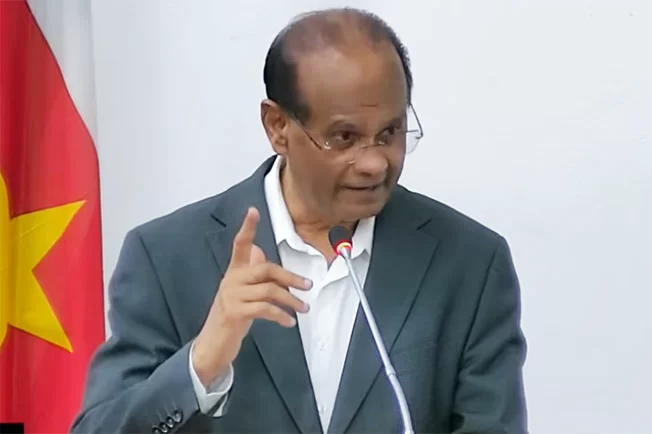
During parliamentary debate on Suriname’s proposed General Tax Law (Algemene Wet Belastingen, AWB) in the National Assembly on Tuesday, the National Democratic Party (NDP) caucus has announced its support for the long-awaited tax reform legislation — but it has drawn a clear line: the full law will only enter into force once the country’s Tax Administration is fully prepared to roll out the new system.
Rabin Parmessar, NDP caucus leader and chair of the rapporteur committee tasked with preparing the draft legislation, put forward 11 non-negotiable conditions for the bill’s passage, with core priorities including robust legal protection for taxpayers, personal data privacy, digital security, and verifiable operational capacity of the Tax Administration.
Parmessar emphasized that his caucus fully recognizes the urgent need for a unified overarching legal framework for tax collection in Suriname. The current system scatters formal tax rules across dozens of separate pieces of legislation, and the AWB is designed to harmonize these regulations, standardizing processes ranging from tax filing and assessments to appeals, information requirements, audits and penalties. The NDP also backs broader efforts to modernize and digitize the Tax Administration, strengthen crackdowns on tax evasion and profit shifting, and deepen international tax cooperation — all longstanding priorities for fiscal reform in the country.
But these reforms must be paired with a strong system of legal safeguards for taxpayers, Parmessar argued. One of his central conditions is that the AWB cannot be implemented in isolation. The new legislation must be fully aligned with the existing Collection Law, the Introduction Law, and the Tax Cases Jurisdiction Act, to prevent a scenario where the Tax Administration gains new investigation and penalty powers before the accompanying legal protections for taxpayers are operational.
The biggest point of contention surrounds the proposed effective date of the law. The current draft sets entry into force for the day after its proclamation, but Parmessar argued that the Tax Administration’s actual operational readiness should be the only determining factor for the timeline. The new regulatory framework relies on fully functional digital infrastructure, secure electronic communication, sufficiently trained staff, safe processing of sensitive fiscal data, timely processing of appeals, and a fully operational tax judiciary — none of which are confirmed to be ready at present. To address this gap, Parmessar proposed a phased rollout, where individual provisions of the law only take effect once independent verification confirms all implementation preconditions have been met.
For full national implementation of the AWB, Parmessar is calling for a concrete, public implementation roadmap and a mandatory readiness assessment that verifies the new system is prepared on legal, organizational, and technical levels, and that all implementation costs are fully funded.
Another major concern centers on the broad information-gathering powers granted to the Tax Administration under the draft law. The legislation allows tax inspectors to request personal data, financial records, documents, and digital files, and requires third parties to share information with authorities under certain circumstances. While Parmessar acknowledged these powers are necessary for effective tax enforcement, he is calling for clear, explicit legal limits, rooted in the principles of necessity, proportionality, purpose limitation, data security and auditability. This requirement is particularly urgent, he noted, because a separate draft law on personal data privacy is still under debate in the National Assembly, leaving no existing regulatory framework to protect taxpayer information.
Parmessar also pushed for additional safeguards around the proposed reversal and increase of the burden of proof for taxpayers. Under the draft, if a taxpayer is found to have failed to meet their information disclosure requirements, the burden of proof shifts to the taxpayer to demonstrate they do not owe additional tax. Parmessar is requiring that any taxpayer in this situation first receive clear, written notification outlining what information is missing, what deadline they have to correct the issue, and what consequences will follow non-compliance, before any shift in the burden of proof takes effect.
The NDP also objects to the proposed maximum one-year standard decision period for tax objection applications. While Parmessar acknowledged the Tax Administration currently struggles with backlogs and that complex cases require extended processing times, he argued that a one-year standard timeline is unnecessarily long. Any extension of the standard period should be reserved for exceptional cases and require explicit public justification, he said.
Additional provisions put forward by the NDP address equity in digital tax reform. Parmessar stressed that digitization cannot leave vulnerable groups behind: accessible, in-person support must remain available for taxpayers living outside the capital Paramaribo and for people with limited digital literacy. The government also needs to outline clear contingency rules in advance for cases where government digital systems fail, preventing taxpayers from meeting filing deadlines through no fault of their own.
Finally, Parmessar called for ongoing parliamentary oversight after the bill is passed. He proposed adding a mandatory evaluation and reporting requirement directly into the text of the AWB: the government would report annually to parliament on the functioning of the new law in its first five years, followed by a comprehensive full evaluation at least once every three years after that. Ahead of the final vote on the legislation, Parmessar also called for a final thorough technical legal review of the draft to check numbering, cross-references, and alignment between legal provisions and explanatory notes, to avoid costly legal disputes down the line.
Summing up the NDP’s position, Parmessar said the caucus supports building a stronger, more effective Tax Administration, but not granting that administration unlimited, unregulated power. “Effective tax collection must be matched by clear regulation, transparency, accountability, and robust legal protection for all taxpayers,” he said. “The quality of this new law will ultimately be judged not by what we codify here in parliament, but by whether the system actually works for all Surinamese in practice.”