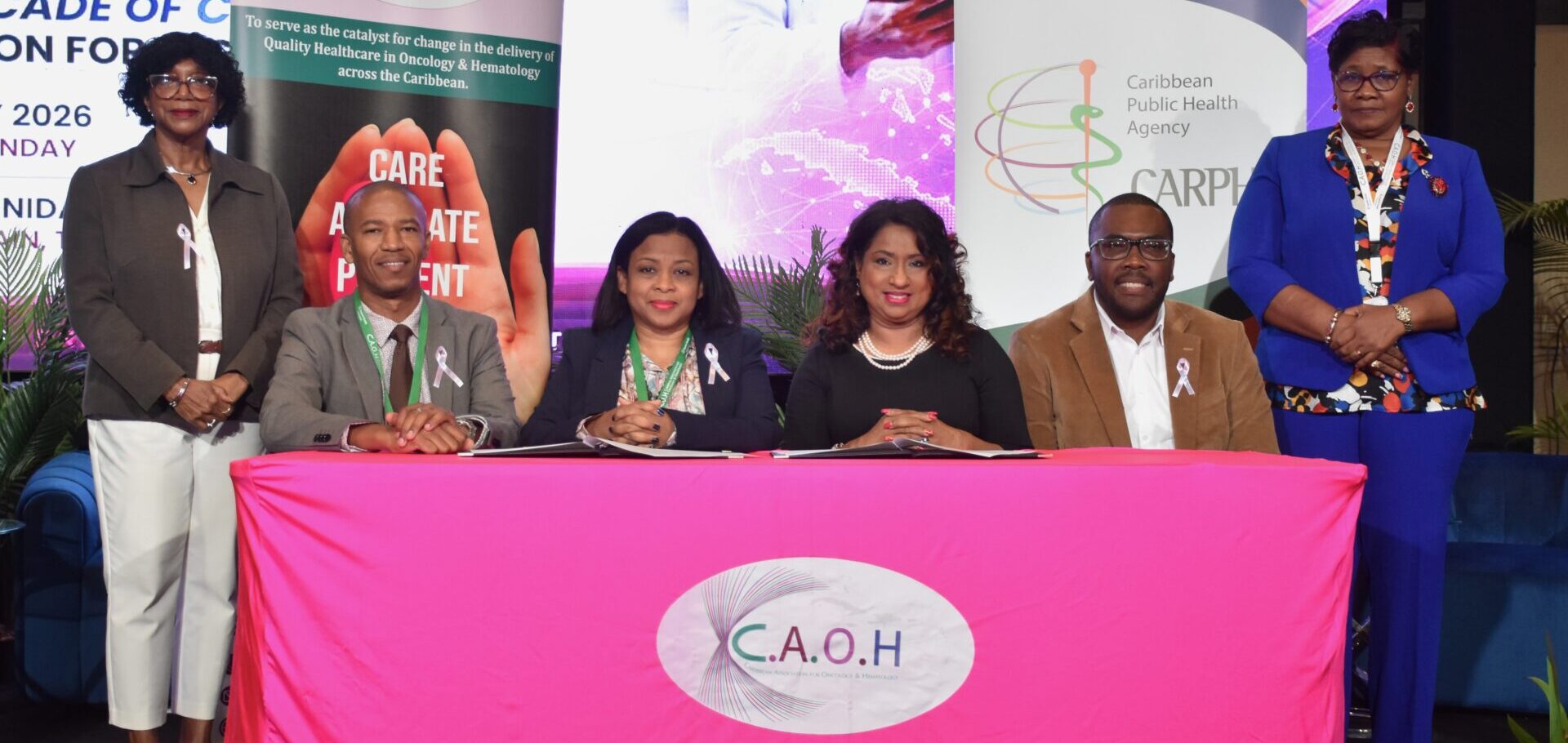
As the Caribbean braces for a dramatic 55% surge in new cancer cases by 2050, two leading regional health bodies have joined forces in a landmark five-year collaboration to ramp up the region’s capacity to prevent, treat and control the disease.
Projections from regional health planners show that annual new cancer diagnoses across the Caribbean will jump from 123,884 in 2024 to 191,997 by mid-century, creating an urgent need for coordinated, cross-regional action to address the expanding public health challenge. It is against this critical backdrop that the Caribbean Public Health Agency (CARPHA) and the Caribbean Association for Oncology and Hematology (CAOH) have formalized their new partnership through a signed Memorandum of Understanding (MoU), announced in a joint press statement issued by the organizations.
The agreement outlines a broad scope of work, prioritizing key areas including enhanced cancer surveillance, expanded professional training for oncology and hematology practitioners, joint clinical and public health research, public outreach on nutrition and healthy lifestyles, and improved access to safe, quality-assured cancer medications across the region.
“Regional collaboration has always stood as one of the Caribbean’s greatest strengths,” noted Dr. Lisa Indar, Executive Director of CARPHA, at the MoU signing ceremony. “This partnership creates a vital opportunity to unify technical expertise, regional population data, and coordinated public health action to boost prevention efforts, expand early detection, strengthen national cancer control systems, and improve access to reliably tested, quality cancer medicines.”
Dr. Marisa Nimrod, Chair and Chief Executive Officer of CAOH, echoed this sentiment, emphasizing that the partnership will unlock new opportunities for professional growth and collective impact across the Caribbean’s oncology community. “Through this alignment with CARPHA, our member clinicians and researchers will gain access to joint programming, cross-regional training initiatives, collaborative research opportunities, and expanded professional networks,” Nimrod explained. “It also creates clear pathways for our community to contribute to stronger cancer surveillance systems and advance the development of evidence-based Caribbean cancer policy and public health programs.”
To deliver on the agreement’s commitments, CARPHA will leverage existing institutional resources across three of its key departments: the Chronic Disease and Injury Department, the Caribbean Regulatory System, and the Medicines Quality Control and Surveillance Department. Additional priorities of the partnership include expanding the completeness and accuracy of regional cancer registry data, rolling out public education campaigns to promote cancer-preventive healthy lifestyles, improving workplace safety protocols for staff handling hazardous cancer treatments, and strengthening pharmacovigilance and post-market monitoring frameworks for oncology medications.
The collaboration marked its first public joint activity at CAOH’s 14th Annual Scientific Conference, held July 17, 2026 at the Trinidad Hilton. CARPHA officials Dr. Chantelle Bailey and Nicole Ennis led a hybrid technical panel focused on advancing medicine quality assurance, pharmacovigilance, and post-market surveillance in oncology care, which drew in-person and virtual participants from across the region. Panel discussions covered a range of pressing challenges including the spread of substandard and falsified cancer medications, the role of laboratory testing in verifying drug quality, cross-border regulatory cooperation, streamlined systems for adverse drug reaction reporting, and the implementation of risk-based monitoring frameworks for oncology treatments.
Looking ahead, CARPHA officials note that the sustained partnership will support the delivery of safer cancer care and help build stronger, more resilient public health systems across all 19 CARPHA Member States, positioning the region to better manage the projected growth of cancer burden in the coming decades.