Stargazing enthusiasts across the Caribbean island of Dominica are gearing up for one of the most anticipated celestial events of 2026, a near-total partial lunar eclipse that will bring a striking Blood Moon display to local skies — provided weather conditions stay clear for the overnight show.
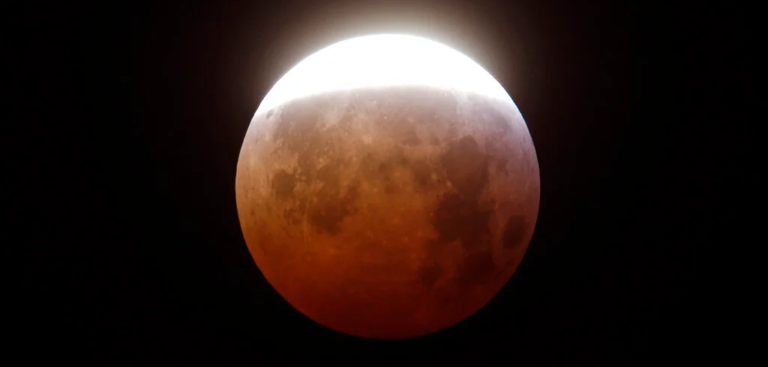
While astronomers classify the event as a partial lunar eclipse, it will come remarkably close to a full total eclipse when viewed from Dominica. At the peak of the spectacle, roughly 93.9% of the Moon’s full disk will be covered by Earth’s darkest, central shadow, the umbra, creating a visual almost indistinguishable from a total eclipse for casual observers.
The event will unfold in stages across the night of Thursday, August 27 and into the early hours of Friday, August 28. The first subtle phase, known as the penumbral eclipse, kicks off at 9:23 PM local time on August 27, when the Moon begins sliding into Earth’s faint outer shadow. This initial phase is often hard to spot with the naked eye, but the show becomes unmistakable starting at 10:33 PM, when the Moon first touches the darker umbra. From that point onward, observers can watch as Earth’s curved shadow slowly creeps across the lunar surface.
The highlight of the night, maximum eclipse, arrives at exactly 12:12 AM on August 28. This is when the coverage of the Moon hits its 93.9% peak, and the full effect of the rare coloring becomes visible. The eclipsed portion of the Moon will take on a deep, dramatic reddish, copper, or crimson hue — a phenomenon popularly called a Blood Moon.
This iconic red coloring is not a random coincidence: according to NASA, it forms as sunlight passes through Earth’s atmosphere before reaching the lunar surface. Shorter blue wavelengths of light scatter out as they move through the atmosphere, while longer red and orange wavelengths bend through the air and are redirected onto the eclipsed Moon, creating the characteristic Blood Moon glow.
After the maximum peak, the shadow begins to retreat. The partial eclipse phase concludes at 1:51 AM, with the Moon leaving the umbra, and the final faint penumbral phase wraps up entirely by 3:01 AM.
Unlike the dangerous solar eclipses that require special protective gear to view safely, this lunar event is completely accessible to all skywatchers. No specialized optical equipment is needed to enjoy the main display; the eclipse is perfectly safe to view with the naked eye, meaning anyone can step outside at the right time and look toward the Moon to see the spectacle. Those with binoculars or a small telescope will be able to make out finer details of the shadow’s edge and the gradient of colors across the Moon’s face, but even unassisted viewing will deliver a stunning show for those lucky enough to have clear skies.
Local astronomy groups and skywatching enthusiasts are already encouraging residents and visitors to mark their calendars for the event, noting that near-total partial eclipses of this magnitude are relatively rare occurrences for any given location.