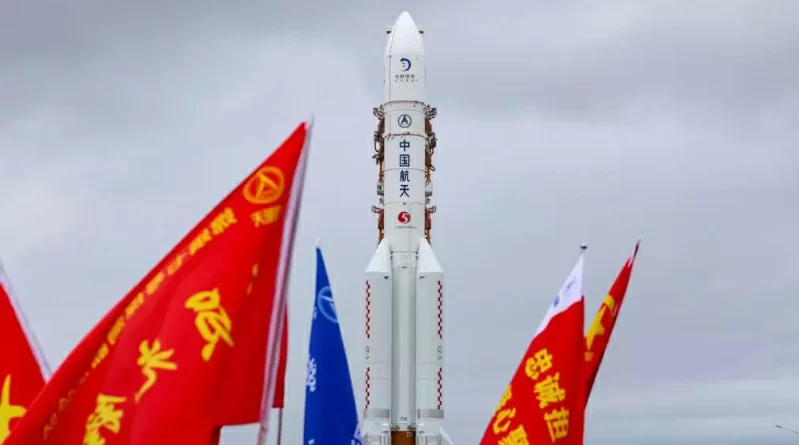
China has announced a last-minute delay to its highly anticipated Chang’e-7 lunar mission, a groundbreaking unmanned expedition targeted at the moon’s south pole that aimed to detect and study buried water ice deposits. The mission, originally scheduled for launch within the next few days from the Wenchang Space Launch Center on China’s southern island province of Hainan, was called off after Chinese space authorities determined the probe failed to meet pre-launch technical requirements.
In a brief statement released Sunday, the China National Space Administration confirmed that the mission will not proceed within its originally planned launch window this year. The decision followed a comprehensive technical evaluation conducted under the core guiding principles of caution, reliability, and a commitment to ensuring absolute mission success. No further details have been provided on the specific issues that prompted the delay, and no revised launch date has been announced to date.
As the seventh mission in China’s expanding Chang’e lunar exploration program, Chang’e-7 is widely regarded as the most technologically sophisticated unmanned lunar mission the country has ever developed. The multi-component mission consists of four separate craft: an orbiter that will circle the moon, a main lander, a wheeled rover, and an innovative small flying robot capable of crawling, jumping, and hovering across challenging lunar terrain. Its primary objective is to touch down in the permanently shadowed craters that dot the moon’s south pole, a remote region where planetary scientists suspect large, viable deposits of water ice have been preserved over billions of years.
The discovery and characterization of lunar water ice carries enormous strategic and scientific value for future human deep space exploration. These deposits could be processed to produce drinking water, breathable oxygen, and even rocket propellant — resources that are critical to establishing a long-term permanent human outpost on the moon. This potential has turned the lunar south pole into the epicenter of a new global space race, led primarily by China and the United States. While the U.S. has deployed multiple probes targeting the region, no mission to date has successfully completed core sampling and verification of accessible water ice deposits.
Prior to the delay announcement, experts noted that Chang’e-7 was positioned to become the first mission to achieve this historic milestone, and the postponement could temporarily shift the dynamics of the ongoing global lunar competition. “With Chang’e-7, China’s lunar program is shifting from pure exploration to a focus on resource utilization,” Yuqi Qian, a lunar geologist at the University of Hong Kong, previously told CNN. The mission was expected to deliver definitive answers on whether the lunar south pole holds enough usable water ice to support future human activities, marking a key step forward in global lunar research.
China’s lunar program takes its name from Chang’e, the traditional Chinese moon goddess. The program’s most recent prior mission, Chang’e-6, made global history in 2024 as the first probe ever to return rock and soil samples from the far side of the moon, a feat that demonstrated China’s growing advanced deep space exploration capabilities. As of now, the timeline for Chang’e-7’s new launch date remains unclear.