Trinidad and Tobago is facing a growing wave of bomb threats, with multiple new incidents reported across the nation on Wednesday, just days after seven separate threats were documented last week. This escalating pattern of security scares has put law enforcement on high alert and sparked renewed public discussion around the government’s upcoming decision on whether to extend the country’s current anti-crime state of emergency, set to expire on September 17.
The first round of threats, which unfolded last Wednesday, prompted the Trinidad and Tobago Police Service (TTPS) to immediately bolster security measures at police stations nationwide. Those earlier threats targeted a range of high-profile and public locations: five regional magistrates’ courts in Arima, Princes Town, Chaguanas, Siparia and Sangre Grande; Kent House, the administrative headquarters for the Ministry of Rural Development and Local Government; an unnamed site in San Fernando; and Valpark Shopping Plaza in Valsayn. Following those reports, TTPS activated its full emergency security protocols, boosted its operational readiness, and dispatched officers to sweep all targeted sites for hazards.
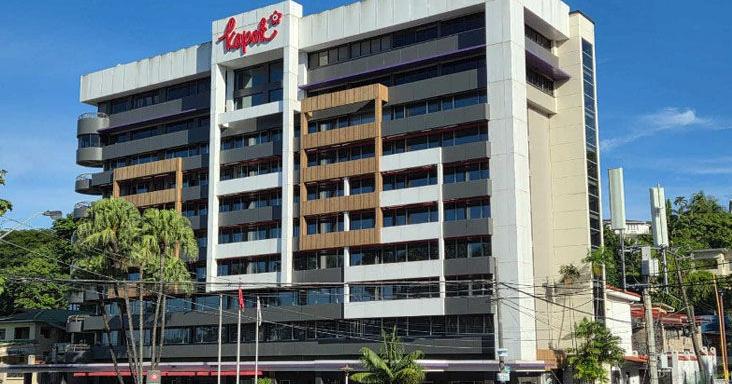
The latest wave of threats brought two more locations into the crosshairs: the Forestry Division headquarters on Long Circular Road, and the well-known Kapok Hotel. In line with established response procedures, the TTPS deployed its specialized Explosive Detection and Disposal Unit (EDDU) to both sites, backed by local station officers and investigators from the Criminal Investigations Department.
At the Forestry Division facility, EDDU teams conducted a full walk-through inspection alongside on-site staff, completing a comprehensive sweep that turned up no suspicious items and confirmed the building was safe for occupancy. The same protocol was carried out at the Kapok Hotel, where teams also completed a full check with staff assistance, finding no explosive devices and clearing the property as secure. When contacted by the *Sunday Express* for comment on the incident, a hotel operator said she was not authorized to speak to media and advised reporters to follow up with management on a weekday.
In an official statement, the TTPS confirmed that it is continuing to assess all reported threats and run active investigations into the origins and circumstances behind the coordinated scare campaign. Authorities have issued a public appeal for residents to remain calm, avoid sharing unconfirmed information on social media and other platforms, and refrain from distributing content that could spark unnecessary public panic. Anyone with information that could assist investigators is urged to contact their nearest local police station immediately. The TTPS also reaffirmed its unwavering commitment to protecting public safety and pledged to release updated details as the investigation progresses.
Speaking to reporters on the sidelines of a back-to-school community event in his Tunapuna constituency, Homeland Security Minister Roger Alexander praised law enforcement’s rapid and professional response to the ongoing string of threats. He emphasized the critical role of collaborative intelligence work, noting that the TTPS is already receiving valuable support from international partner embassies and allied security agencies in its efforts to crack down on the perpetrators and address broader criminal challenges. “It is important for us to have intelligence agencies supported by our colleagues on the outside, and now they are participating in the fight against crime,” Alexander said.
Beyond the bomb threats, the incident comes as the government nears a key deadline for decision on the current state of emergency (SoE), which has granted law enforcement expanded powers to target organized crime and violent crime across the country. Justice Minister Devesh Maharaj, who also attended the Tunapuna back-to-school event, told reporters Wednesday that the cabinet has not yet reached a final decision on whether to extend the emergency measures, which are scheduled to end September 17.
Maharaj explained that before any decision is sent to Prime Minister Kamla Persad-Bissessar and the National Security Council for formal approval, the government will first conduct a full review of the latest national crime data. “It will be premature of me at this stage to say what will happen,” Maharaj said, noting that any extension would require careful analysis of the emergency measure’s impact. As of Wednesday night, the national murder toll stood at 235, with four new killings confirmed overnight – two in Fyzabad and two in Arima. By comparison, the total murder count at the same point last year was 240.
Despite the latest homicides, Maharaj asserted that the current state of emergency has been a clear success in reducing overall crime. He pointed to official police statistics that show both murder rates and rates of other serious crimes have dropped compared to 2024, when Trinidad and Tobago recorded a devastating all-time high of 626 murders, surpassing the previous record of 605 set in 2022. “The SoE has been a success. The murder rate and serious crime rate are down by police statistics,” he added.
For his part, Alexander noted that murder statistics should be interpreted with context, saying that officials need to distinguish between gang-related killings, which represent a systemic threat to public safety, and domestic homicides rooted in private personal conflict. He explained that some types of killing are more readily addressed by expanded law enforcement powers, while others stem from deeper social and relationship challenges that require broader policy solutions.
The question of whether the government can constitutionally call a new state of emergency immediately after the current one expires on September 17 was put to Marvin Gonzales, chairman of the opposition People’s National Movement (PNM). Gonzales confirmed that there is no formal constitutional barrier blocking the government from taking that step, but argued that such a move would violate the spirit of the nation’s founding document. “It will be an abuse of the Constitution because that was never intended by the framers of the Constitution, but nothing prevents them from doing it,” Gonzales said.