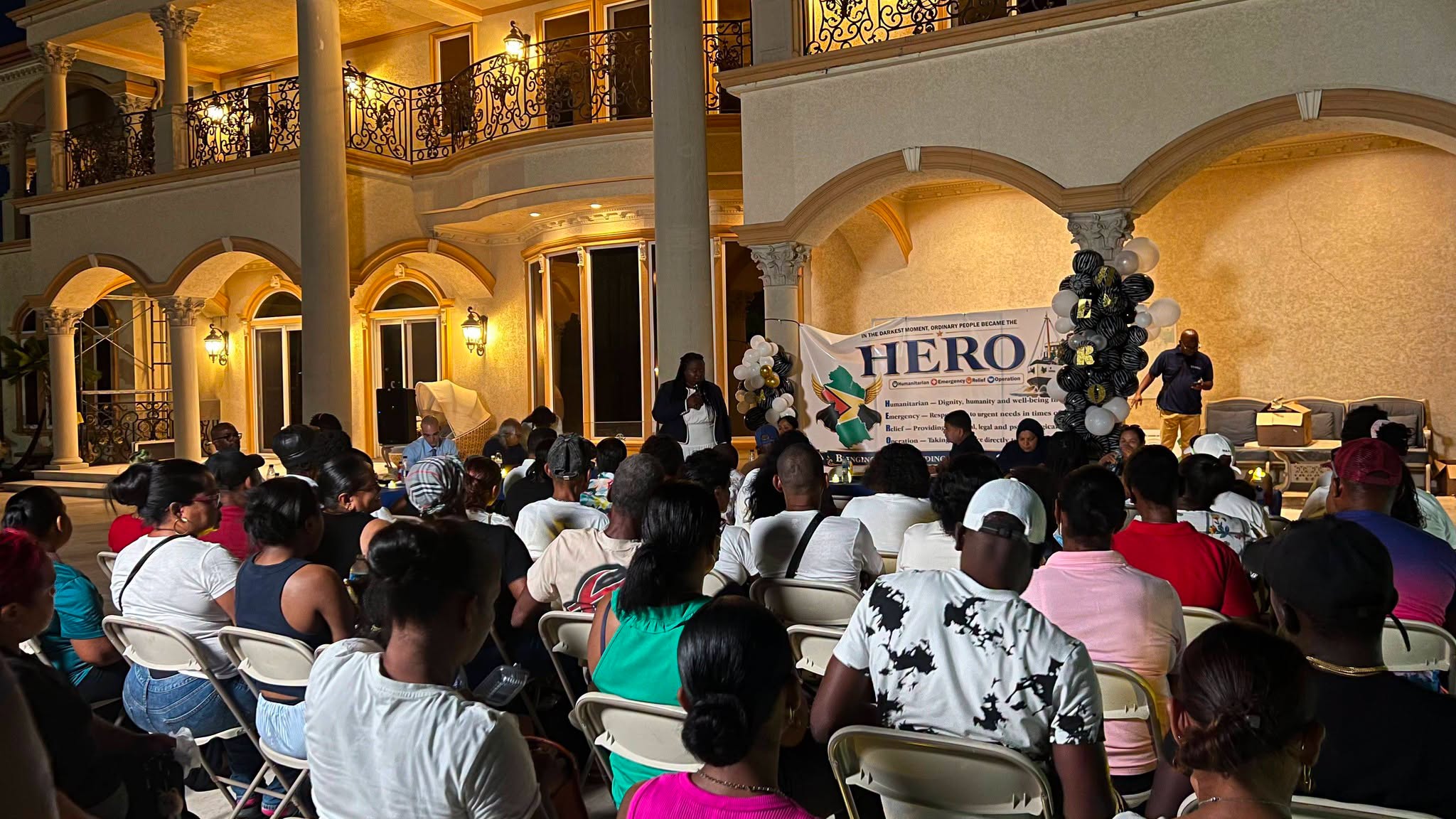
On Friday, one month after the deadly sinking of the MV Barima ferry that left dozens dead and missing off Guyana’s Essequibo Coast, the country’s main opposition party We Invest in Nationhood (WIN) launched a cross-sector emergency support initiative named the Humanitarian Emergency Relief Operation (HERO), centered on aiding survivors, bereaved families and rescued personnel affected by the disaster.
Opposition Leader Azruddin Mohamed has publicly called on the ruling government to disburse an immediate interim payment of GY$5 million to every survivor, next-of-kin of the deceased, and families of still-missing victims, a payout that would total approximately GY$800 million. Mohamed argued this urgent disbursement would alleviate the severe financial strain and emotional trauma the tragedy has inflicted on affected households. Citing his familiarity with what he claims are the governing administration’s procedural delays, Mohamed urged officials to immediately authorize the central bank to release the funds, stating: “You can call the governor of Bank of Guyana, Mr Gobin Ganga and let him open the safe.”
The MV Barima, an 87-year-old ferry constructed in Scotland, sank on July 19 while carrying an estimated 179 passengers and crew members. To date, official records confirm 72 fatalities, with 76 people rescued from the incident, the deadliest maritime disaster in recent Guyanese history.
Speaking at the launch ceremony held at opposition leader Mohamed’s residence in Houston, East Bank Demerara, WIN General Secretary Odessa Primus noted that HERO was designed as an inclusive, non-partisan platform that welcomes participation from other political parties, non-governmental organizations, and civil society groups. Primus emphasized that the initiative prioritizes the needs of Guyanese people above political, religious or sectional divides, built on the principle of collective action to support affected communities through the crisis. The initiative’s immediate interventions, funded by donations from the Guyanese public and diaspora community, include covering school-related costs for children of affected families ahead of the new school year starting in August, providing clinical psychological counselling, and distributing essential care packages and food hampers.
In addition to humanitarian support, Mohamed confirmed that a team of prominent Guyanese lawyers has already committed to providing pro bono legal representation for tragedy victims, to hold the government accountable and prevent what the opposition claims are unfair practices that sidelined survivors of a previous deadly disaster. Recalling the 2023 Mahdia dormitory fire, where the government reached a GY$5 million per-family compensation agreement with victims’ relatives, Mohamed stated his goal is to prevent the administration from repeating what he frames as unfair treatment of affected families, and to ensure victims’ rights are not violated. The legal team already assembled includes high-profile figures Nigel Hughes, Eusi Anderson, Roysdale Forde, Christopher Ram, Damien Da Silva and Siand Dhurjon, and WIN says it is open to bringing on more volunteer legal representatives to meet demand.
Senior attorney Christopher Ram accused the government of double standards in its handling of the tragedy, pointing out that the ferry is operated by the state-owned Transport and Harbours Department. Ram argued that if a private entity had been responsible for the disaster, the government would have already imposed severe pressure and penalties on the operator. He noted that existing Guyanese law already mandates compensation for disaster victims, rather than requiring families to beg for charitable handouts, and that public funds including those in the Amerindian fund are available to cover these payments. “We have laws on our books that talk about compensation, not charity. Nobody should be begging for money for you. The government owes a duty to pay it,” Ram said. Echoing the call for immediate interim payouts, Ram sternly warned victims against signing any legal documents that would waive their right to full future compensation: “If they give you money, take the bloody money. Sign nothing. Do not give up your right. If a paper is put before you, get someone to read that paper.” Ram also recommended that victims unify to demand a compensation framework structured to account for individual factors including life expectancy, earning capacity, and the role of the deceased as a household breadwinner or parent, arguing that such a unified, evidence-based demand would leave the government no justifiable ground to refuse. Fellow attorney Damien Da Silva echoed these remarks, confirming the legal team is ready to begin work on behalf of victims immediately.
Mohamed also reiterated the urgent need to salvage the MV Barima, which rests 40 feet below the ocean surface roughly 10 miles off the Essequibo Coast. He called on the government to draw from the country’s daily oil revenue of GY$6.3 billion to fund the immediate interim compensation payouts, so that victims can begin rebuilding their lives. Earlier in August, the Maritime Administration (MARAD) received expressions of interest from firms for the salvage operation, with requirements to preserve forensic evidence for the upcoming official Commission of Inquiry into the disaster.
Moving forward, WIN representatives plan to travel directly to Port Kaituma and Mabaruma, the home regions of many victims, to meet with affected families and assess their on-the-ground needs.