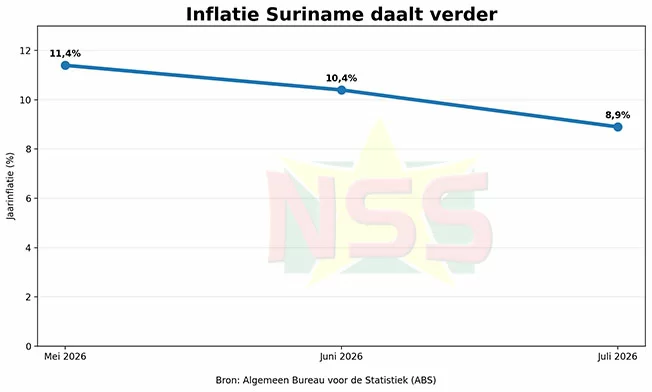
Preliminary data released Friday by Suriname’s General Bureau of Statistics (ABS) has confirmed a notable cooling of the country’s annual inflation rate in July, bringing the key metric below the 10% threshold for the first time since September 2025. The latest reading landed at 8.9% year-on-year, down sharply from June’s 10.4% and May’s peak of 11.4% in recent months, signaling a slowdown in the rapid pace of price growth that has strained household budgets across the nation.
Despite the welcome drop in the headline inflation rate, ABS officials emphasized that the decline does not signal an overall reduction in the general price level. Month-on-month, consumer prices still rose by an average of 0.5% between June and July 2026, with the overall consumer price index climbing from 896.6 in July 2025 to 976.2 this July, up from 971.2 recorded in June. This means that while prices are not rising as quickly as they were just a few months ago, the overall cost of living remains significantly higher than it was one year ago. It should also be noted that the ABS did not collect price data for this report from three inland districts: Marowijne, Brokopondo and Sipaliwini, where local prices are already documented to be many times higher than the national average.
Digging into the granular data reveals stark disparities in price changes across key categories of everyday consumer goods and services, with some essential items seeing double-digit or even near-double annual price hikes. Fresh produce remains the most severely affected category: fruits and vegetables rose 7.8% in price just from June to July, hitting a 35.6% year-on-year increase, one of the largest jumps recorded.
Other food staples have also seen steep growth. Fish, fish products and shrimp rose 15.3% year-on-year, while milk, dairy products and eggs climbed 11.6% annually. Other food products and non-alcoholic beverages recorded an 18.4% annual increase. While meat and meat products dropped 3.3% in price between June and July, they still remain 8% more expensive than they were in July 2025.
Outside of the food sector, healthcare has seen the most dramatic surge in costs. Medical and paramedical services are now 43.1% more expensive than they were one year ago, a far steeper increase than the 3% annual rise recorded for pharmaceutical products. Dining out and takeaway food have also become significantly more costly: restaurant meals are up 12.4% year-on-year, while prepared sandwiches, pastries and snacks have risen 15% annually.