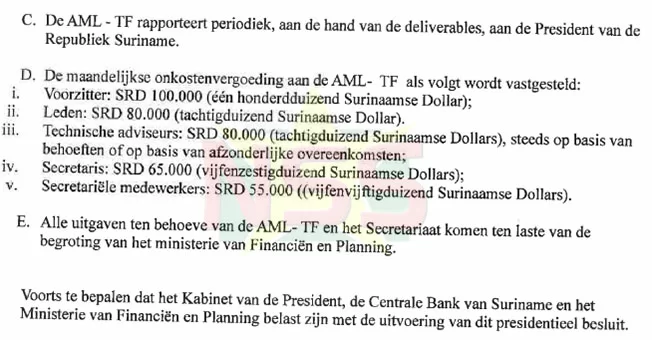
A Surinamese parliamentarian has sparked public debate by calling on the government to clarify unusually high monthly compensation packages for members of newly established state committees and special units, including a presidential anti-money laundering task force. Mahinder Jogi, a member of the National Assembly from the VHP party, raised the question during a plenary session Thursday, questioning the staggering pay increases compared to similar anti-money laundering bodies formed in previous years. At the center of the controversy is the Anti-Money Laundering Task Force (AML-TF), created by a presidential decree signed by President Jennifer Simons on August 10, 2026. According to the official text of the decree, the task force chair, Jennifer van Dijk-Silos, will receive a monthly expense stipend of 100,000 Surinamese dollars (SRD), with each of the four other appointed task force members earning 80,000 SRD per month. The pay scale, which far outpaces compensation for past comparable roles, has drawn sharp scrutiny from opposition and ruling coalition lawmakers alike. Jogi pointed out that just a few years ago, officials serving on similar anti-money laundering commissions and working groups received between 10,000 SRD and 15,000 SRD per month, a fraction of the current stipends. He recalled that even decades ago, public controversy erupted over far lower compensation packages for a former prosecutor general who led an earlier anti-money laundering unit, leaving many wondering why the dramatic increase is justified today. The newly formed task force will operate from July 1, 2026 through December 31, 2027, with an option for extension, and falls directly under the Office of the President in her role as chair of the national Anti-Money Laundering Steering Council. Its core mandate is to prevent Suriname from being added to international anti-money laundering blacklists. The South American nation is currently in an enhanced international monitoring process for its anti-money laundering, counter-terrorism financing and counter-proliferation frameworks, and must demonstrate measurable progress on technical compliance, enforcement effectiveness, and institutional implementation to avoid punitive blacklisting. In addition to the chair and four members, the decree also sets pay for support staff: a secretary earns 65,000 SRD per month, and two administrative support staff each receive 55,000 SRD monthly. Technical advisors, if added, would also earn 80,000 SRD per month under separate contracts. All operational costs, including stipends, are charged to the national budget of the Ministry of Finance and Planning. The total fixed monthly payroll for the task force’s core team already comes to 595,000 SRD, not including any additional costs for technical advisors that may be hired. The AML-TF’s responsibilities include cataloging all outstanding regulatory obligations, reviewing existing and draft anti-money laundering legislation, identifying gaps in current implementation, developing a national action roadmap, reporting bottlenecks directly to the president, and publishing regular progress updates. The task force is granted broad authority to request information directly from government departments, semi-public agencies, state-owned enterprises, and private sector business associations, though access to confidential or legally restricted information requires explicit presidential approval. The decree also imposes strict controls on external communication: all substantive media statements from the task force must first be reviewed and approved by the president. Jogi has formally asked Finance and Planning Minister Adelien Wijnerman to provide full detailed information on the compensation scheme to the National Assembly, to answer the core question of whether a new presidential unit is indeed paying its members five to 10 times more than equivalent prior bodies. VHP parliamentary leader Asis Gajadien has echoed Jogi’s request, noting that he has also been shocked by reports of inflated stipends for multiple new state committees. Gajadien pointed out that many similar commissions previously received less than 25,000 SRD per month total, yet today individual members are receiving more than 75,000 SRD per month with no corresponding increase in the scope or difficulty of their assigned duties. Beyond transparency for the AML-TF, Gajadien is demanding the government release a full public overview of all active anti-money laundering bodies and committees operating under Suriname’s existing legal framework, including details on which bodies are currently operational, which new bodies have been added in recent months, and what compensation each serving member receives.