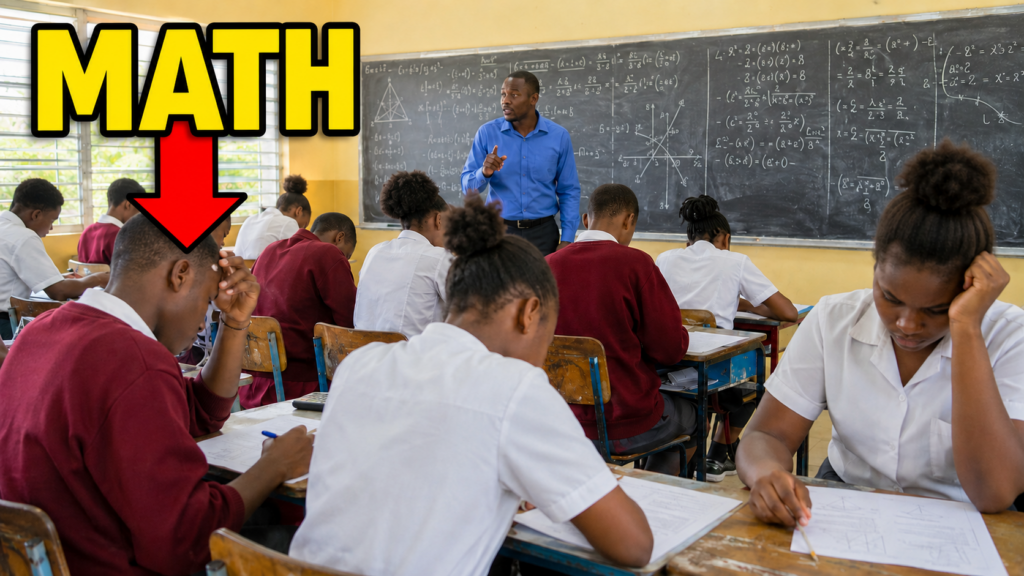
When preliminary results for the 2026 Caribbean Secondary Education Certificate (CSEC) examinations were released, officials in Antigua and Barbuda were confronted with a stark and disappointing outcome: only 30.3% of test-takers passed the mathematics section, a result that places the small island nation nearly 12 full percentage points below the broader Caribbean regional average. The alarming underperformance has prompted the country’s Ministry of Education to roll out a series of sweeping, targeted interventions aimed at lifting mathematics proficiency across all school levels, signaling an end to business-as-usual practices in math instruction.
Clare Browne, the country’s Director of Education, labeled mathematics the most problematic area of the 2026 preliminary CSEC results during a public discussion on the findings hosted by local broadcaster ABS Presents. “We’re at 30 per cent. The regional average is 42. We are way below the regional average,” Browne emphasized, adding that the Ministry of Education has fully recognized the severity of the gap and the urgent work that lies ahead. CXC Local Registrar Maritza West later confirmed the 30.3% pass rate when presenting official subject performance breakdowns for the country, echoing that mathematics continues to be a consistent area of underperformance.
For education leaders, the poor result is particularly disheartening given the efforts already deployed to turn outcomes around. Browne noted that the ministry’s dedicated Mathematics Unit and classroom teachers across the country have invested significant time and energy into boosting student performance in recent years. “I know the Mathematics Unit has been doing much. I know our teachers have been doing much in terms of seeking to improve the Mathematics situation,” he said. “And it just appears as if the struggle is real and the struggle continues. But the struggle — we will continue to fight until we overcome.”
To address the persistent gap, the ministry has already begun restructuring its approach to mathematics education starting with expanded leadership capacity. The Mathematics Unit has been expanded to add two full-time education officers: one focused exclusively on mathematics instruction at primary school levels, and a second tasked with supporting upper primary and secondary school programs. Beyond structural changes, officials will conduct a comprehensive review of mathematics teacher placements across all secondary schools, with the goal of matching qualified educators to roles where they can drive the strongest student outcomes.
Browne made clear that paper qualifications alone will no longer be sufficient to retain a mathematics teaching post, for educators who consistently fail to deliver improved results will be reassigned. “Even if you have the paper qualifications and you’re not delivering, and we have to kind of move you out of a situation, then we will,” he said, quickly adding that the policy shift is not a criticism of working teachers, many of whom are already pushing to improve outcomes. “I’m not knocking teachers because I know our teachers are trying hard. But we’re ensuring that we place our Mathematics teachers in the best possible position so that they are able to do the best for their charges.”
Additional on-the-ground support will come from curriculum officers, who will now enter mathematics classrooms regularly to conduct direct observation of instruction, offer real-time mentoring, and provide targeted support to educators who need it. “We’re going to be going into the classrooms, monitoring and mentoring, because we need to be sure as to what is happening there,” Browne explained.
The ministry will also carry out full audits of school timetables across all grade levels to verify that students are receiving the minimum required instructional time for mathematics, as outlined in national education policy. Under existing rules, students in Grades One through Six in primary school must receive a minimum of 255 minutes of mathematics instruction each week, while kindergarten students require 200 minutes weekly. For secondary schools operating on a five-day schedule, first-form students must have six 45- to 60-minute mathematics periods per week, while students in Forms Two through Five must receive a minimum of five periods. Schools following a six-day rotating schedule are required to offer seven periods for first-form students and six periods for Forms Two through Five.
Going forward, Browne acknowledged that turning around national mathematics outcomes will require long-term sustained effort and willingness to make difficult, unpopular decisions. “If we have to move people out, then we’re prepared to move people out,” he said. “We have to do something. It cannot be business as usual.”