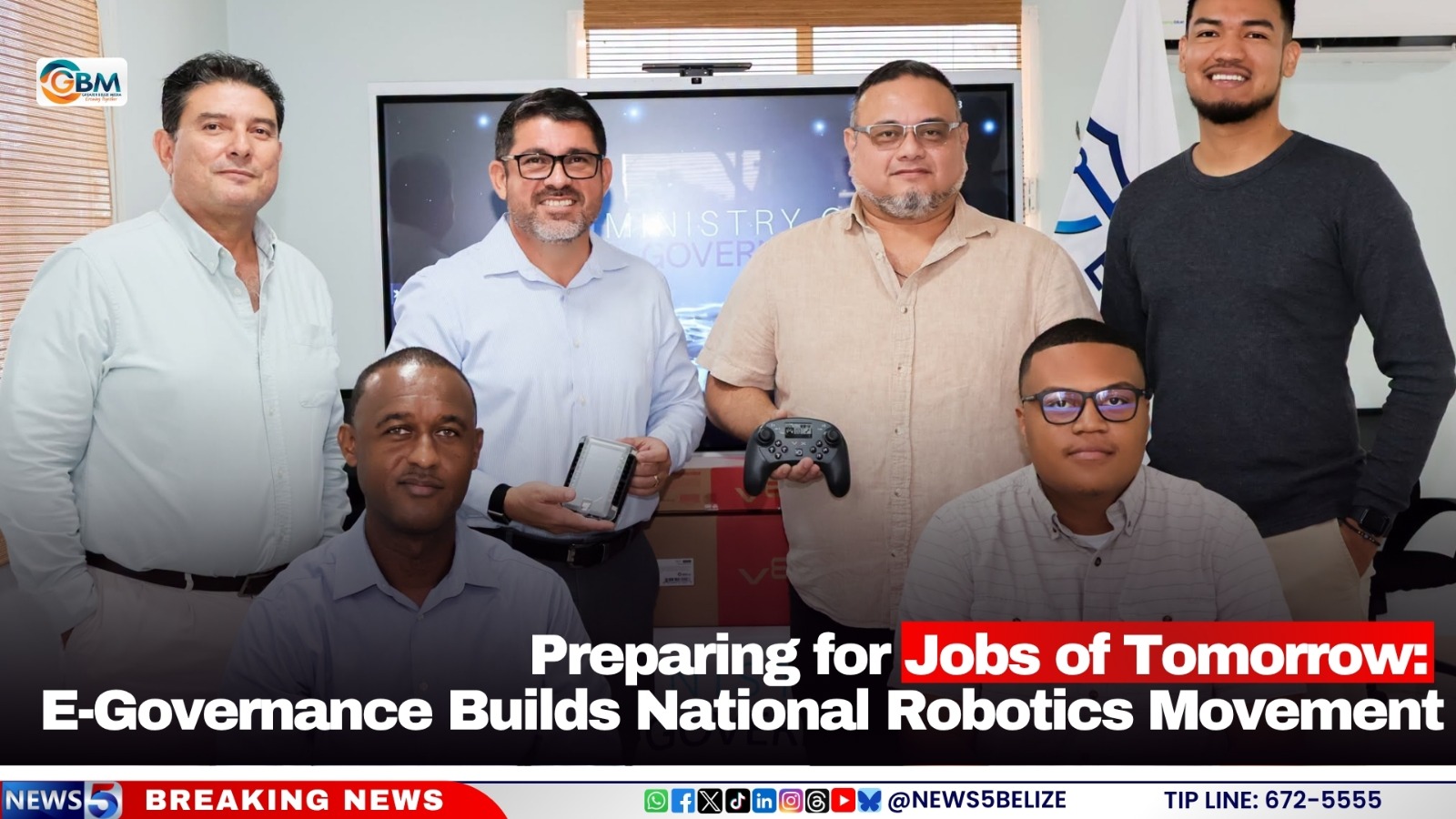
On August 20, 2026, Belize kicked off an ambitious national effort to integrate advanced robotics education into secondary and post-secondary learning institutions across the country, starting with a high-tech donation to the University of Belize (UB) from the nation’s Ministry of E-Governance.
The donation, a fully equipped VEX V5 Classroom Super Robotics Kit, was delivered to UB’s Jaguar Tech Studio to transform how students engage with engineering and technology education. Comprising more than 1,500 individual components—including precision smart motors, responsive environmental sensors, and durable modular structural parts—the kit enables learners to bridge the gap between theoretical classroom learning and practical, hands-on innovation. Students can now design, build, and program fully functional dynamic robotic systems from scratch, gaining tangible experience that aligns with emerging global tech industry standards.
Jose Urbina, Chief Executive Officer of the Ministry of E-Governance, confirmed that the Belize Robotics Federation will be the next recipient of one of the specialized kits. While institutions for the three remaining initial kits have not yet been finalized, the ministry has already committed to procuring an additional five units to roll out to qualifying educational and technical institutions across all regions of Belize.
“Our core vision for this initiative is to build the critical infrastructure and capacity we need to prepare Belizean youth for the jobs of tomorrow,” Urbina explained in an interview following the handover. “We want to empower students to leverage their creativity and innovation, building one-of-a-kind projects using these robotic kits that solve real local challenges.”
Beyond equipment distribution, the Ministry of E-Governance has partnered with the Belize Robotics Federation to develop and roll out standardized robotics training courses that will be accessible to institutions across the entire country, ensuring consistent skill development regardless of geographic location. A key long-term goal of the initiative is to grow Belize’s presence and competitiveness at premier global robotics events, most notably the annual Robotics World Championship.
Urbina emphasized that competing on the international stage delivers far more than just recognition for young participants. “The ultimate outcome we’re working toward is increased representation from Belize at the Robotics World Championship,” he said. “These competitions give our young people invaluable exposure to cross-cultural teamwork, collaborative problem-solving, and cutting-edge engineering practices that they can’t get from a textbook alone.”
To expand the reach of the initiative, Urbina issued an open invitation to all interested educational institutions across Belize to connect with the Belize Robotics Federation to apply for a kit and join the growing national movement to build a stronger, more innovative tech-focused education ecosystem for the next generation.