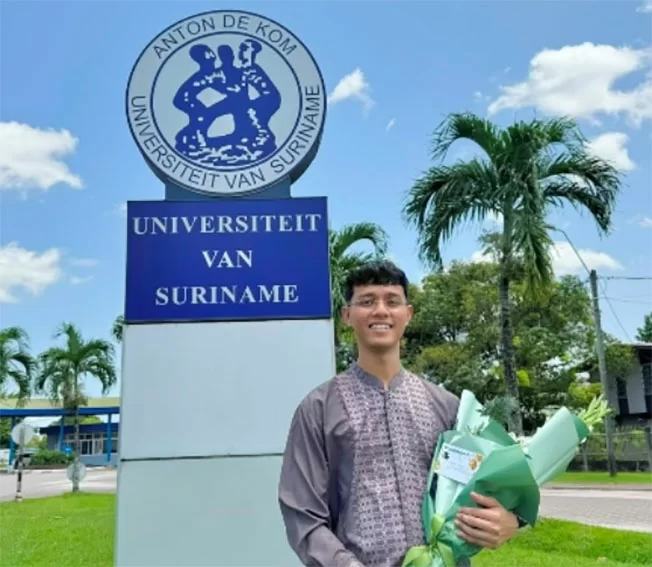
Across Suriname’s thriving fishing industry, large volumes of fish byproducts — including heads, fins, bones, scales, offal, and unwanted bycatch — have long been treated as valueless waste, discarded in landfills or dumped at sea. This widespread practice not only squanders potentially useful organic material packed with proteins, fats, and minerals but also creates unnecessary environmental pressure. Now, a new undergraduate study from Anton de Kom University of Suriname (AdeKUS) has uncovered a practical, sustainable path to repurposing this discarded material into high-value products: crude fish oil and nutrient-adequate starter feed for broiler chickens.
The research was completed by Mukhlis Karsodjojo, who earned his Bachelor of Science in Agricultural Production with a specialization in Agroprocessing from the university’s Faculty of Technological Sciences on August 17. Karsodjojo’s core research objective was to identify ways to unlock greater economic value from the residual waste streams generated by Suriname’s domestic fishing sector, turning a widespread disposal problem into a usable local resource.
To test viable approaches for extracting fish oil from fish waste, Karsodjojo evaluated two eco-friendly extraction methods: wet rendering and enzymatic hydrolysis, testing both on waste from a single fish species and mixed-species waste residues. Both methods successfully produced usable crude fish oil, which the study assessed across key metrics including total yield, color, odor, and mineral oil contamination. The analysis found that enzymatic hydrolysis delivered a significantly higher oil output than wet rendering, marking it as the more efficient and effective green extraction method for small-scale local operations.
In the second phase of the study, Karsodjojo explored integrating processed fish waste into starter feed for young broiler chickens. He developed custom feed formulations that combined processed fish byproducts with locally available Surinamese ingredients, then tested the nutritional content of these blends, measuring moisture, ash, protein, fat, and carbohydrate levels. When compared to mass-produced commercial starter feed currently sold in Suriname, the custom blends met all requirements for adequate nutrient content, proving the concept’s nutritional viability.
While the research confirms the technical feasibility of this circular economy approach, it also highlights a key remaining barrier to widespread adoption: on small production scales, the cost of manufacturing the custom fish-based starter feed currently exceeds the price of standard commercial alternatives. Despite this economic challenge, the study emphasizes that the approach delivers meaningful systemic benefits: it reduces total waste volumes, cuts reliance on imported feed ingredients by leveraging local raw materials, and creates new economic value from material that would otherwise be discarded entirely.
Karsodjojo’s work concludes that Suriname has significant untapped potential to utilize fish byproducts more sustainably, but notes that further research is still needed. Future studies should focus on developing effective refining methods for the crude fish oil extracted from waste, and on identifying process adjustments to lower production costs for the chicken starter feed to make it competitive with commercial options. The research was supervised and reviewed by a team of academic advisors including dr. ir. F. van Genderen, dr. A. Kent, ing. S. Moeljoredjo, M. Jaggan, and prof. L. Ori.