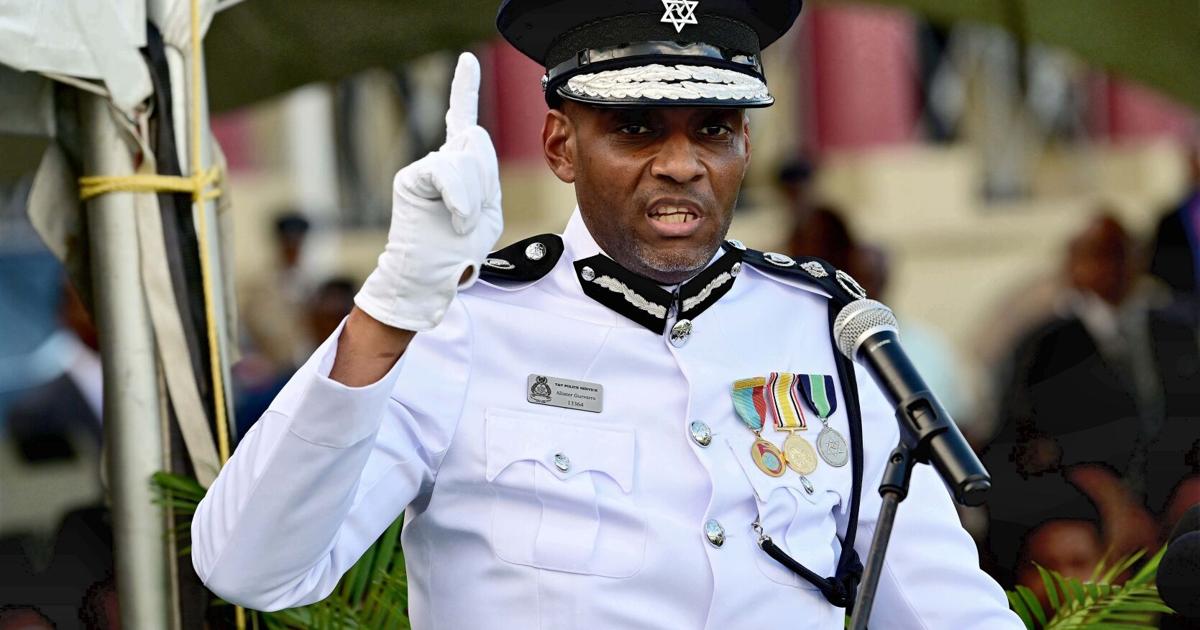
Amid swirling public speculation and political scrutiny over his unannounced five-day overseas trip earlier this month, Trinidad and Tobago Police Commissioner Allister Guevarro has broken his silence, releasing a nearly three-minute audio recording to local media that defends his actions, rejects claims of institutional crisis, and pushes back against efforts to politicize his absence.
Guevarro explained that his decision to apply for emergency leave was prompted by sensitive intelligence received on August 10 from the director of the Strategic Services Agency (SSA) and the head of the Special Branch. Following formal protocol, he submitted his leave application to Homeland Security Minister Roger Alexander, who granted approval, with official correspondence then forwarded to the Police Service Commission (PolSC) as required by regulation.
“I followed the requirements of the established process and I breached no protocols or policies,” Guevarro stressed in the recording, pushing back on narrative that frame his unplanned absence as a violation of institutional rules. While he declined to disclose specific details of the intelligence that prompted his travel, he dismissed a string of circulating rumors that offered unconfirmed explanations for the trip, including claims that he was receiving urgent medical treatment, investigating unexplained foreign assets held by local figures, or traveling to revoke visas for a list of targeted individuals. Guevarro emphasized that upon his return to Trinidad and Tobago, he fully debriefed both the chair of the National Security Council (NSC) — which is led by Prime Minister Kamla Persad-Bissessar — and Homeland Security Minister Alexander, and directed all further inquiries on the purpose of his travel to those authorities.
Crucially, Guevarro rejected widespread claims that his temporary absence created a leadership vacuum or destabilized the Trinidad and Tobago Police Service (TTPS). He noted that the force is built on a hierarchical, contingency-ready framework designed to maintain operational continuity during temporary gaps in senior leadership, with trained executive officers prepared to step in to uphold stability.
“Leadership transitions, temporary or otherwise, are not a crisis. They are part of the organisation’s design,” Guevarro said. “As for those who felt that Rome was burning in my absence, I want to reassure you that the Trinidad and Tobago Police Service is an institution built on structure, continuity and contingency.” He also criticized actors who have sought to manufacture controversy and politicize the situation, adding a sharp rebuke: “To those who chose to politicise the matter and attempted to manufacture scandal and bacchanal, all I will say is this, your petticoat is showing.”
Asked for comment on Guevarro’s statement Wednesday, Minister Alexander offered only a brief, favorable response: “A responsible (Commissioner of Police) who is in charge of a responsible institution giving a very responsible response.”
During Guevarro’s absence, the most senior executive TTPS officer, Deputy Commissioner Junior Benjamin, has overseen day-to-day operations of the force. Speaking with local outlet *Express* earlier this week, Benjamin confirmed that there is no leadership or administrative breakdown within the service, noting that the force has operated successfully under similar temporary arrangements in the past.
Benjamin also explained why no formal acting commissioner had been appointed, clarifying that the legal process requires PolSC to submit a nominee to the President, who then forwards the nomination to Parliament for review before the appointment can be finalized. With Parliament currently in recess, the formal appointment process cannot move forward at this time, a situation that has occurred previously without disrupting TTPS operations. “There’s no problem in terms of proper administration and leadership at the TTPS at this time,” Benjamin affirmed. Benjamin is no stranger to stepping into the top role, having previously served as acting commissioner in October 2025, and already assumed acting duties during the tenures of past substantive commissioners Erla Harewood-Christopher and McDonald Jacob.
The controversy has drawn attention from Trinidad and Tobago’s opposition, with People’s National Movement (PNM) chairman Marvin Gonzales calling for full transparency from the ruling government. Speaking Saturday following the PNM General Council meeting in Port of Spain’s Balisier House, Gonzales demanded clear answers from both Alexander and Prime Minister Persad-Bissessar, pressing for details on Guevarro’s location, departure date, and the status of an acting appointment.