As the 2026 academic year approaches, a small technical high school in western Belize has thrown a long-simmering national conversation about school grooming standards back into the spotlight, drawing sharply divided responses from parents, educators and community members across the country.
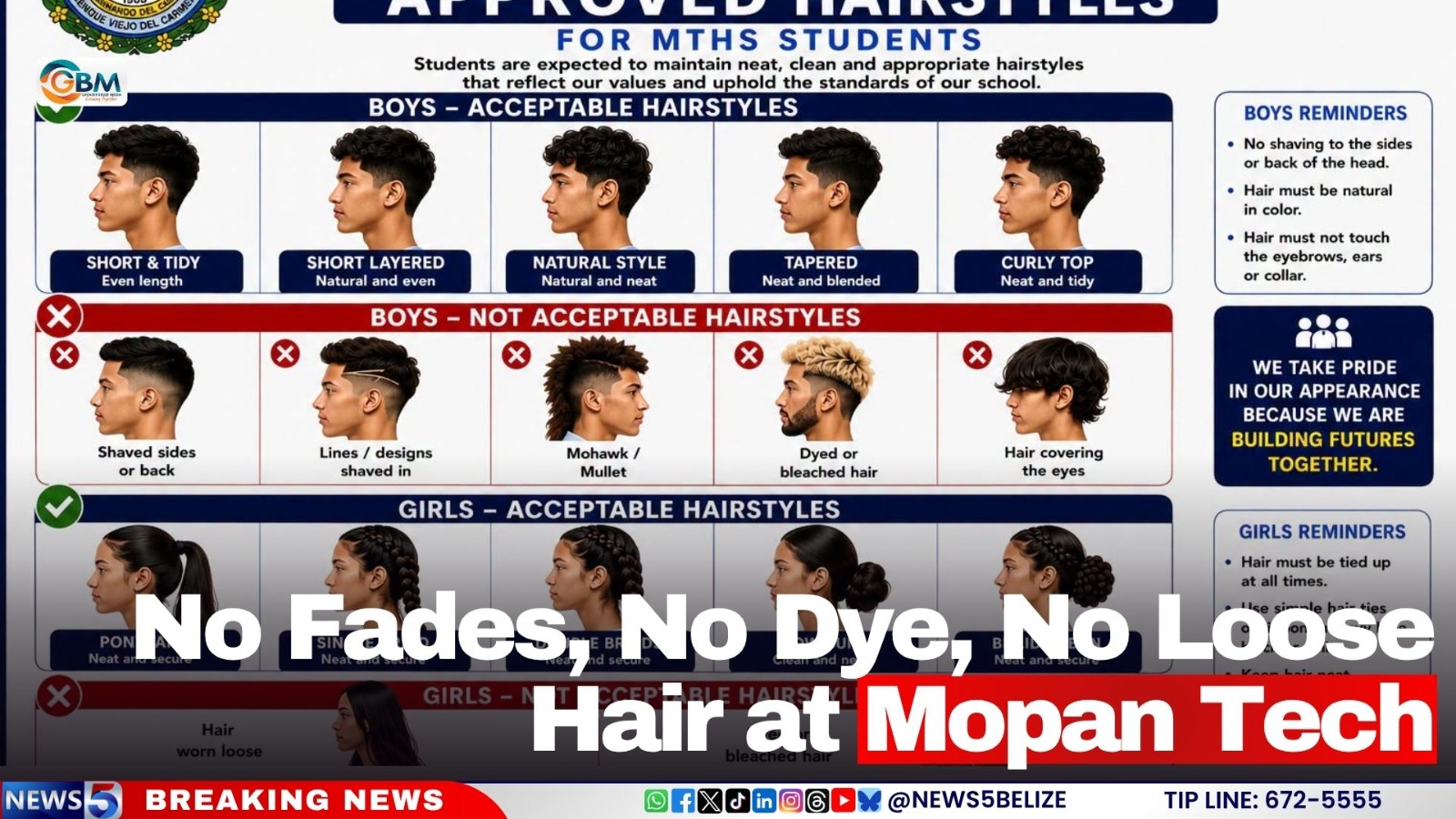
Five days before Mopan Technical High School’s August 24 reopening in Benque Viejo del Carmen, Cayo District, school administrators published a detailed “Approved Hairstyles” guide to the institution’s official Facebook page. The visual guide, which features AI-generated images of student models demonstrating both permitted and prohibited styles, pairs clear illustrations with gender-specific grooming rules that leave little room for interpretation.
For male students, the policy permits only short, neatly trimmed cuts including tapered fades and natural curly tops. All hair must remain its natural color, and cannot extend to touch the eyebrows, ears or collar. Shaving the sides or back of the head is explicitly forbidden. Styles ranging from mohawks and mullets to dyed or bleached hair and shaved decorative designs are marked as unacceptable. For female students, approved looks are limited to neat, secured ponytails, braids, and buns, with a requirement that all hair be tied up at all times using only simple navy blue, black, or white fasteners. Unbound loose hair and artificially colored hair are both prohibited.
In the post’s accompanying note to parents, school leadership framed the policy as far more than a superficial focus on appearance. Addressing the common question of what hair has to do with academic learning, administrators argued that grooming standards are a core part of preparing young people for long-term success beyond the classroom. Learning to adhere to shared appearance expectations, practice self-discipline, respect institutional rules, and present oneself professionally, the school noted, are foundational skills for becoming responsible, successful adults.
Principal Katie Jones doubled down on this reasoning in an interview with local outlet News Five, emphasizing that the policy is rooted in building student discipline rather than restricting personal expression. “While some people say that hair has nothing to do with learning, we do believe that it sets discipline and standards for our school,” Jones explained. She added that clear grooming boundaries help acclimate students to professional workplaces, where strict uniform and appearance expectations are standard practice. “It is our fault if we don’t really have these things that are going to guide them throughout their life,” she added.
This latest policy update comes more than a year after a national debate over school hair policies first erupted in Belize, triggered by similar controversies at multiple institutions including Anglican Cathedral College in August 2025. At that time, the Belize National Teachers’ Union (BNTU) issued an official statement opposing policies it labeled as discriminatory, aligning itself with the UBAD Educational Foundation. “The BNTU stands in solidarity with UBAD Educational Foundation against discriminatory hair policies in schools. We are deeply concerned by reports of students being reprimanded, suspended, or otherwise penalized for wearing hairstyles that reflect their heritage or religious beliefs,” the union said at the time.
When reached for comment by News Five, Chief Education Officer Yolanda Gongora confirmed that the Ministry of Education is currently reviewing the matter but declined to release an official statement ahead of the review’s completion.
Online, the school’s Facebook post has sparked a flood of public comments that highlight the deep divide in Belizean public opinion on the issue. Supporters of the policy have praised it as a necessary step to prepare students for the workforce. “Great initiative,” one commenter wrote. “When they go into the real world, it’s not if you want or like… you have to follow the rules of your job or no job at all.” Another supporter echoed that view, writing “I concur; it’s called discipline and self-care.”
Critics, however, have pushed back against the restrictions, questioning their relevance to academic outcomes and raising concerns about cultural exclusion. Multiple commenters argued that schools should abandon what they described as an outdated “colonialist mindset” that prioritizes arbitrary appearance rules over actual learning. “Imagine thinking hair length dictates IQ. Focus on the curriculum, not the barber shop,” one critic wrote. Other parents pointed out that the list of approved styles fails to account for diverse cultural hair traditions. One parent of a Creole descent student asked, “What about the females of Creole descent? Braids and cornrows have become very popular among schoolgirls,” noting that the narrow approved options leave little room for culturally significant hairstyles.