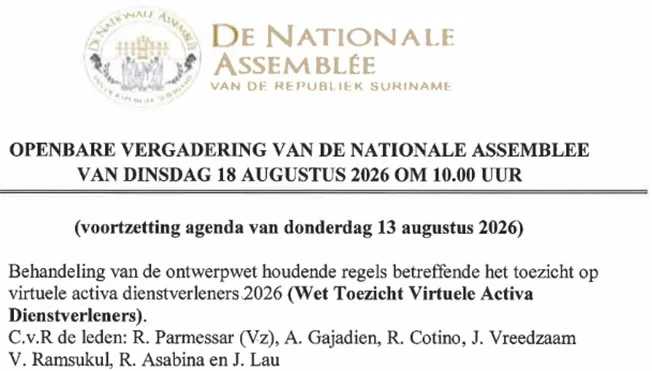
As Suriname’s National Assembly continues its debate on a landmark bill to regulate virtual assets including cryptocurrencies on August 18, there is near-universal agreement on one core point: targeted oversight of the digital asset space is long overdue. What remains deeply contested, however, is the specific design of the proposed legislation, with lawmakers raising urgent concerns that overly harsh rules could stifle innovation and lock small local entrepreneurs out of the emerging market. The first round of deliberations on the Draft Act on Supervision of Virtual Asset Service Providers drew widespread cross-party criticism, centered on excessive regulatory burdens, overly broad powers granted to the Central Bank of Suriname (CBvS), insufficient legal protections, and risks of crowding out domestic businesses. At the same time, all stakeholders agree that robust regulation is critical to curbing money laundering and other forms of financial crime linked to unregulated digital assets.
Cross-party scrutiny of the bill emerged during the initial deliberation round, with senior committee members flagging key flaws in the current draft. Rabin Parmessar, National Democratic Party (NDP) member and chair of the committee of rapporteurs, questioned both the scope and practical enforceability of the proposed regulatory regime. Asis Gajadien, a committee member from the ruling Progressive People’s Party (VHP), warned that regulation must not devolve into a framework that actively blocks innovation or forces existing and new entrepreneurs to operate under unworkable compliance requirements. Fellow NDP committee member Jennifer Vreedzaam emphasized her own focus on unaddressed risks, the structure of ongoing oversight, and the practical challenges of rolling out the new rules.
A consistent thread running through almost all parliamentary contributions is that Suriname cannot continue to operate without clear rules for virtual assets. The cross-border, partially decentralized structure of these digital instruments makes them uniquely vulnerable to misuse for money laundering and other illicit financial activity. Yet lawmakers also recognize that the underlying blockchain and digital asset technology offers tangible benefits: enabling cheaper, faster cross-border payments, expanding financial inclusion for unbanked communities, and creating new opportunities for domestic entrepreneurship.
Kishan Ramsukul, a VHP member of the rapporteur committee, highlighted the specific upsides virtual assets bring to Suriname, particularly for facilitating remittances from the country’s large diaspora, supporting cross-border payments for small and medium-sized domestic enterprises, and expanding financial access in regions with limited traditional banking infrastructure. While Ramsukul agrees regulation is necessary, he cautioned that the bill in its current form imposes unbalanced, overly burdensome requirements that would disproportionately harm small players. Under the current draft, all virtual asset service providers must be registered legal entities, meet yet-to-be-specified capital requirements, maintain a minimum of two directors plus a supervisory board, and operate an extensive administrative organization with strict internal controls. For small, innovative startups, these requirements are effectively insurmountable, risking their complete exclusion from the market, Ramsukul argued.
To address this gap, Ramsukul called for a proportionate, tiered regulatory system that does not impose identical strict requirements on all providers regardless of their size, business model, and associated risk level. He also warned against the current bill’s overly broad definition of virtual assets, arguing that traditional online banking, Surinamese dollar (SRD) transactions, and existing mainstream digital wallets should not fall under the scope of this legislation. He suggested separate, tailored rules could be developed for company-specific tokens and other niche digital applications.
By contrast, NDP lawmaker Ebu Jones centered his intervention on the pressing need for strong rules to counter criminal activity. Jones stressed that insufficient regulation of virtual assets creates severe public risk, as proceeds from drug trafficking, corruption, and other illicit activities can easily be converted into Bitcoin or other decentralized digital assets and moved beyond the reach of law enforcement. Jones also brought up the online gambling sector, arguing that policymakers need to assess whether digital balances bought, sold, or exchanged for cash within betting platforms should also be brought under the regulatory scope, suggesting a broader definition of covered assets may be necessary.
Jones further linked the virtual asset regulation bill to broader national efforts to combat corruption and seize illicitly gained assets. Without clear visibility into conversions between fiat currency and virtual assets, he argued, authorities will struggle to trace the movement of criminally obtained wealth. He also called for accelerated progress on Suriname’s long-awaited asset seizure legislation, often referred to as the “skimming law” that targets illicit proceeds.
After the conclusion of the first round of debate, a clear dynamic has emerged: there is remarkably broad consensus on the end goal of regulating virtual assets, but deep disagreement on the policy tools to achieve that goal. Most speakers acknowledge that regulation is required not just for domestic stability, but also to meet Suriname’s international anti-money laundering and counter-terrorism financing (AML/CFT) obligations. The core disagreements revolve around whether the proposed rules are appropriately proportionate, practically implementable, and clearly defined under law.
Key sticking points that remain unresolved include the scope of powers and institutional role of the CBvS, transitional arrangements for existing virtual asset service providers, market access for small local entrepreneurs, oversight of foreign-based digital asset platforms, protection of customer personal data and deposited funds, and how to preserve space for innovation while maintaining compliance with strict global AML/CFT standards.
On the day of the continued debate, the burden shifts to the ruling government to respond to the dozens of concerns raised by lawmakers. Answers from the executive branch will signal which criticisms the government accepts, and whether the bill will be amended before the National Assembly holds a final vote on the legislation.