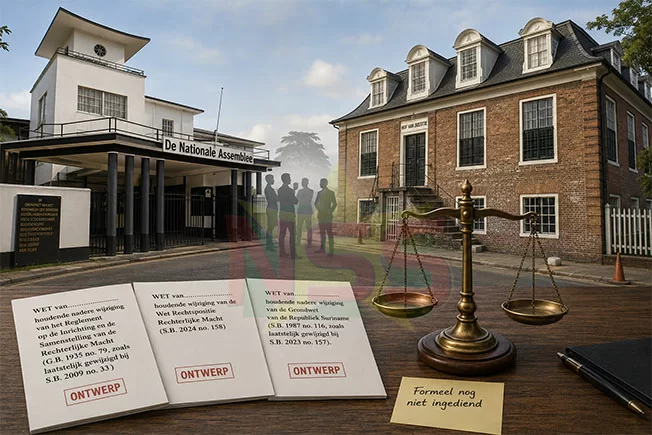
An old Dutch proverb warns against crying out before you have been struck, and this warning has never felt more relevant to the heated public debate unfolding around proposed judicial branch reforms in Suriname. Right now, the amendments being discussed are still only draft concepts, agreed in broad terms by the governing coalition but not finalized, not formally submitted to the National Assembly (DNA), and facing internal opposition within the ruling bloc. Any constitutional change to the judiciary will also require a two-thirds majority vote to pass, a high bar that many proposals may never clear. Despite all this uncertainty, public discourse has already hardened into opposing camps, acting as if the final legislative decision has already been made.
The Court of Justice and Public Prosecutor’s Office (OM) have already sounded the alarm, warning that the changes threaten judicial independence and carry severe constitutional consequences. Their call has been echoed by a broad coalition of groups, including lawyers, business associations, civil society organizations, and even medical professionals. No one disputes that judicial independence is a non-negotiable pillar of the rule of law: if judges believe this fundamental principle is at risk, they not only have the right but the duty to speak out. The question that has gone remarkably undiscussed, however, is whether every proposed adjustment to the position of the Court and OM automatically counts as an attack on the rule of law.
These proposed reforms do not only touch on abstract constitutional principles. They also address practical questions of institutional organization, procedural authority, employment terms for judicial staff, and most notably, financial governance. Debate over this last area has simmered for years. Salaries and budgetary allocations for the judiciary have sparked public controversy before, repeatedly raising the question of how judicial independence balances against democratic oversight of public spending and state accountability for taxpayer funds. Local outlet Starnieuws has previously highlighted the extraordinary financial implications that could stem from the current Act on the Legal Position of the Judicial Branch. After all, judicial independence cannot reasonably mean that every matter related to budgets, salaries, spending, and financial oversight is placed entirely outside the scope of democratic decision-making.
With public momentum already building against the reforms, a pressing question remains: how many of the organizations that have lined up behind the Court and OM have actually read the draft amendments themselves? How many have taken the time to distinguish between proposals that genuinely threaten judicial independence and those that only address administrative structure, financial oversight, and institutional governance? The judiciary holds significant, well-deserved social authority, which makes it easy to mobilize broad public support when its leadership claims its independence is under threat. That is precisely why civil society must be more, not less, critical of all powerful institutions, including the judiciary.
Those who scrutinize the government and the National Assembly should not stop asking questions the moment the Court or OM speaks. Independence does not equal untouchability. And to reiterate, nothing is set in stone yet: the six-party coalition has reached broad agreement on direction, but internal objections remain, the text is not finalized, and the two-thirds majority required for constitutional change is far from guaranteed.
Why, then, are we acting as if the final blow has already been struck? This uncertainty does not absolve reform proponents of their responsibilities: if they are moving forward with changes that would erode judicial independence, they owe the public full transparency and clear explanation. Once the amendments are formally tabled, they must be published in full and subjected to rigorous legal review. But the debate must center on the actual text of the proposals, not speculative fears over what they might contain.
It is entirely possible that many of the current warnings will prove justified. It is just as possible that controversial provisions will be modified or scrapped entirely before they ever reach a formal vote in the National Assembly, or that they will fail to win the required supermajority. That is how the parliamentary process is designed to work: it allows for debate, amendment, and even rejection before any final decision is made.
The most worrying outcome of the current moment is that opposing factions have formed before the legislative process has even properly begun. Anyone who questions the position of the Court and OM risks being labeled an enemy of judicial independence, while anyone who questions the government’s approach is dismissed as a defender of entrenched power. That is not how a functioning rule of law operates.
Judicial independence must remain protected. Parliament must be free to carry out its core legislative work. And above all, civil society must preserve its most critical ability: to maintain a skeptical, critical stance toward all centers of power. If we fail to do that, we will not only have cried out before we were struck. We may never have even stopped to ask who intended to strike us in the first place.