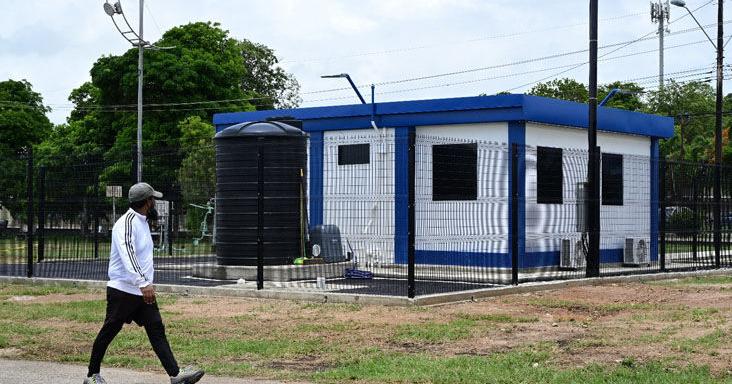
A planned expansion of community policing across Trinidad and Tobago has become the center of a conflict between central and local government authorities, even as law enforcement leaders prepare to bring new facilities online. Deputy Commissioner of Police Junior Benjamin has confirmed that the Trinidad and Tobago Police Service (TTPS) is eagerly anticipating the launch of multiple new permanent police posts, including a key location at Eddie Hart Savannah in Tacarigua. When reporters from the Express visited the Tacarigua site this week, the fully built structure was found shuttered and non-operational, with only a single security guard stationed in a nearby blue tent, indicating that final opening procedures are still underway. Benjamin emphasized in an interview that the TTPS is committed to leveraging these new facilities to their full potential once they open. The new posts, he explained, are designed to address two longstanding gaps in local public safety: they will cut emergency response times dramatically during critical incidents, and give neighborhood residents a more accessible local hub to file reports and access routine police services without traveling long distances to distant precincts. Despite broad support for the goal of expanding policing access, the project has run into opposition from the Tunapuna-Piarco Regional Corporation, whose chairman Josiah Austin says the construction of the Tacarigua post violated local regulatory laws. Austin told reporters that the regional corporation issued both a formal notice of violation and a stop-work order before construction was completed, but central government officials proceeded with the project regardless, choosing to ignore the legal directives. Austin stressed that his corporation does not oppose the creation of these new police posts as a policy initiative – the objection is centered on the process the central government used to advance the Tacarigua site. He called on the government to ensure that future construction of additional posts includes required consultation with local governing bodies and relevant state agencies, such as the National Gas Company (NGC). Austin noted that the ongoing standoff should serve as a clear reminder that central government must adhere to all existing legal requirements when undertaking public projects within jurisdictions managed by local authorities. ‘At some point they would learn that Central Government cannot bully Local Government, as the law is the law and the right thing is the right thing,’ Austin said. Last week, Austin first raised public concerns about the project, noting that the Tacarigua site lacked pre-construction consultation with the corporation and was built over decommissioned NGC gas lines. The NGC has since released a statement confirming that the lines are no longer active and do not present any public safety hazard at the site. The broader 30-post initiative was first announced two weeks ago by Prime Minister Kamla Persad-Bissessar, who framed the program as a mobile joint army-police expansion that will boost public safety across both islands of Trinidad and Tobago. The plan has already drawn backing from other local government leaders, including Chaguanas Mayor Faaiq Mohammed and Tobago House of Assembly Chief Secretary Farley Augustine. However, it has also faced scrutiny beyond the local government dispute: opposition attorneys have formally submitted a request to the Office of the Procurement Regulator, calling for a full investigation into the procurement processes used for the construction and site preparation work across all 30 planned posts.