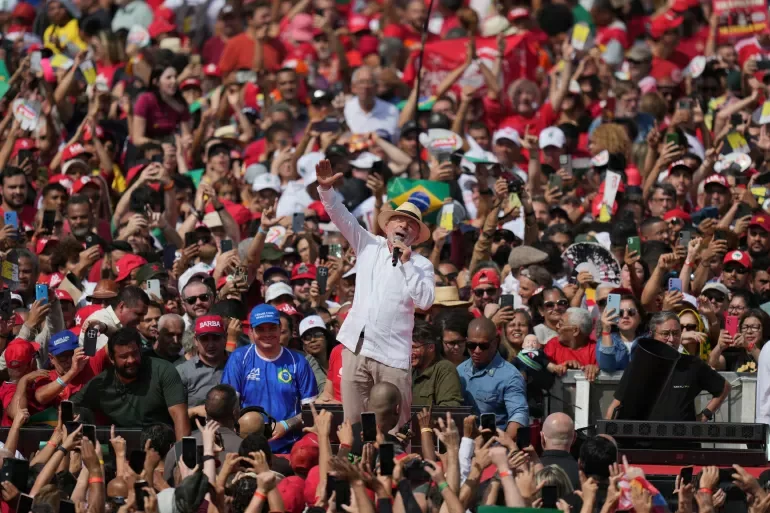
As Brazil gears up for its hotly contested October 4 presidential election, the two leading candidates have officially kicked off their campaign journeys in the political strongholds that forged their public profiles, setting the stage for a fiercely competitive race that will shape the South American nation’s next term.
Incumbent president Luiz Inacio Lula da Silva, an 80-year-old former union leader running for a fourth presidential term, addressed a crowd of over 10,000 enthusiastic supporters on Sunday at Vila Euclides Stadium, located near São Paulo in the city of Sao Bernardo do Campo. This venue carries deep personal and political meaning for Lula: it was the same area where he launched his political career 47 years ago. Recently diagnosed with skin cancer, Lula used the opening rally to reaffirm that his policy agenda remains the critical path forward for Brazil, and pushed back against what he claims is foreign interference in the election. Members of Lula’s coalition allege that foreign interference, particularly from the United States, is designed to advantage his rival, Flavio Bolsonaro.
Flavio Bolsonaro, the senator and son of former Brazilian president Jair Bolsonaro, held his own opening rally that drew thousands of supporters on Copacabana Beach in Rio de Janeiro. Flavio’s father, who remains under house arrest following recent legal proceedings, was absent from the kickoff event. The younger Bolsonaro centered his opening remarks on his pledge to strengthen Brazil’s trade ties with major global partners, including the United States, China, Israel, and Argentina. His campaign has already secured public endorsements from high-profile international leaders, including Argentina’s President Javier Milei and Israeli Prime Minister Benjamin Netanyahu.
A striking shared priority across both candidates’ early campaign platforms is courting female voters, a demographic that makes up nearly 53 percent of Brazil’s 158 million registered electorate. Both candidates have made addressing the national crisis of gender-based violence and femicide a central campaign promise, after official data recorded a record-high nearly 400 femicide cases across the country in the first quarter of 2026.
Lula used his opening rally to call for full gender equality and mutual respect between men and women, announcing he will unveil a new national plan to combat gender-based violence within 10 days. He stressed explicitly that any man who perpetrates violence against women has no place or voice in his campaign. Flavio Bolsonaro also positioned himself as a champion for the fight against violence against women, structuring his campaign events to include female companions and surrogates at his side to highlight the issue.
With just over a month and a half remaining before voting opens on October 4, the race is already shaping up to be one of the most divisive and closely watched elections in Brazil’s recent history, with voters set to decide between two competing visions for the nation’s future.