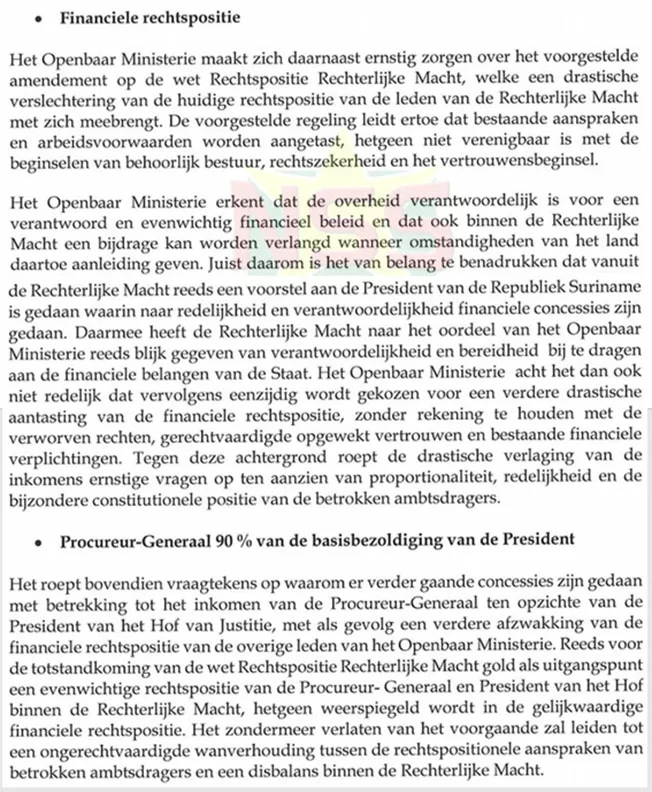
A heated public debate over planned judicial system reforms in Suriname has entered an extraordinary new phase, after the country’s Court of Justice and Public Prosecutor’s Office (OM) issued unusually harsh warnings against draft amendments that have not yet been formally tabled before the National Assembly (DNA). Civil society groups, legal associations, and business organizations have since rallied to support the two judicial institutions’ concerns, setting the stage for a high-stakes institutional conflict over legislation that parliament has not even officially received.
The core question animating this crisis is not whether the Court and OM have the right to voice their concerns—all parties agree these institutions must retain space to defend their institutional interests. Instead, the critical debate centers on where the legitimate protection of judicial independence ends, and inappropriate interference with the democratic legislative process begins. This distinction is particularly vital, as the entire dispute revolves around the future of Suriname’s rule of law.
The planned reforms, which include changes to the constitution, the Judicial Position Act, and regulations governing the structure and composition of the judiciary, directly impact the organization of both the courts and the Public Prosecutor’s Office. It is entirely reasonable for these two institutions to closely monitor legislative proposals that reshape their own operations. In fact, for major, system-altering reforms of this nature, it is standard good governance practice to solicit input from expert bodies and directly affected institutions. But the steps taken by the Court and OM go far beyond the bounds of technical advice or informal consultation.
Multiple senior leaders of the National Assembly have confirmed that the amendments at the center of the controversy have never been formally submitted to the legislative body. DNA Speaker Ashwin Adhin confirmed this during a public plenary session Friday. Ebu Jones, one of the proposed amendments’ initiators, also stated that no formal filing had taken place, and Rabin Parmessar, chair of the parliamentary committee reviewing the broader reform bill, added that his committee had not received any official version of the draft changes.
This does not mean the text does not exist: draft amendments are routinely prepared ahead of formal submission, as initiators revise, debate, and adjust proposals before settling on a final version to present to parliament. Starnieuws has learned that the draft proposals have been discussed within the governing coalition, but internal coalition discussion is a far cry from formal submission to the full parliament—a distinction that has been all but lost in the raging public debate.
What makes the situation even more unusual is that the Court itself explicitly acknowledged in its formal letter that it was aware of the draft’s informal status. The court noted that the latest version of the amendments, dated August 3, 2026, was unsigned and shared privately with the Court’s president. While the OM has claimed the amendments were already formally submitted to DNA, this assertion has been proven incorrect.
The fact that the two judicial bodies hold documents that remain outside the formal parliamentary process does not invalidate their substantive concerns about judicial independence. But it does throw into sharp relief the appropriateness of the method they chose to respond.
Against the informal status of the draft amendments stands an extraordinarily formal public response. The Court and OM submitted their objections in writing to DNA’s speaker, and delivered the letters via court bailiff—a process that cast the two judicial bodies as formal claimants, not just interested commentators. This is far from a casual, routine way to share an opinion, creating a paradoxical situation: a proposal that has not been formally introduced to parliament has already received a full-throated formal institutional rebuke, prompting serious questions about why this aggressive approach was chosen.
If the Court had learned of a private draft that raised severe constitutional concerns, standard procedure would be to reach out to initiators, the government, or the DNA speaker to flag potential risks, offer legal guidance, and request formal consultation once the proposals are officially submitted. That stands in stark contrast to the current scenario, where sweeping constitutional warnings were directed at parliament before any formal submission even occurred.
The language used by both institutions is equally uncompromising. The OM claims the proposed amendments would undermine the independence, effectiveness, and authority of the judiciary, warning that they would destabilize the rule of law and weaken the entire judicial branch. The Court has also issued stark warnings, stating that the proposals would carry severe constitutional and institutional consequences. It added that if the proposals move forward in their current form, the court will reconsider its constitutional, organizational, and legal positions, and take whatever steps it deems necessary to protect judicial independence. No one disputes that the Court has every right to defend its institutional independence.
But when a branch of state issues such stark warnings, it must be clear what exactly it is responding to. At the time the warnings were issued, the draft text had not been formally laid before parliament, and initiators still retained the full right to revise, cut sections, or abandon the proposals entirely. The warnings therefore pre-empt the formal parliamentary legislative process.
A second wave of reaction soon followed, with business groups, bar associations, and civil society organizations—including the Suriname Business Association (VSB), the Citizen Initiative for Participation and Good Governance (BINI), the Association of Surinamese Manufacturers (ASFA), the Association of Small and Medium Enterprises (AKMOS), and the Center for Good Governance (CGB)—all lining up behind the Court and OM’s concerns over judicial independence. These groups have warned against one-sided changes and called for broad consultation and consensus building.
There is no question that civil society organizations have every right to speak out on issues of public importance. A robust civil society should indeed mobilize when core rule of law values are potentially at stake. But critical citizenship does not only apply to the government and parliament—it also applies to authoritative institutions like the Court and OM.
This raises important questions: how many of the organizations that have publicly taken a position have fully reviewed the draft amendments themselves? Did they know the amendments had not been formally submitted to DNA? Did they independently verify the status of the documents? And have they drawn a clear distinction between opposing potential changes and opposing amendments that have actually been formally introduced to parliament? The institutional authority of the judiciary cannot replace independent assessment. Civil society groups that claim to defend the democratic rule of law must also hold all branches of state—including the judiciary—accountable for how they exercise their power and institutional influence.
The greatest risk at this stage is that the debate has spun out of control before the legislative process even begins. Positions have already hardened, long before DNA has formally received the amendments or opened a public parliamentary debate on their content. The Court and OM have issued severe warnings, civil society has thrown its support behind them, and DNA representatives have raised sharp questions about why the two judicial bodies are responding to text that parliament does not officially have.
This dynamic risks turning a constitutional debate about judicial organization into an all-out conflict between branches of state, which would be a deeply unfortunate outcome for Suriname. Judicial independence is too important to treat lightly, but the primacy and autonomy of the democratic legislative process carries equal weight. The rule of law is not only threatened when politicians accumulate too much power—it is also put under strain when branches of state pressure one another outside of established constitutional procedures.
For this reason, critical scrutiny must be applied to both sides of the dispute. Judicial independence works both ways. The Court and OM have every right to issue warnings—indeed, if they genuinely believed judicial independence was under imminent threat, remaining silent would be difficult to defend. But their unique institutional position also imposes a unique responsibility on how they engage in the public and political sphere.
Judiciary do not hold political power in the traditional sense; their authority rests precisely on their independence, legal expertise, and institutional restraint. When that authority is deployed to intervene in a debate over draft legislation that has not even been formally submitted, there must be space to question that choice without every critical question being dismissed as an attack on judicial independence. The same critical standard applied to the presidency, government, and parliament must also be applicable to the Court and OM. This is not an attack on the rule of law—it is a core requirement of it.
No one disputes that the Court and OM had the right to speak out. The open question remains whether the method and intensity of their intervention was proportionate, given that the proposals had not been formally submitted to parliament. It also remains unclear whether civil society organizations conducted sufficient independent review of what was actually on the table before joining the unified opposition.
If a private draft can already trigger formal warnings from two core judicial institutions, a bailiff-delivered rebuke to parliament, mass civil society mobilization, and a potential constitutional clash between branches of state before parliamentary debate even begins, there is good reason to examine not only the content of the amendments, but also the power of the institutions that have lined up against them. The rule of law protects judges from political pressure, but it also requires that all power—including judicial and institutional power—be open to critical scrutiny.