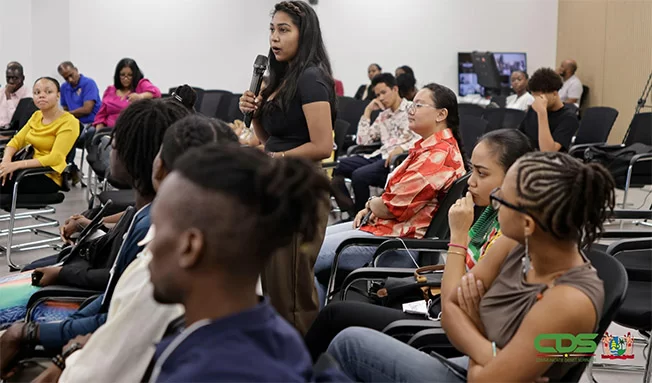
Against the backdrop of Suriname’s 2026 Heritage Month, young people from across the nation have gathered to unpack one of the country’s most enduring open questions: what exactly does it mean to be Surinamer, and how do shared history, collective heritage, and extraordinary cultural diversity shape that identity?
Organized by Anton de Kom University of Suriname (AdeKUS), the youth-focused dialogue brought together participants aged 18 to 35 from a range of community and civil society organizations, held at the auditorium of the Ministry of Public Health, Welfare and Labor. Unlike conventional policy-focused forums that aim to produce immediate conclusions, this event was intentionally designed to spark open, inclusive conversation rather than force a single, uniform definition of national identity. The core goal, organizers emphasized, is to center youth voices in shaping how Suriname’s heritage can support the country’s ongoing social and national development.
Discussion topics spanned interconnected themes of national identity, nation-building, and ethnic diversity, exploring the intertwined histories and cultures of Suriname’s many distinct ethnic communities, and how these groups coexist in a single shared society. Participants deliberately examined both the common ground that unites Surinamese people and the differences that enrich the nation’s social fabric, probing how to navigate this diversity in a way that strengthens collective cohesion.
Darren Sarijoen, chair of the AdeKUS organizing committee leading the event, stressed that young people deserve a central seat at the table for conversations about national heritage. “Young people are the ones who will carry this heritage forward into the future,” he explained. “That is why it is critical that they are active participants in this conversation from the start.” For organizers, the dialogue also serves as a window into how the younger generation conceptualizes heritage and identity, informing how these critical themes can be advanced in public and academic discourse moving forward.
Notably, the entire planning and design process for the gathering was led almost entirely by young people and university students. Sarijoen noted that the university leadership specifically mandated that youth lead the debate, tasking participants with developing discussion topics and shaping the substantive program of the event themselves.
Professor Ine Apapoe, a member of the Presidential Working Group for Heritage Month 2026, reinforced that the forum was never intended to deliver an immediate, one-size-fits-all definition of Surinamese identity. “The goal of this dialogue is to talk with young people about what Surinamese identity means to them,” she said. “We are not here to get a quick answer. We are here to start the conversation, identify the key issues, and carry those insights forward as we build the kind of Suriname we all want to live in.”
Sarijoen echoed that there is currently no single, widely agreed-upon answer to the question of Suriname’s national identity, and that openness is precisely why continued youth engagement matters so much. He encouraged young participants: “Cherish your heritage, reflect on what our identity means, think about how we want to build our nation going forward, and consider how we can leverage our heritage, history, and all the traditions we have inherited to build a stronger future for all of us.”
Moving beyond Heritage Month, the insights and outcomes from the dialogue will be put to long-term use by AdeKUS, which plans to use the findings to deepen academic research on identity and heritage in Suriname. As a leading knowledge institution, the university will integrate outcomes from the youth conversation into ongoing research initiatives to further explore this critical national topic, Apapoe confirmed.