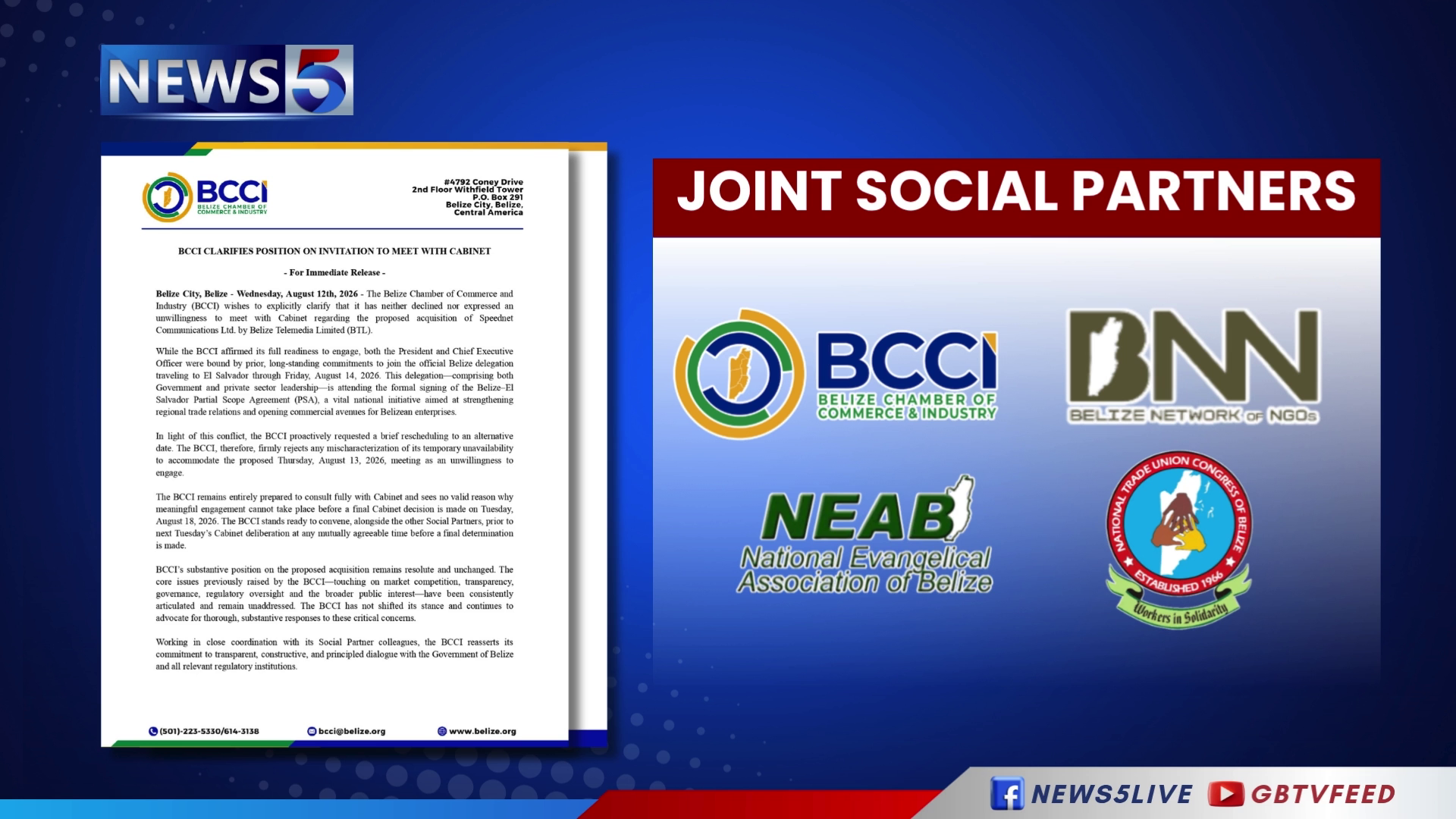
A high-stakes meeting scheduled for August 13, 2026, between Belize’s Cabinet and the country’s top social partner organizations to discuss the controversial proposed BTL/Speednet acquisition failed to convene, leaving unresolved tensions and sparking plans for mass public protests against the deal. The meeting was designed to give Cabinet members direct access to concerns from the Belize Chamber of Commerce and Industry (BCCI) and the National Trade Union Congress of Belize (NTUCB), the two leading bodies representing business and labor interests in the country, respectively. But scheduling conflicts derailed the talks before they could begin. BCCI confirmed that its president and chief executive officer were already committed to joining an official Belizean government delegation to El Salvador, a long-planned trip that could not be rescheduled at the last minute. The organization formally requested that the meeting be pushed back a short time to accommodate their attendance. With BCCI unable to attend as planned, NTUCB also opted to skip the scheduled session. In an interview with local reporters, NTUCB President Ella Waight explained her organization’s decision to boycott the reschedulable meeting. Waight noted that the invitation for the meeting only extended to BCCI and NTUCB, aligned with the country’s traditional tripartite structure for labor negotiations that includes government, employer representatives, and worker representatives. But she emphasized that the proposed acquisition is far from a narrow labor issue—it is a matter of national importance that requires input from the full coalition of social partners. “This is far beyond a labor issue. This is a national issue. It should have been that all social partners would have been invited to that meeting to make their presentation,” Waight stated. Waight added that both organizations had requested a postponement to the following week to allow the full social partner coalition to finalize its position and attend the meeting as a unified group, but the government never responded to the request. When asked if BCCI’s international trip constituted a missed opportunity to engage with the Cabinet, Waight pushed back on that framing, noting that critical international engagements are mandatory for both business and labor leaders, and NTUCB would have made the same choice to prioritize a pre-planned international commitment. “These international meetings we have to attend, they are very crucial for our constituents and they cost money,” she explained. In the wake of the collapsed meeting, NTUCB has escalated its campaign against the Briceño administration’s proposed acquisition, announcing a two-phase series of public protests to demand the government heed widespread national concerns. The first phase, dubbed “Blackout Friday,” will launch tomorrow, calling on all Belizeans—including workers, employers, and students—to show their solidarity against the deal by wearing black clothing. Organizers are also encouraging participants to share photos of their participation on social media to amplify the message and encourage more Belizeans to speak out publicly against the acquisition. The second phase will see coordinated peaceful demonstrations held on Tuesday, July 18, in two major population centers: Belize City and the capital of Belmopan. In Belize City, protesters will gather outside BTL headquarters from 10 a.m. to 1 p.m., with organizers calling on attendees from Corozal, Orange Walk, San Pedro, and Belize City itself to assemble at that location. In Belmopan, protesters will gather outside government administration buildings during the same time window, drawing participants from Punta Gorda, Stann Creek, and Cayo districts. Waight explained that the split protest locations are designed to maximize visibility and demonstrate broad, nationwide opposition to the proposed acquisition, ensuring the government cannot ignore the depth of public concern. She emphasized that the actions are rooted in a call for transparency: social partners have repeatedly requested access to detailed information about the deal to conduct a full analysis before any final decision is made, and that demand has not yet been met. “When the coalition came about we all signed on to saying that we need this information, we need to ensure that all the social partners could attend any meeting, but of course we need the information we have asked for, to analyses it, to be able to present to the Cabinet meeting,” Waight said. This report is a transcribed version of an evening television news broadcast, with Kriol-language statements rendered using a standardized spelling system for accessibility.