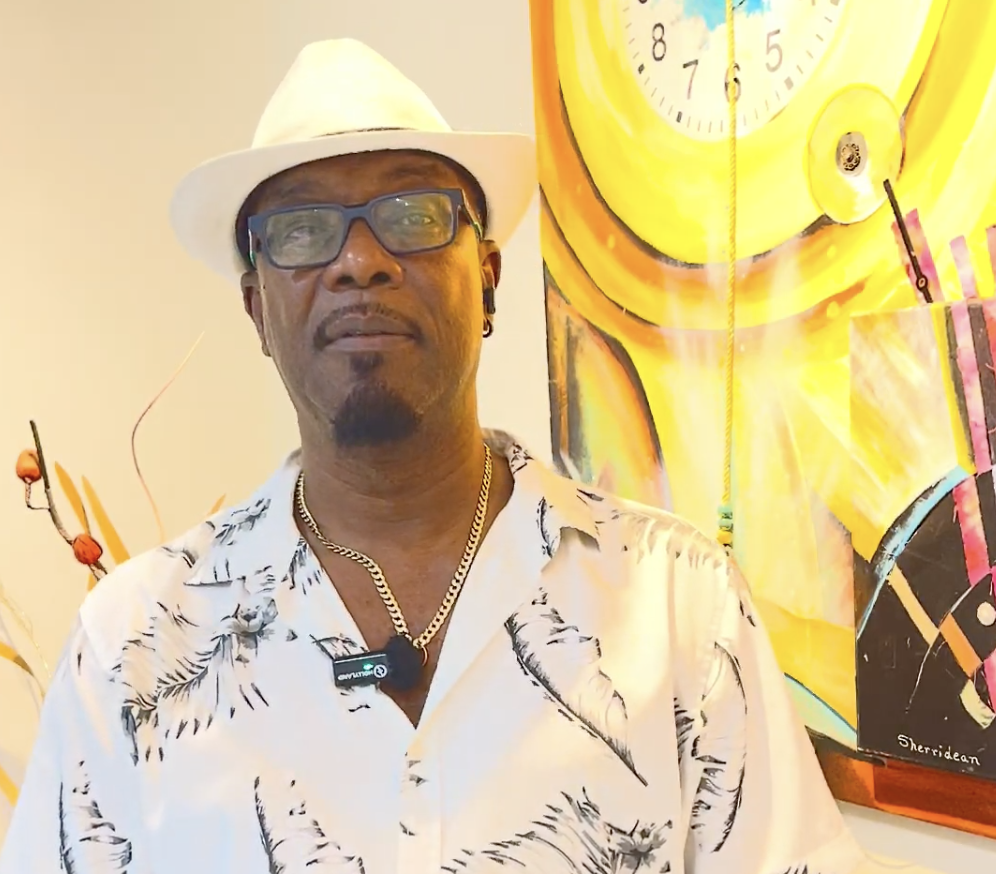
Three decades ago, George Cox never mapped out a career in education. As a young boy growing up, his sights were firmly set on engineering, drawn by his lifelong love of designing and building new things. That early curiosity, which would one day steer him toward a career in art education, first emerged when he began taking apart his father’s belongings — including an old family television — to understand how they worked. When his father ordered him to have the set working upon his return from a trip, Cox managed to get it running despite having extra parts and screws left over, a small early win that hinted at his knack for problem-solving.
After finishing secondary school, Cox enrolled at Barbados Community College, where he opted to study subjects he felt naturally drawn to: English, history, and art. Before long, art became his primary focus, and his first teaching role soon followed: a part-time position at St Leonard’s School, which he remembers fondly for its tight-knit staff and welcoming environment. As a young educator entering the field without an official mentor, Cox drew on the lessons he learned from his own past teachers, particularly a man named Mr. Jones, who left an indelible mark on his approach to teaching. Cox blended the strongest qualities of the teachers who shaped him to build his own unique educational philosophy, one rooted in the idea that every student learns differently.
For Cox, teaching is far from a one-size-fits-all lecture. It is an inherently personal practice, shaped by the unique personalities and needs of each learner in the classroom — a belief that also extends to his perspective on art education. He is a vocal advocate for expanding art’s role in early K-12 education, arguing that the subject fosters independent thinking in a way that rote memorization-heavy curricula cannot. Unlike core subjects that often focus on recalling pre-determined information, art asks students to form their own ideas, visualize three-dimensional space, and explore their understanding of the world around them, alongside other creative subjects like English, theater, and music.
After 30 years in the classroom, Cox has witnessed profound shifts in how students engage with learning, and few changes have been as impactful as the rise of digital technology and social media. While he acknowledges that access to computers and digital tools offers clear benefits for students, he warns that attention-driven platforms like TikTok and Instagram have created new obstacles for independent thought. Most students can navigate these platforms for casual use, he notes, but few have learned to leverage them for practical purposes, like generating income or researching relevant information. Instead, most gravitate toward low-effort, superficial content: gossip, provocative imagery, and self-portrait content. Over time, Cox says, constant exposure to this curated, algorithm-driven content has left many of his students struggling to develop and articulate their own original ideas.
Even after decades of shaping young minds, Cox says he continues to learn and grow alongside his students. For new and veteran teachers alike, his core advice is simple: practice patience. Teaching, he emphasizes, is a lifelong calling, not just a job. For anyone considering entering the profession, he offers a playful yet revealing warning: “Don’t do it.” The joke comes with a caveat, though — once you enter education, it is nearly impossible to leave. The work is deeply personal, he explains, and even addictive: getting to interact with hundreds of distinct young personalities and watch them grow is a one-of-a-kind privilege.
For Cox, the most rewarding part of a career in education is watching former students go on to build their own lives and careers. He still recalls one former student who now has a family of his own, and the profound impact Cox had on his trajectory. Moments like that, when he sees the long-term ripple effect of his work, make the long days and occasional frustrations of teaching entirely worthwhile. When asked to sum up his teaching philosophy in just a few words, Cox lists four core values: patience, genuineness, communication, and forgiveness. Forgiveness, he explains, applies both to students who make mistakes and to teachers themselves — acknowledging that no educator is perfect, and everyone has room to grow.
Though he never ended up designing and building the physical structures he dreamed of as an aspiring engineer, Cox has spent 30 years building something far more enduring: the confidence in young people to think independently, create freely, and find their own path in the world.