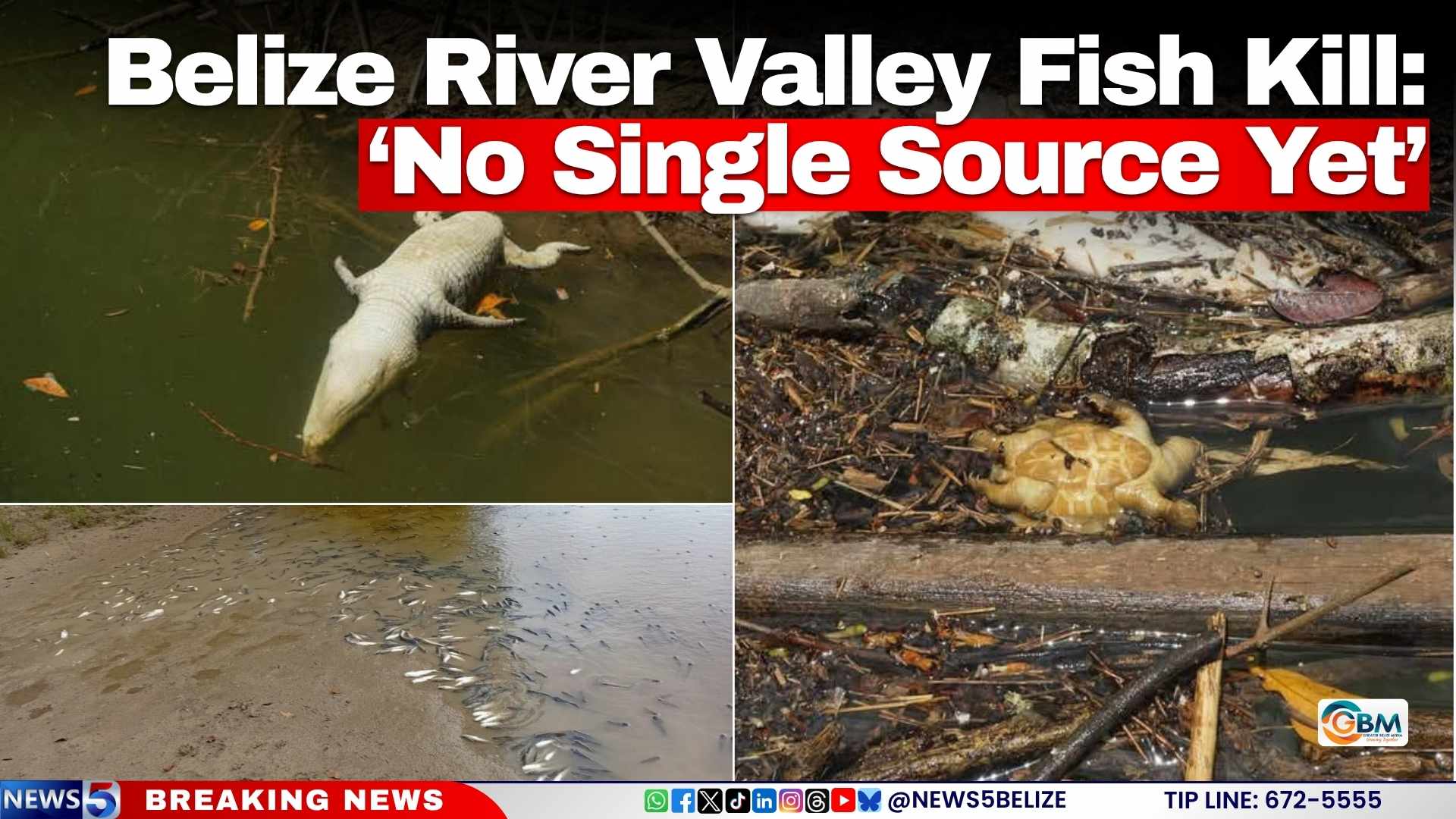
A weeks-long environmental crisis unfolding along the Belize River Valley has moved into its investigative phase, with Belize’s Department of the Environment (DOE) releasing key preliminary findings on Tuesday that shed light on what caused the widespread death of fish, turtles and crocodiles last week. According to top DOE officials, the confirmed root cause of the mass mortality event is hypoxia—dangerously low levels of dissolved oxygen in the water—driven by a combination of recent flooding and nutrient-heavy agricultural runoff into the river system.
Chief Environmental Officer Anthony Mai told reporters that post-mortem examinations led by marine biologist Dr. Abel Carias have already ruled out infectious disease as a cause. Key to that elimination is the fact that the die-off impacted multiple distinct species rather than being isolated to a single population, a pattern that would be expected if disease were the trigger. The low oxygen conditions, Mai explained, also account for the deaths of semi-aquatic species like turtles and crocodiles: when water becomes completely anoxic, it releases toxic hydrogen sulfide gas that accumulates at the water surface, where these animals surface to breathe.
Water quality sampling conducted across the affected stretch of the river pinpointed the most severely impacted zone: a segment running between St Paul’s Bank and Grace Bank, where dissolved oxygen levels dropped to the lowest recorded readings and fish mortality hit its peak. Elevated chlorophyll-A concentrations in these samples confirmed that nutrient runoff from surrounding agricultural lands sparked a harmful algal bloom, which in turn depletes oxygen as the algae grows and decomposes.
In the wake of the fish kill, public and regulatory attention quickly turned to Santander Sugar, a major local agricultural operation, after community members raised questions about whether drainage canals on the company’s property connect to tributaries that feed into the Belize River. However, the DOE emphasized Tuesday that no conclusive evidence has emerged to link the mass mortality event to Santander Sugar or any other single source of pollution.
Satellite imagery of the area does confirm that severe flooding inundated Santander Sugar’s farmlands and neighboring agricultural properties in the days immediately before the fish kill was reported. This widespread flooding pushed massive volumes of runoff water directly into the Belize River, carrying accumulated agricultural nutrients with it. “That large amount of water from this field went into the river and may have definitely contributed to the change in the aquatic ecosystem, the increased algae, the low dissolved oxygen, et cetera,” Mai noted.
So far, the investigation has found that Santander Sugar has cooperated completely with regulatory teams conducting the probe. Officials also confirmed that Santander Sugar is far from the only agricultural operation in the region with drainage canals connected to the affected river system, meaning multiple landowners could have contributed to the nutrient buildup that sparked the bloom.
To rule out additional contributing factors, Belize’s Pesticide Control Board has already completed an inspection of the agrochemicals used by Santander Sugar. Data from that inspection will be cross-referenced with results of chemical analysis and sediment sampling currently being carried out by Belizean environmental experts across the impacted river stretch.
Most full test results from the multi-agency probe are expected to be released by the end of this week. Mai highlighted that the investigation has already stood out as a major example of cross-institutional collaboration, bringing 15 separate local, national and academic agencies to the table. Partner organizations include the University of Belize, the Belize Agricultural Health Authority, and the national Fisheries Department, among others.
In the interim, research teams are continuing continuous water quality monitoring along the entire length of the river. Officials warn that contaminated water with low oxygen and residual toxins could impact residential communities located further downstream before it ultimately flows into the Caribbean Sea, making ongoing monitoring critical for protecting public and ecosystem health.