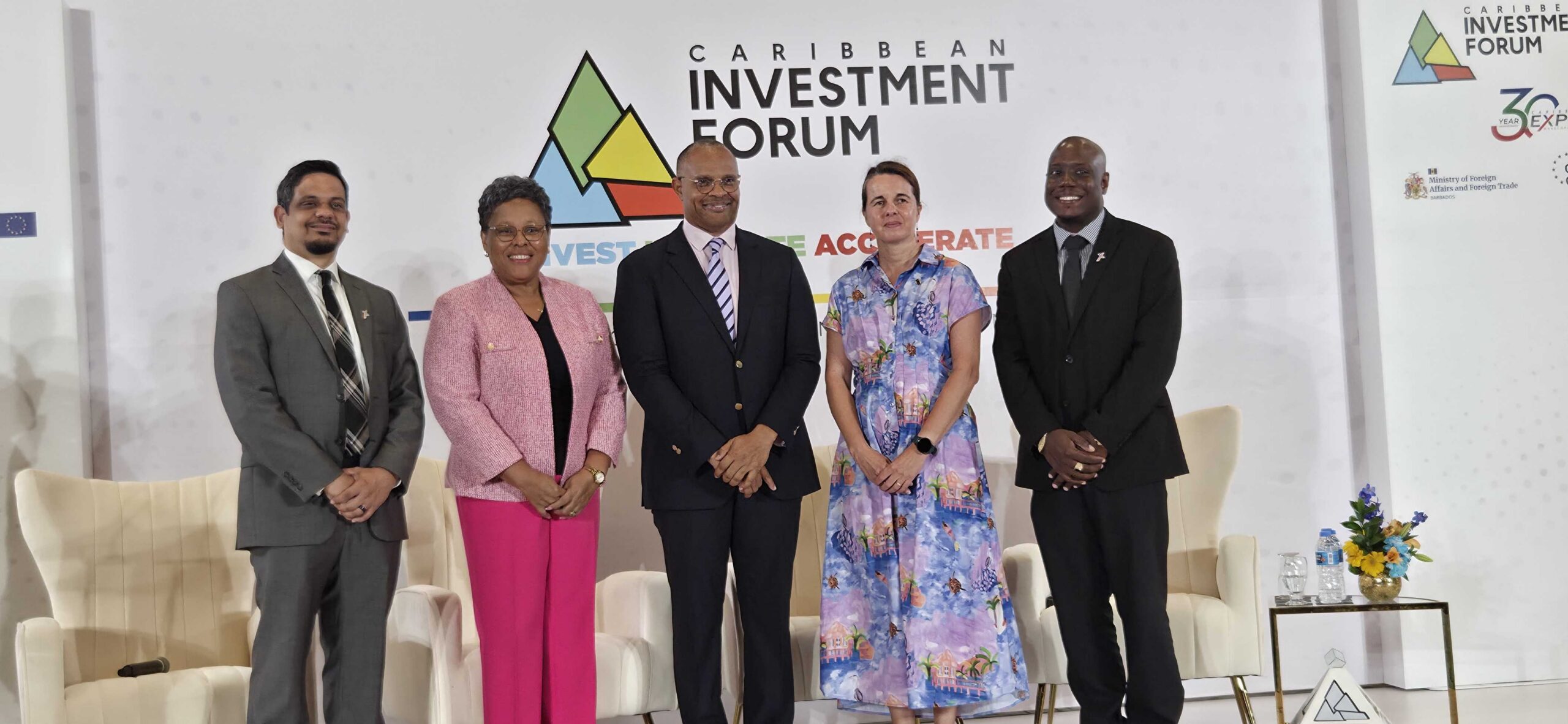
Against a backdrop of uneven global foreign direct investment (FDI) flows to developing economies, Barbados’ Senior Minister and Minister of Foreign Affairs and Foreign Trade Chris Sinckler has issued a bold call to international investors on Wednesday, challenging long-held misconceptions that frame the Caribbean as a fragmented collection of small, high-risk markets. Instead, he positioned the region as a cohesive, stable, and innovation-driven economic hub primed to deliver strong commercial returns across sectors aligned with pressing global priorities.
In his address to a gathering of diplomats, C-suite business leaders, and cross-sector global stakeholders, Sinckler pushed back against the pervasive narrative that Caribbean nations sit on the margins of the global economy, waiting for incremental scraps of development. “The truth is that nothing could be further from the truth,” he stated. “Our region is a stable, connected, and increasingly innovative geopolitical and economic space that offers commercially sound opportunities in sectors that are top global priorities.”
Key high-growth areas Sinckler highlighted include renewable energy, digital technology, modern logistics infrastructure, climate resilience infrastructure, and food security systems – all sectors that have seen rising global investor appetite amid efforts to decarbonize economies and strengthen global supply chains.
Central to Sinckler’s pitch is the upcoming high-level regional investment forum hosted by Barbados this October, themed “Invest, Innovate, and Accelerate.” The event is designed to connect global capital with regional opportunities, and build a unified regional investment strategy that can capture a larger share of global FDI.
Citing recent international trade data, Sinckler noted that total global FDI rose 6% to $1.6 trillion in 2025, but flows to developing countries – including Caribbean nations – grew by just 2% over the same period. This divergence, he explained, reflects a clear trend: global capital is increasingly selective, flowing only to jurisdictions that demonstrate preparedness, credibility, and the capacity to deliver on investment projects. “We must ensure our regional assets are positioned to secure a far larger proportion of that capital,” he emphasized.
To unlock this potential, Sinckler called for urgent systemic reforms across the region’s public and private sectors, targeting persistent administrative bottlenecks and outdated institutional rigidity that he described as one of the biggest constraints on regional investment growth. From customs clearance and port facilitation to tax policy, transportation, banking, and access to finance, he argued that inflexible operational procedures have held the region back from realizing its full investment potential. “We continue to shoot ourselves in the foot if we fail to harness and unleash the hidden capacity that exists in this region,” he said.
Sinckler also stressed that regional policymaking must shift toward a more empirical, data-driven model, leveraging emerging technologies such as artificial intelligence to deliver the transparency, speed, and regulatory stability that international investors require.
To back his argument, Sinckler pointed to Barbados’ own track record of successful structural reform, which has built sustained investor confidence. The country has logged 22 consecutive quarters of economic expansion, cut unemployment to 6.1%, and grown international reserves to $3.1 billion – enough to cover nearly 26 weeks of imports. The island nation has also delivered major public infrastructure investments to reduce trade frictions, including the recently completed $213.5 million Berth 6 project at Bridgetown Port, which is set to boost shipping and logistics capacity across the entire Caribbean.
Barbados has also advanced digital financial inclusion with the launch of BiMPay, its national instant payment platform. By integrating commercial banks and credit unions onto a single network, the system lowers transaction costs and speeds up cash flow for micro, small, and medium-sized enterprises – the backbone of the Caribbean’s domestic economy.
“Barbados is ready because we have done the heavy lifting in the past few years in rebuilding the foundations of our economy on which investment depends,” Sinckler said. “We have restored economic stability, modernised legislation, upgraded infrastructure, and fast-tracked cutting-edge digital technology.”
He also paid tribute to Dr Lynette Holder, outgoing chair of the Caribbean Export Development Agency, for her leadership in developing the regional forum into the Caribbean’s leading investment matchmaking platform. Dr Damie Sinanan, the agency’s executive director, and Ambassador Fiona Ramsey of the European Union Delegation to Barbados and the Eastern Caribbean also participated in the event.
Sinckler closed by urging global entrepreneurs and business leaders to take full advantage of the forum’s business-to-business matchmaking sessions, framing the gathering as a critical catalyst to turn innovative ideas into tangible, revenue-generating projects. “Our investment proposition must include not only what can be built in the Caribbean, but the assets that Caribbean people can use to build things for the world,” he said. “Barbados is open for business. We welcome investors to come, innovate with us, grow with us, and build a prosperous future together.”