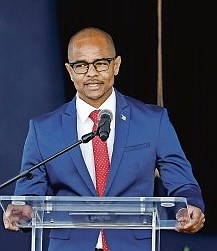
In back-to-back addresses this week, two senior Bahamian government officials have sounded the alarm over growing risks of external technological control, framing the pursuit of digital sovereignty as the next critical phase of the nation’s independence project.
Speaking to the Rotary Club of Southeast Nassau, Innovation and National Development Minister Sebastian Bastian laid out a sweeping framework for why the Caribbean nation must reevaluate its relationship with foreign technology providers. Political independence, gained by The Bahamas in 1973, is no longer enough to guarantee full control over national affairs, he argued, as all sectors of public and private life become increasingly reliant on foreign-owned digital infrastructure, cloud services and algorithms.
“The next form of colonialism may not arrive with soldiers,” Bastian said in his address titled “The Power of Sovereignty.” Instead, he warned, it emerges through un-auditable systems, unchallengeable algorithms, one-sided exit clauses, and essential services that nations can use but never control. “Digital colonialism begins wherever convenience becomes dependency.”
Bastian emphasized that his call for greater national control is not a rejection of foreign investment, international partnerships, or a push for full state ownership of every digital asset. Instead, he outlined a balanced approach: “open, but not exposed; connected, but not captured; partnered, but never powerless.”
The minister highlighted submarine telecommunications cables as one of the most critical pieces of national infrastructure, noting that roughly 99 percent of global internet traffic traverses these cables, carrying everything from banking transactions and government communications to healthcare and education data. For an archipelagic nation like The Bahamas, control over cable routes, landing points, capacity, maintenance and emergency recovery is core to national resilience, he said, stressing that “No single failure should isolate our people or paralyse our economy.”
The same logic applies to data centres and cloud infrastructure, which now underpin nearly every core government function, from civil registration and customs to taxation, social assistance, health records and emergency response. Bastian argued that governments must retain the ability to audit critical systems, access their own data, migrate services if a provider changes contract terms, recover from cyberattacks, and exit agreements when necessary. “If someone else can switch off the systems that run your country, you have digitised dependence — not development,” he said.
Turning to public procurement, Bastian said governments must never purchase “black box” technology that they cannot audit, secure, operate or leave. Contracts for critical systems must mandate open standards, data portability, strong cybersecurity protections, service continuity, full audit rights, clear exit provisions, secure off-site backups, and structured knowledge transfer to local teams. “This is not technical housekeeping,” he said. “This is statecraft.”
Bastian extended his warning to the private sector, noting that hotels are heavily reliant on foreign booking platforms, retailers depend on external payment processors, creators are tied to large social networks, and many small businesses store all their sensitive data on a single foreign cloud service. While these tools create major economic opportunities, they also concentrate power in the hands of external entities, leaving local businesses vulnerable when algorithms are adjusted, fees rise, or accounts are suspended. “A business that needs an algorithm’s permission to reach its own customers does not fully own its market,” he said.
To counter these risks, Bastian called on private businesses to maintain direct customer relationships, protect their intellectual property, retain independent copies of all their data, strengthen cybersecurity defenses, and diversify sales and payment channels. He also advocated for greater support for domestic Bahamian technology firms, including improved access to capital, intellectual property protection, and opportunities to enter global markets.
A core pillar of Bastian’s vision is building local technical expertise. The minister stressed that even if The Bahamas continues to partner with global technology firms, purchasing off-the-shelf systems will never eliminate dependence if local Bahamians lack the skills to operate, repair, adapt and secure that technology. “A nation cannot outsource what it never learned to do,” he said.
Capacity building must be written into technology contracts from the start, Bastian argued, with major digital projects required to create apprenticeships, professional certifications, trained public sector staff, experienced local engineers, vendor-neutral technical documentation, and opportunities for local firms. He called for a national skills pipeline that stretches from primary schools through technical training, university and full employment, reaching all parts of the country including New Providence, Grand Bahama and the smaller Family Islands. The nation needs a new generation of local software developers, cybersecurity professionals, data scientists, cloud architects, network engineers, AI specialists and technology-literate public leaders to govern digital systems, he said.
Bastian also urged the nation to develop homegrown technology solutions tailored to the unique challenges Bahamians face, including inter-island logistics, hurricane preparedness, marine protection, financial services, tourism, public health, food security, digital government and the creative economy. Ultimately, he said, Bahamian technology should serve the broader Caribbean market, local cybersecurity firms should compete for international clients, and local creators should retain full ownership of their digital content. “We must not generate the data while someone else captures all the value,” he said. “The Bahamas must not simply log into the future. We must help code it.”
Framing the push for digital sovereignty as the natural continuation of the 1973 independence movement, Bastian said responsibility for achieving this goal extends far beyond the national government, to telecom providers, banks, educational institutions, private tech firms, regulators, investors, entrepreneurs, parents and ordinary citizens. He called on every business to audit its resilience in the event of a major digital platform failure, every government ministry to map who controls its systems and confirm local capacity to operate and develop them, and every school to assess whether it is merely teaching students to use technology, or equipping them to build it. “The generation of 1973 secured the right to govern our land,” he said. “Our generation must secure the right to govern our digital future.”
Shortly after Bastian’s address, Economic Affairs Minister Senator Jerome Fitzgerald echoed the warning during a speech at the CANTO conference, noting that the entire Caribbean faces the risk of a new era of digital colonialism unless regional governments take coordinated action to take greater control of data, technology infrastructure and artificial intelligence. Fitzgerald warned that Caribbean nations are increasingly dependent on foreign-owned digital systems, with all the valuable data, profits and decision-making power remaining outside the region. “The Caribbean is entering the digital age through an architecture that risks reproducing the central logic of the colonial age,” he said, describing the current dynamic as “extraction without ownership, participation without power, and dependence presented as development.”
Fitzgerald called for the creation of a Caribbean Digital Sovereignty Compact that would establish unified regional standards for data centres, cybersecurity, cloud service contracts and disaster recovery. He also proposed building shared regional cloud and cybersecurity capabilities, and requiring all technology contracts to include open standards, independent audit rights, Caribbean-controlled encryption and mandatory knowledge transfer. He noted that the upcoming World Telecommunication and ICT Policy Forum, scheduled to be held in New Providence from September 1 to 4, will give Caribbean governments and regulators a key opportunity to align on a unified, coordinated position on digital sovereignty.