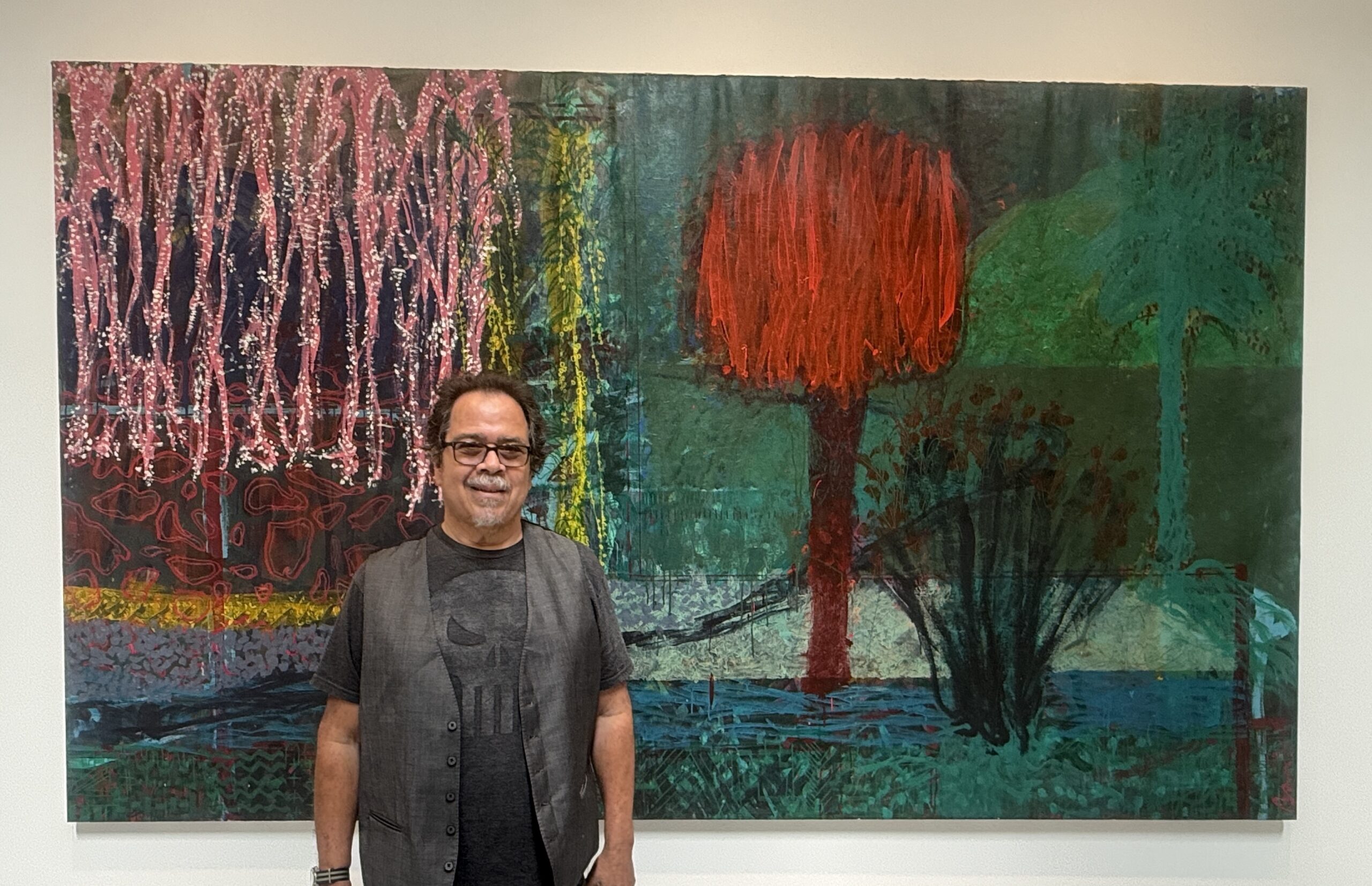
For the ninth consecutive time, Grenada is showcasing Caribbean art to a global audience at the Venice Biennale, one of the world’s most prestigious international contemporary art events. Hosting a national pavilion at the iconic exhibition has opened invaluable doors for Grenada’s artistic community, forging lasting connections with curators, critics, and creators from across the globe that expand the international reach of Caribbean art.
This year’s pavilion, curated by Daniele Radini Tedeschi for the 2026 edition, marks a milestone for Grenada, cementing its position as the most consistent Caribbean participant in the history of the Biennale. Expanding its regional scope, the 2026 pavilion includes work by Trinidadian artist Edward Bowen, whose standout piece *A Walk in the Park with Doctor Bob* offers a deeply intimate exploration of the concept of Baudelairean correspondences, the idea that all elements of nature and human experience are interconnected through overlapping symbols and senses.
Bowen’s painting draws its inspiration from four years of regular walks through the botanical gardens of Port of Spain, Trinidad, shared with a close friend. Rather than creating a static, literal depiction of the garden landscape, Bowen sets out to capture the cumulative experience of these walks: condensing dozens of casual outings into a single reimagined image that follows the fluid, unstructured logic of involuntary memory, much like the narrative style of Marcel Proust’s work. Lived experience blends seamlessly with artistic imagination, as the canvas becomes a landscape shaped by memory rather than physical geography.
The artist’s visual language amplifies this focus on memory over strict realism. While underlying linework lays out the basic structure of the garden scene, expressive brushwork and bold, saturated color work loosen this framework, letting gesture and hue become the primary conveyors of meaning. Vibrant crimson, glowing pink, luminous blue, and deep forest green reject the conventions of descriptive naturalism: a deep red tree anchors the composition like a sacred totem, cascades of pink foliage blur the line between living vegetation and ghostly apparition, and a thick band of blue hints at water without creating a clear illusion of depth. Though recognizable landscape elements — trees, meadow, water, sky — remain, their physical coherence gives way to an emotional logic, where color does not describe the natural world, but remembers it.
This liberation of color from purely descriptive function opens the work to deeper interpretation, aligning it with the sensibility of magical realism. Here, magical realism is not defined by the intrusion of the supernatural into everyday life, but by a mode of perception that reveals the extraordinary already latent within ordinary experience. Nature is no longer a passive backdrop for human activity, but an active, animistic participant in the walker’s journey, lending the shared routine of a walk a quiet spiritual dimension. This echoes the layered meaning of Caribbean landscapes found in the work of iconic regional writers including George Lamming, Jean Rhys, and Derek Walcott, where physical place is always also a site of spiritual and emotional resonance.
Ultimately, Bowen’s work directly echoes Charles Baudelaire’s foundational poem *Correspondences* from *The Flowers of Evil*, which frames nature as a temple where symbols and senses intersect to create a vast, interconnected web of meaning. The painting invites viewers to enter this web, uncovering the visible and invisible bonds that connect people to each other, to their memories, to nature, and to their own emotions.
The critical analysis of Bowen’s work comes from Valentina Minniti, an emerging Italian art critic and curator who connected with the Grenada Pavilion through the global networks forged at the Biennale. Minniti brings a diverse academic background spanning modern literature, literary criticism, communication, and fine arts; she previously served as a lecturer in English for Arts and Communication at the Academy of Fine Arts in Reggio Calabria from 2022 to 2024, and currently collaborates with Start Group Srl to promote international artistic talent. Her critical practice centers on close observation of artworks as physical objects, examining technique, material, and visual language to uncover layered symbolic, art historical, and psychological meaning. Her contribution to the Grenada Pavilion’s programming strengthens the project’s global reach, building another critical link in the expanding network of international influence for Grenadian and Caribbean art.
The Grenada Pavilion opened to visitors in May 2026 and will remain on view through November 22, giving art audiences from across Europe and the globe months of access to the Caribbean showcase in the heart of Venice.