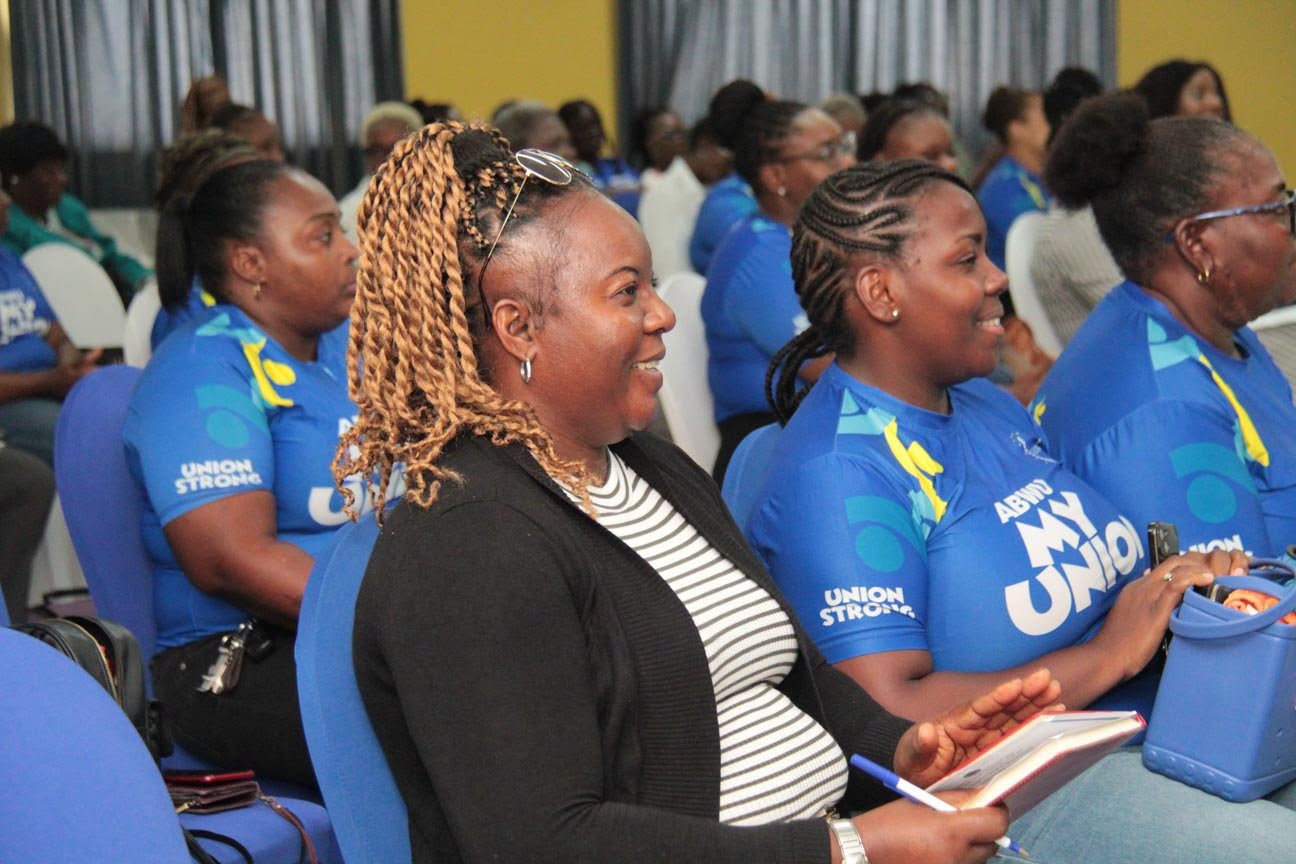
The annual Antigua and Barbuda Workers’ Union (ABWU) Women’s Conference, which centered its 2025 discussions on the critical dual themes of women’s empowerment and mental health, has wrapped up with a landmark resolution to expand and strengthen protections for female workers across the nation. Drawing nearly 100 female delegates from dozens of workplaces spanning Antigua and Barbuda’s diverse industries, the three-day gathering created a collaborative space for participants to unpack their on-the-job experiences, exchange actionable strategies, and build collective momentum to improve well-being both at work and in their personal lives.
The newly adopted resolution outlines four clear, high-priority focus areas that will guide the ABWU Women’s Council’s advocacy work over the coming year, pushing for tangible, equitable, and enforceable workplace reforms tailored to women’s unique needs. First, the union will advocate for infrastructure upgrades that meet gender-specific needs, ensuring all workspaces are safe, accessible, and responsive to women’s requirements. Second, it will push to expand access to comprehensive health supports, including preventive care, reproductive health services, and reasonable workplace accommodations for menstrual health needs. Third, the resolution enshrines mental health as a non-negotiable component of overall workplace wellness, requiring employers to prioritize accessible mental health resources for female staff. Finally, the union will ramp up its advocacy to close persistent gender pay gaps and deliver fair, equitable compensation for all women workers.
Beyond passing the resolution, the conference featured interactive deep dives into three underdiscussed issues that disproportionately impact working women: mental load, unpaid invisible labor, and occupational burnout. Clinical psychologist Jo-Nelle Walsh led the session, explaining that centuries of rigid traditional gender roles have left the vast majority of women overwhelmed by unbalanced expectations that stack professional duties alongside unpaid domestic and care work. She urged attendees to set intentional, healthy boundaries around their time and energy, emphasizing that prioritizing personal well-being is not a selfish act. “It is okay to say no—and to say no without feeling guilty,” Walsh told the engaged audience.
Human resource consultant and popular columnist Calisha Spencer echoed that call to action, encouraging participants to claim greater agency over their personal and professional trajectories. “Own your choices and take charge of the direction of your own life,” Spencer advised the gathered delegates. Additional thought-provoking sessions were delivered by Senator Malaka Parker and former ABWU executive member Andre’ Sharpe, who shared practical tools and frameworks to help women build long-term economic and personal empowerment.
Reflecting on the conference’s growing impact, Women’s Council Chair Hazel Luke noted that the annual event has built steadily increasing momentum over the past three years, with participation and engagement rising each session. “We are deeply encouraged by the feedback we receive each year,” Luke said. “Our women are truly benefiting, not just from the sessions themselves but also from the progress we’re making turning our resolutions into tangible changes through collective bargaining agreements.”
Women’s Council Secretary Imani Meade highlighted a recent, concrete win that proves the conference’s work drives meaningful, lasting change for female workers. Earlier this year, the Antigua and Barbuda Labour Department certified the union’s first collective bargaining agreement that includes explicit provisions addressing the so-called 3Ms: menstruation, maternity, and menopause, as well as andropause. Those groundbreaking provisions originated directly from a resolution adopted at the 2024 ABWU Women’s Conference, and the union is now pushing to include similar language in other ongoing collective bargaining negotiations across multiple sectors.
Attendees left the conference with overwhelmingly positive impressions, with many highlighting the value of connection and collective action. “Women really need to stick together. I’m very happy that I came to this conference,” one long-time participant shared. Another attendee, who has joined the conference’s workshops for two consecutive years, added: “They have been inspiring, and I thoroughly enjoy them.”
Today, the ABWU Women’s Conference stands as one of the union’s most impact core initiatives, underscoring the organization’s unwavering commitment to advancing gender equity, empowering working women, and driving progress that improves lives both in the workplace and across Antigua and Barbuda’s broader society.