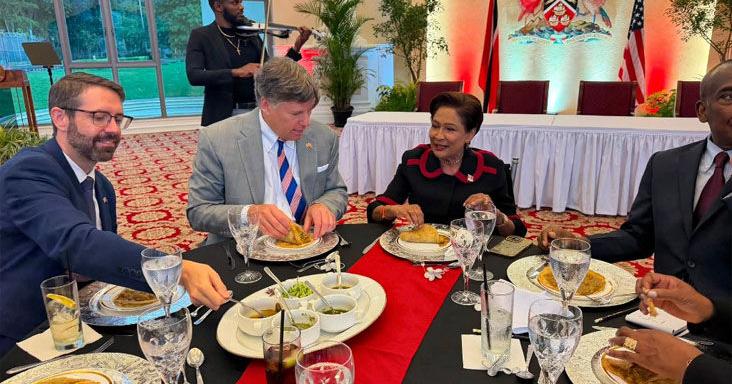
In a major announcement delivered during the official visit of U.S. Deputy Secretary of State Christopher Landau at St Ann’s Diplomatic Centre, Trinidad and Tobago Prime Minister Kamla Persad-Bissessar unveiled two landmark energy deals that mark a turning point for the nation’s industrial and energy future.
The first and most significant of these agreements sees global energy giant BP agree to transfer a 20% stake in the Trinidadian portion of the cross-border Cocuina-Manakin natural gas field to Trinidad and Tobago’s state-owned National Gas Company (NGC). Spanning the maritime border between Trinidad and Tobago and Venezuela, the field is split between Manakin, located in Trinidad’s Block 5, and Cocuina, which sits in Venezuela’s Plataforma Deltana Block 4. Negotiations over the coordinated development of the field stretch back more than a decade, rooted in a 2015 bilateral agreement between the two governments that unitized the field, allocating 66% of reserves to the Manakin side and 34% to Cocuina. This makes the project the first fully agreed unitized cross-border gas development in the Western Hemisphere.
Under the existing production sharing contract for Block 5, BP’s local affiliate Amoco Trinidad Gas BV has served as the primary operator. Persad-Bissessar outlined that years of stalled negotiations gained new momentum in 2024: the U.S. Office of Foreign Assets Control (OFAC) granted a negotiation license to BP and NGC in May of that year, followed by Venezuela’s issuance of a 20-year license in July 2024 that formalized a 20% stake for NGC and 80% stake for BP across the entire cross-border project. Negotiations were left unfinished when a change of government occurred in April 2025, but were finalized within 16 months of Persad-Bissessar’s administration returning to office.
Persad-Bissessar emphasized that the new ownership structure, which aligns NGC’s stake across both the Trinidadian and Venezuelan portions of the field, removes the last major barrier to progress. “These agreements align NGC across the field, remove a major obstacle and allow BP to accelerate its final investment decision, completing in a little over one year what remained undone for more than ten years,” the Prime Minister stated. She added that the project is set to become the first successful cross-border development to monetize natural gas through Trinidad and Tobago’s existing energy infrastructure.
Alongside the Cocuina-Manakin deal, the Prime Minister announced that BP has completed the acquisition of all of Woodside Energy’s shareholding in the deep-water Calypso gas field. First awarded to BHP Billiton during the 2012–2014 bid rounds under Persad-Bissessar’s first administration, Calypso is one of the country’s most promising untapped domestic gas sources, spanning Blocks TTDAA 14 and 23(a). After returning to office in April 2025, Persad-Bissessar’s government brought all parties to the table to resolve the impasse that left the project undeveloped, with the acquisition finalized on August 6, 2026. The full ownership consolidation will speed up project sanctioning, cut operational costs, maximize use of existing NGC infrastructure, and unlock necessary fiscal support from the Ministry of Energy, bringing much new gas supply to the country, the Prime Minister said.
These developments come on the heels of other growing international interest in Trinidad and Tobago’s offshore energy sector. Persad-Bissessar highlighted that ExxonMobil, which exited local exploration in 2003 after a period of unsuccessful activity more than two decades ago, has recently returned and signed a new exploration agreement. The company’s endorsement of the upcoming deep-water exploration bid round, paired with BP’s two new deals, signals a resurgence of global investor confidence in the nation’s offshore energy potential, the Prime Minister noted.
Independent reporting from Reuters confirms that the Cocuina-Manakin field holds an estimated one trillion cubic feet of proven natural gas reserves. NGC already holds a 20% stake in the Venezuelan Cocuina portion of the field, aligning with its new stake on the Trinidadian side. Under current marketing plans, 70% of the field’s output will be supplied to Atlantic LNG, home to Latin America’s largest liquefied natural gas export terminal. The facility has faced significant operational strain in recent years as declining domestic gas production from Trinidadian fields cut into its output, forcing the idling of one of its four processing trains. BP holds a 45% stake in Atlantic LNG, with NGC owning 10% and Shell holding the remaining 45%. The remaining 30% of Cocuina-Manakin output will be allocated to domestic petrochemical production. Industry sources quoted by Reuters expect a final investment decision on the project to be reached by the end of this year. Venezuela’s oil ministry had not responded to requests for comment as of yesterday’s reporting.
During the announcement, Persad-Bissessar also publicly thanked U.S. President Donald Trump for his administration’s support, noting that the deepening bilateral partnership between the two countries has translated into tangible development opportunities for both nations and the wider Caribbean region. Landau’s visit, she added, advanced three key bilateral development initiatives: the proposed Curlew Midstream fuel storage and bunkering terminal, Pinnacle Steel and Vanadium Corporation’s restoration of the shuttered former ISCOTT steel plant, and the BP-NGC Cocuina-Manakin agreements. New MOUs signed yesterday with Pinnacle Steel and Hummingbird AI Holdings also reinforce Trinidad and Tobago’s goal of becoming a regional hub for technology-driven investment, she said. “We are restoring Point Lisas as an engine of growth. Pinnacle’s acquisition and proposed upgrade of the former ISCOTT plant for steel and vanadium production can and will restore capacity, create jobs and benefit local contractors and manufacturers, while signalling confidence in our steel sector,” Persad-Bissessar said.
The Prime Minister closed by reaffirming her government’s commitment to working alongside BP, NGC, and all industry stakeholders to speed up final investment decisions and bring both new projects into production as quickly as possible to support long-term industrial growth in Trinidad and Tobago.