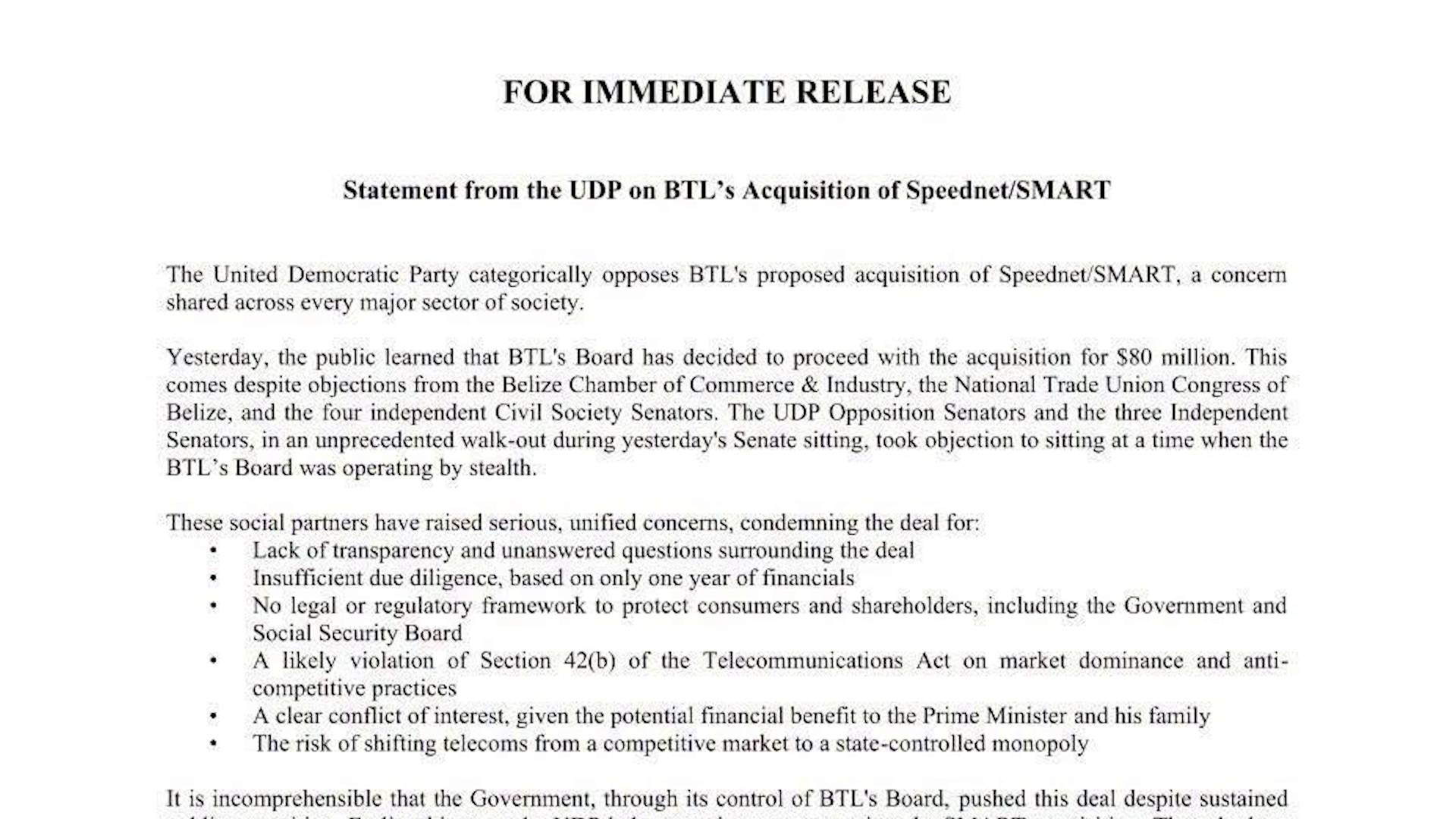
In a formal stance released on August 6, 2026, Belize’s United Democratic Party (UDP) has doubled down on its opposition to the proposed acquisition of Speednet by national telecommunications firm BTL, warning that pushing the deal through without addressing critical open questions would be a reckless move that ignores the interests of the Belizean public.
UDP leader Tracy Panton confirmed that the party’s opposition has remained consistent since the acquisition was first proposed, a position the party has already cemented through two public demonstrations organized to rally public awareness around the issue. Panton emphasized that BTL is ultimately a public asset, tied directly to the investments of every Belizean taxpayer and contributors to the country’s Social Security Board. Given that public stake, Panton argues, the government has no right to rush a major industry-altering deal without full transparency and direct consultation with the Belizean people.
“We can’t have a rogue government making decisions for the Belizean people without consultation with the Belizean people,” Panton said in an interview, reiterating the party’s core objection. “The information the public has requested is reasonable and at the very minimum should be provided before any deal proceeds.”
When asked about comments from the Belize Chamber of Commerce and Industry (BCCI) president that the government is already prioritizing the deal before regulatory review and could use legal maneuvers to bypass the Public Utilities Commission (PUC), Panton expressed agreement with the chamber’s concerns. She noted that the current administration has a well-documented pattern of pushing forward with its own agenda regardless of input from civil society, social partners, or the general public. Over time, Panton added, this consistent disregard for public input has left many Belizeans jaded and skeptical of the government’s process.
Beyond the lack of transparency and public consultation, the UDP’s official statement also flags two additional major red flags: an unaddressed conflict of interest at the heart of the deal, and the significant risk that the acquisition would consolidate the entire Belizean telecom market into a single monopoly, eliminating existing competition and putting consumers at risk of higher prices and reduced service quality. The party insists that none of these critical concerns have been adequately addressed, and the deal cannot move forward until full financial, legal, and public-interest assessments have been completed and shared publicly.
This report is a transcript of an evening television newscast, with all Creole-language statements transcribed using a standardized spelling system for accessibility.