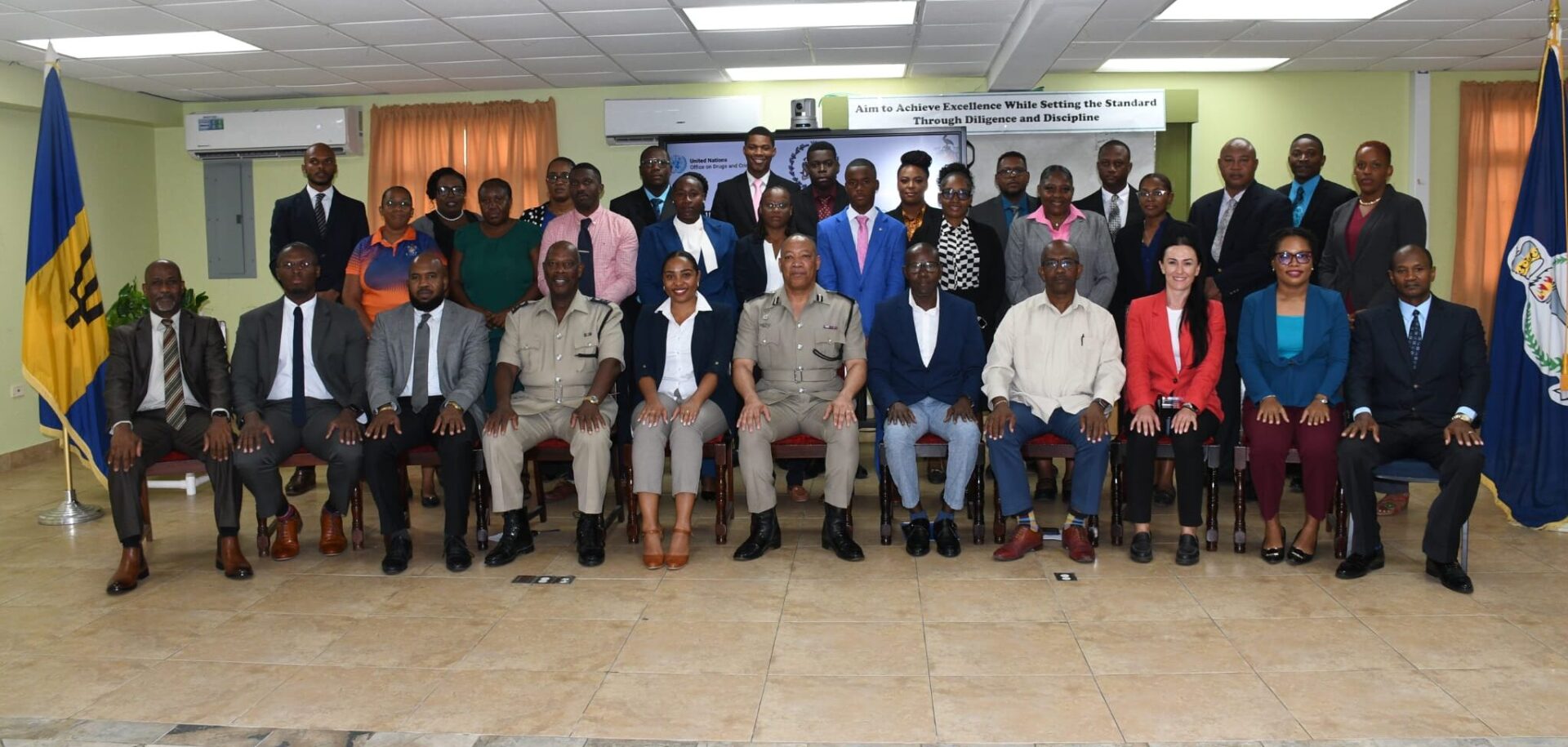
In a landmark collaborative effort between higher education and law enforcement, 19 members of the Barbados Police Service (TBPS) have made history as the first graduates of a formal Crime Scene Investigators Workshop, developed through a new partnership between The University of the West Indies (UWI) Global Campus and TBPS. Held at the Regional Police Training Centre (RPTC), the foundational Basic Crime Scene Investigation and Management course was co-delivered by TBPS’s Forensic Scenes of Crime Unit, with additional support from the United Nations Office on Drugs and Crime (UNODC).
The intensive training programme combined theoretical classroom instruction with hands-on practical skill-building across a full spectrum of core forensic and investigative domains. Trainees covered critical topics ranging from fundamental crime scene management, proper evidence preservation and documentation, and targeted evidence collection to collision reconstruction, fingerprint development, DNA and biological evidence handling, forensic photography, electronic evidence processing, basic ballistics, and effective courtroom evidence presentation. The graduation ceremony, held on July 17, marked a key turning point for professional policing training in the country.
Speaking at the ceremony, TBPS Deputy Commissioner of Police Adrian Broomes framed the milestone as a transformative shift for law enforcement in Barbados. While this training represented the third iteration of crime scene investigation courses for TBPS, it is the first to be delivered through a formal partnership with a leading regional academic institution. Broomes emphasized that the collaboration underscores TBPS’s ongoing commitment to equipping investigators to meet the evolving, complex demands of modern policing. “By aligning ourselves with The UWI Global Campus, we affirm that policing is not simply a vocation. It is a profession grounded in knowledge, ethics and continuous development,” he noted.
Ryan H. Byer, Head of Site for UWI Global Campus Barbados, echoed this sentiment, explaining that the partnership advances multiple institutional and national priorities. The initiative represents a critical step forward in formalizing accreditation for professional training delivered through the RPTC, while also advancing UWI Global Campus’s core “Triple A” Strategic Plan focused on expanding access to education, aligning programming with regional needs, and maintaining agility in addressing emerging challenges. Byer added that the programme embodies the university’s mission to deliver responsive education that meets the needs of both Barbados and the wider Caribbean region. He also recognized the RPTC leadership team, including Commandant Rodney Archer, Deputy Commandant Lawrence Collymore, and course coordinator Sergeant Mauricio Chase, for their work in executing the programme successfully.
Looking ahead, Byer urged TBPS to expand the collaborative framework by developing additional professional development pathways through UWI Global Campus, including fully online certificate programmes in high-priority fields such as Community-Based Policing, Criminology, Counselling, Supervisory Management, and Psychology.
For the graduates, the training delivered tangible improvements to their professional capacity. Multiple graduates reported increased confidence in their work and strengthened ability to manage crime scenes in line with globally recognized professional standards. Sergeant Roz’ Marie Ward-Waterman, a returning UWI student who earned the Best Overall Student award, noted that the formal academic partnership adds significant professional value to TBPS as an institution. “This… will not only add value and a core of professionalism to the Barbados Police Service through each participant of the Basic Crime Scene Investigation and Management Course, but it is the foundation that will usher The Barbados Police Service into a more knowledge driven atmosphere,” she said.
Organizers of the initiative emphasized that the cross-sector partnership reflects a shared commitment to raising national investigative standards, expanding access to accredited professional education for law enforcement, and ensuring frontline officers hold the formal qualifications, technical knowledge, and practical skills needed to preserve critical evidence effectively and uphold fair administration of justice in Barbados.