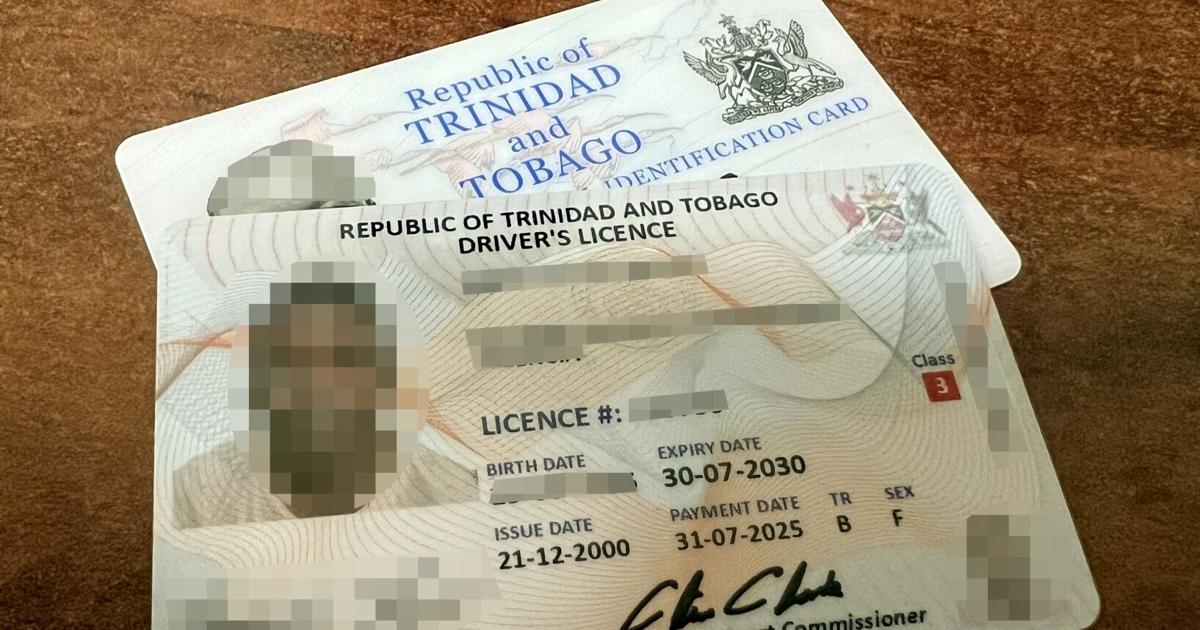
Trinidad and Tobago’s Minister of Homeland Security Roger Alexander has publicly confirmed that the current national administration is moving forward with plans to introduce new legislation that would mandate every individual aged 16 and older, including both citizens and foreign visitors, to carry a valid form of government-issued photo identification at all times when in public spaces.
The confirmation follows the leak of a confidential Cabinet Minute dated April 2, 2026, which circulated widely across social media platforms one day prior. The document outlined the proposed legislative amendments and has since been verified as authentic by Alexander during an exclusive telephone interview with local media outlet the Express. Following the Cabinet’s initial review, the proposal has been referred to the Finance and General Purposes Committee for further scrutiny and budgetary assessment.
When pressed on whether failure to produce ID upon request from law enforcement officials would be classified as a criminal offense, Alexander noted that final details of the policy are still being finalized. He did, however, confirm that a grace period will be built into the framework to allow individuals to retrieve or present their documentation after a request, and expressed his personal support for financial fines or other administrative penalties for repeated non-compliance.
Framing the policy as a critical tool to address longstanding challenges facing the Trinidad and Tobago Police Service, Alexander pointed to repeated difficulties officers face when serving arrest warrants. He shared a common scenario: police arrive at a location to arrest a suspect named John Brown, only for the individual to claim they are Harry James and have no connection to the warrant, with no easy way for officers to verify their identity on site. Beyond law enforcement, he added that mandatory ID will streamline legitimate business transactions and formal employment background checks, noting that similar requirements are already standard practice across most of the world. The policy, he argued, will also foster a stronger sense of national belonging among young people entering adulthood, and make it far easier for authorities to separate criminal actors from law-abiding residents.
To ensure broad access to national identification cards, Alexander explained that the government will coordinate closely with the Elections and Boundaries Commission (EBC) and multiple government ministries. For teenagers aged 16 and older still enrolled in school, the EBC will deploy mobile registration teams directly to campus, allowing students to complete the process and receive their ID before graduating, eliminating barriers for young people who may struggle to travel to official registration offices.
The proposal has already drawn criticism from the opposition People’s National Movement (PNM), a reaction Alexander said he fully expected. He accused the PNM of a long-standing pattern of obstructing every government initiative designed to address the country’s ongoing crime crisis, calling their opposition hypocritical. “These same critics travel to other countries, follow local laws and readily present their passports or ID when requested by authorities, but here in Trinidad and Tobago, they seem content to allow lawlessness to continue and undermine the rule of law,” he said. “They are stuck in the 1970s, with their heads conveniently buried in the sand. The public has a right to ask why the PNM opposes every single policy this government introduces to make life harder for criminals.”
Alexander also criticized the previous PNM administration for lax identification protocols, saying the former government allowed individuals to register residency in the country without requiring valid proof of identity from their country of birth. He gave an example of one individual who successfully registered twice under two different names — Josh Hernandez and an alternate alias — due to gaps in the old system. He emphasized that mandatory public ID aligns with long-held international standards, pointing out that Trinidad and Tobago citizens are required to present complete, verified documentation and valid visas when traveling abroad, and that photo ID is already required to open basic bank accounts in the country.
When asked about a timeline for rolling out the new policy, Alexander said implementation will move forward as soon as the Prime Minister gives official approval. Beyond the ID mandate, he also shared updates on other core government public safety initiatives: 30 joint army-police security outposts are set to begin deployment across the country within the coming days, as part of ongoing efforts to clean up what he described as systemic mismanagement left by the previous PNM administration. He also confirmed that he has held talks with the Commissioner of Prisons about relocating the Port of Spain Prison out of the capital city, a long-term priority for the current administration to remove the correctional facility from the heart of the capital’s commercial and residential district. In additional policy news, Alexander added that the government will also introduce legislation to raise the legal age for alcohol and marijuana consumption, framing all of these new policies as interconnected measures to support young people and help them build healthy, law-abiding lives.