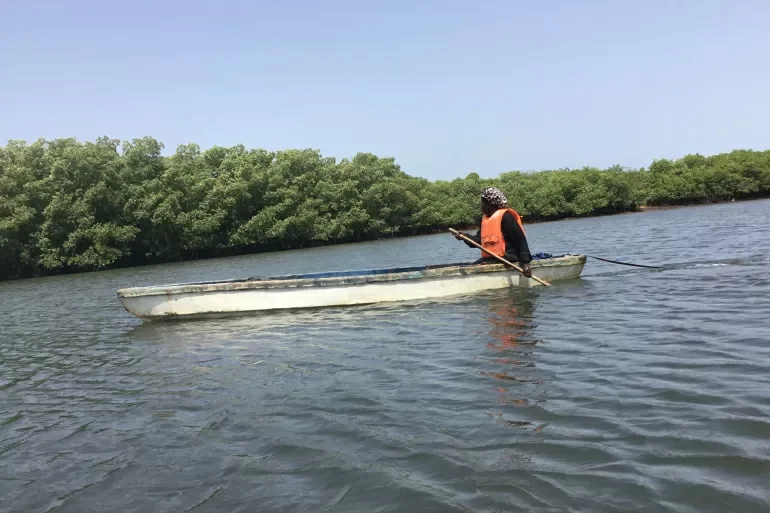
Before the midday sun scorches Gambia’s Atlantic coast, 34-year-old Fatou Jarjue waits for the tide to pull back from the Tanbi Wetlands. Pulling on thick gloves and sturdy socks, she pushes her hand-carved wooden canoe through narrow channels tangled with the sprawling, exposed roots of mangrove trees. Today, the empty pans stowed in her vessel are not meant for oysters—they will hold crabs that burrow in the wet mud beneath the water’s surface, as oyster harvesting is closed for the annual rainy season.
For Jarjue, a mother of one, life is inextricably tied to this vast coastal wetland. Salt-tolerant mangroves, which naturally anchor shorelines and buffer communities from erosion and storm surge, have provided for her family for generations: the trees host oysters, crabs, and fish that feed her household and generate her income, while their dense root systems act as a natural sea wall for her coastal community. On most days, her brother Musa follows in a smaller canoe to keep watch as she paddles deeper into the mangrove forest; on other days, she navigates the muddy waterways alone.
For generations, women in communities surrounding Tanbi Wetland have drawn their livelihood from these waters, and Jarjue continues that tradition. But unlike her predecessors, she has dedicated a large portion of her time to restoring the ecosystem that sustains her people. Just over one year since she began her restoration work, Jarjue says she has planted and restored more than 5,000 mangrove trees, reviving critical habitat that protects both the coast and the local fishing economy.
Raised in Ndangan, a small settlement of 300 people just two kilometers from Banjul, Gambia’s capital, Jarjue learned the rhythm of the wetlands from childhood. At 12 years old, she followed her mother into the mangroves, mastering the skills of oyster foraging, crab trapping, and fishing. For her, the forest was both a classroom and a lifeline. But over the years, she watched the ecosystem change: rising sea levels, accelerating coastal erosion, and shifting weather patterns have steadily eroded the mangrove cover that the entire community depends on. Rather than only harvest from the wetland, she chose to give back, launching her personal restoration effort.
Today, every trip into the mangroves combines harvesting with conservation work: she inspects young saplings, replaces damaged seedlings, and maps areas that need additional restoration. “Mangroves are part of our lives,” she explains. For Jarjue, environmental conservation and community survival are one and the same: the healthier the mangroves grow, the more secure the future for her family and neighbors.
As she paddles through the channels, Jarjue passes fully grown oysters clinging to mangrove roots, waiting for the next harvesting season to open. She leaves them undisturbed, proud to protect the stock that will support her community later in the year. While crabbing provides steady income during the rains, oysters remain the most profitable catch for local women: a standard milk can of oysters sells for roughly 100 Gambian dalasi (about $1.34), and demand at local markets consistently outpaces supply. “Oysters are hard work to harvest,” Jarjue says. “But that’s where the income is.”
Many people mistakenly believe the annual rainy season closure of oyster harvesting is rooted in fears that oysters become toxic during this period. But marine scientist Dawda Saine explains the policy is a deliberate conservation measure tied to ecology and food safety. The closure is part of Gambia’s national Oyster and Cockle Co-management Plan, designed to give oyster populations time to reproduce, grow, and replenish their numbers while reducing pressure on the wetland ecosystem.
“We don’t close the season because oysters are toxic,” Saine told Al Jazeera. “We close it to protect the resource. During the rains, increased runoff flushes more sediment and contaminants into the water, and oysters filter everything in the water they inhabit—this can impact their quality, taste, and safety.” By leaving oysters undisturbed during this period, both the ecosystem and consumers are protected, and the policy has become a widely accepted investment in future harvests for women like Jarjue.
Jarjue is one of dozens of women in Ndangan who have turned from traditional foragers to ecosystem stewards, all working to restore the mangrove habitat their lives depend on. For 48-year-old Sussan Colley, who has foraged oysters and fished the wetlands since her teens, the change brought by restoration is impossible to miss. She remembers when mangrove cover shrank, catches declined, and households that relied on the wetland faced growing food insecurity. As restoration projects took root, Colley saw a steady reversal: oysters returned, grew larger and faster, and the wetland became productive again.
“Mangroves have changed our lives for the better,” Colley said. For her, restoration is also about passing on a new legacy to the next generation. She teaches her children the traditional harvesting skills she inherited from her parents, but adds a new lesson: people must protect the natural systems that sustain them. “I want them to be able to make a living from this land,” she says, “but I also want them to understand how important mangroves are, and what role they play in all our lives.”
Jarjue and other local women received formal mangrove restoration training through a local conservation initiative that supports Gambian coastal communities building climate resilience. The program equipped them with skills to restore degraded mangrove habitats, protect fishing ecosystems, and strengthen their communities’ ability to withstand the impacts of climate change. For the women of Ndangan, the training transformed their relationship with the wetland: it is no longer only a place to harvest resources, but a shared responsibility to nurture and protect.
The work being done in Ndangan carries stakes that extend far beyond the small settlement, to the heart of Gambia’s capital. Banjul is a low-lying island city, increasingly threatened by rising sea levels, coastal erosion, and catastrophic flooding. Experts warn that a one-meter rise in global sea levels would submerge large parts of the capital, making the protection of remaining natural coastal barriers a matter of urgent national importance. This threat is not hypothetical: in 2022, severe flooding displaced thousands of Gambians, laying bare the extreme vulnerability of the country’s coastal communities.
For the communities surrounding Tanbi Wetland, mangroves are far more than an environmental resource—they are a natural coastal defense system that shields inland settlements from storm damage and sea level rise. Rohey Malick Lowe, mayor of Banjul, says the capital’s future is inextricably linked to the survival of the Tanbi mangroves. “Banjul is an island,” she told Al Jazeera. “If the mangroves disappear, the city disappears with it.” The mayor added that city officials are working to protect the capital from growing climate threats, but acknowledged significant remaining challenges, including ongoing degradation of parts of the wetland from unregulated human activity.