As Breastfeeding Awareness Month draws public attention to maternal and child health challenges in Barbados, healthcare professionals are amplifying a urgent call for employers across the island to implement dedicated, private lactation spaces for working breastfeeding mothers. The renewed advocacy comes on the heels of local research that identifies returning to work as the single leading cause of early breastfeeding discontinuation nationwide.
Registered nurse and midwife Shermena Kirton emphasized that sustained improvement in national breastfeeding rates depends entirely on meaningful workplace support for new mothers. Citing recent research on exclusive breastfeeding led by Dr. Ashley Paris, Kirton confirmed that the transition back to professional work is the most consistent barrier to continued breastfeeding, far outpacing other common challenges.
While Barbados offers eligible new mothers three months of maternity leave plus an additional two weeks of home leave, this coverage does not extend to all women, and widespread financial pressure forces many to rejoin the workforce as early as six weeks after giving birth. “Some women simply do not have the luxury of extended time off. They need their paychecks to support their families, so they have to go back long before they are ready to stop breastfeeding,” Kirton explained.
Without access to a private, appropriate space to express and store breast milk, many of these women have no choice but to switch their infants to formula feeding. Kirton also noted that the challenge extends beyond the workplace, noting that a lack of supportive home environments compounds the barriers created by unsupportive work policies.
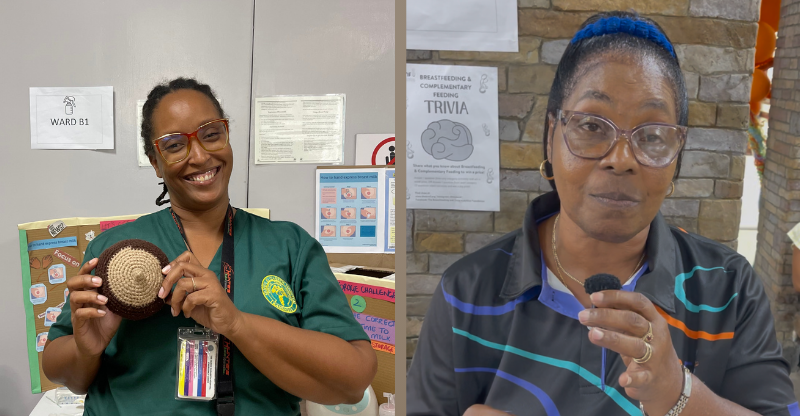
During a recent pop-up public event held for Breastfeeding Awareness Month, reporters from Barbados TODAY were invited to tour two model lactation rooms already in operation at a local hospital — a demonstration that Kirton says proves high-quality lactation spaces do not require costly, elaborate infrastructure. The rooms feature just a few core amenities: a comfortable seating for mothers, a handwashing sink, a refrigerator for milk storage, and a lockable door for privacy. Kirton pointed out that these simple requirements are well within the reach of nearly all employers, regardless of size or budget.
Beyond maternal and child health benefits, Kirton argued that employers themselves gain tangible advantages from accommodating breastfeeding mothers. She explained that breastfeeding leads to healthier infants, which translates to fewer unplanned absences when parents have to stay home to care for a sick child. “Critics may argue that time spent pumping is time away from work, but in the long term, a mother who can pump three times a day will be far more reliable and productive than one who loses three full workdays to caring for a sick child,” she said.
Fellow registered nurse and midwife Simone Richardson-Small, who works on the island’s labour ward, echoed Kirton’s call, stressing that designated lactation spaces should become a universal workplace standard. These facilities are critical not just for infant development, but for protecting maternal health as well, she explained. Without a dedicated space to express milk, breastfeeding mothers face a higher risk of breast engorgement, a painful condition that can progress to mastitis, a serious infection that requires medical intervention.
For infants, consistent access to expressed breast milk delivers lifelong benefits: it supports steady healthy weight gain, lowers the risk of childhood infections, and boosts long-term brain development. “When we support breastfeeding mothers, we are investing in the overall health and future of our entire country,” Richardson-Small added.
The push for change is not limited to frontline healthcare workers. The Breastfeeding and Child Nutrition Foundation (BCNF), a local advocacy group, is pushing for binding legislative action to codify this requirement. Retired veteran midwife and BCNF representative Betty Reid said the organization has long advocated for dedicated lactation spaces in all workplaces, and is now calling on the Barbadian government to introduce a national policy mandating these facilities for all employers. “Every working mother deserves the space to either express milk or breastfeed her child during working hours, and it should be a guaranteed right, not a discretionary perk,” Reid said.