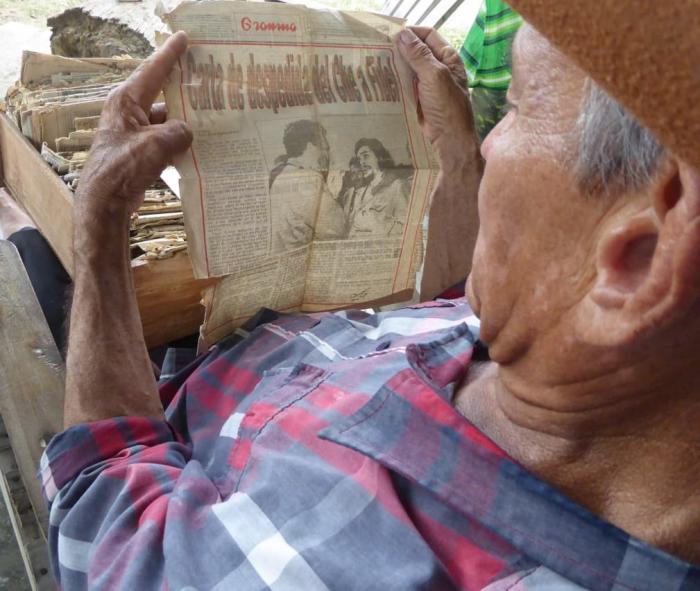
In the quiet coastal community of Perseverance in Guantánamo, Cuba, 71-year-old Roberto Estrada Pereira — known locally by his nickname El Guajiro — still holds tight to a collection of yellowed, time-worn newspapers that have shaped his entire worldview. For six decades, Granma, the official publication of the Central Committee of the Communist Party of Cuba, has been more than just a source of news for him: it is his compass, his bible, and a living archive of the Cuban revolution that he has guarded and cherished since he was a 10-year-old boy.
Estrada’s first encounter with Granma dates back to October 1965, when rumors of a reshuffling of the Party’s Central Committee, the launch of a new official newspaper, and the unexplained absence of revolutionary icon Che Guevara spread through his small, remote neighborhood. Back then, access to information across much of rural Cuba was extremely limited. As Estrada recalls, no household in his neighborhood owned a television, and most relied on a single clunky analog radio that could barely pick up consistent signals. When rumors emerged, residents waited days for regional newspapers to be delivered by traveling vendors, and clarifications of big news often took far too long to reach isolated communities.
On the night of October 3, 1965, the 10-year-old Estrada tossed and turned turning over the questions he had heard from neighbors and his parents: What changes were coming to the Party Central Committee? What was this new Granma everyone was talking about? Where had Che Guevara gone? Like most Cubans of that era, one unshakable belief anchored his uncertainty: if the official word came from Fidel Castro, it was the truth.
Determined to get answers first thing the next morning, Estrada set out two kilometers early to intercept the newspaper vendor before he reached the town. Newspapers were in such high demand that anyone at the back of the line usually left empty-handed, so the young boy offered the vendor 20 cents to secure the first copy of the new paper. When the vendor asked why a 10-year-old was so eager for the publication, Estrada replied that he wanted answers to his questions about the Party, Che Guevara, and most importantly, to read Fidel Castro’s official words.
The vendor handed over the paper, a historic copy: the very first issue of Granma, dated October 1965. Estrada ran home, and spent the entire day poring over the pages, reading aloud and rereading every line, even when he did not understand the meaning of many of the political terms. That moment began a lifelong relationship with the publication that continues to this day.
Today, the former farmer and part-time poet keeps a carefully preserved collection of decades of Granma editions in a drawer at his home. The irregular edges, yellowed paper, and tiny perforations on each page bear the traces of more than half a century. The collection holds every major moment of modern Cuban history: Che Guevara’s farewell letter, the cover of the First Congress of the Communist Party of Cuba, photographs of Fidel Castro at international summits, domestic meetings, and global solidarity trips, as well as reporting on national moments of grief. For Estrada, these are not just old newspapers — they are a national treasure, a tangible link to the revolution he grew up believing in.
In his own poetic verse, Estrada sums up the deep bond between Cubans of his generation, Granma, and the legacy of Fidel Castro: “Granma and Fidel go together,/ weapon and guide,/ pages of dignity,/ defeating falsehoods/ symbol and helmsman.”