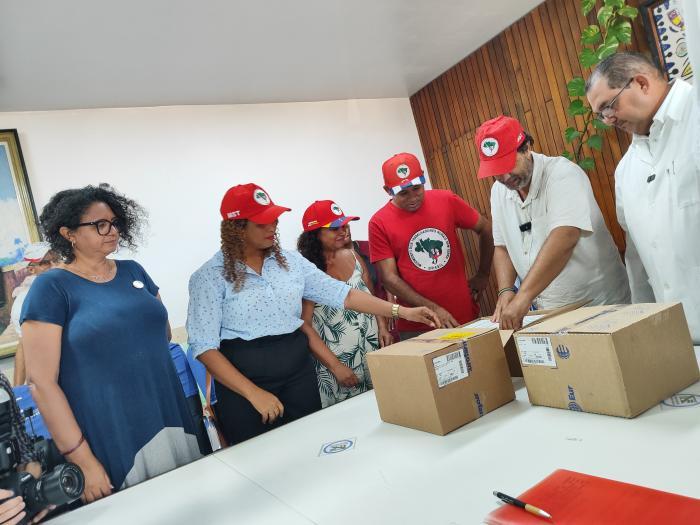
HAVANA – In a striking demonstration of cross-border solidarity, Brazil’s Landless Workers’ Movement (MST) has delivered 7.6 tons of life-saving pharmaceuticals to Cuba’s national public health system, arriving at a moment of profound economic and medical strain for the Caribbean nation.
The donation, which arrives Wednesday, builds on a long-running partnership rooted in the historic fraternal bonds between the Cuban and Brazilian people. The bulk of the shipment is made up of high-risk antibiotics that are core to medical and surgical procedures at Cuba’s top-tier tertiary care facilities. It also includes other high-demand medications, most notably omeprazole, a widely used drug that currently faces severe supply shortages across the country.
One of the primary institutions set to benefit from the donation is the Hermanos Ameijeiras Clinical Surgical Hospital, a national referral center that treats the most complex patient cases from every region of Cuba. Dr. Reynaldo Denis de Armas, the hospital’s deputy director, expressed the Ministry of Public Health’s deep gratitude for the contribution, noting that the aid will be critical to upholding care standards for the facility’s patient population.
“This is a very significant help at this time,” Dr. Denis de Armas said. He emphasized that the donation will directly support the ongoing continuity of essential healthcare services for Cubans across the island.
This shipment is the latest in a series of solidarity efforts organized by the MST. In past campaigns, the movement sent 4.6 tons of medications and medical supplies to Cuba to support recovery work after Hurricane Melissa hit the country’s eastern region, with resources allocated to the Institute of Endocrinology and the Frank País Orthopedic Hospital. Beyond large organized shipments, MST members who travel to Cuba also regularly contribute personal shipments of medication as part of the ongoing initiative, in coordination with Cuban public health authorities.
Marcelo Durão Fernández de Oliveira, a leader of the Brazilian Landless Workers’ Movement, stressed that standing in solidarity with the Cuban people is a point of honor for the organization. He also called out the damaging public health impacts of the decades-long economic, commercial and financial blockade imposed on Cuba by the United States, a policy that has drastically restricted the country’s access to medical supplies and pharmaceuticals.
“Cuba is a humanitarian, humanist, and internationalist example for the world,” Durão Fernández said. He reaffirmed that the MST’s campaign of support will continue far beyond this latest delivery, noting “This is not the last donation; the next one won’t be the last either.” He added that the movement remains committed to upholding the bonds of brotherhood and cooperation between the two peoples.
Against a backdrop of global geopolitical tension and prolonged economic hardship for Cuba, the MST’s latest contribution reinforces a core truth: even in the most adverse circumstances, cross-people solidarity remains a powerful force that advances efforts to protect public health and individual well-being.