In one of the largest coordinated law enforcement operations targeting environmental crime in the world’s largest tropical rainforest, police forces from five Amazon basin nations — Bolivia, Brazil, Colombia, Ecuador and Peru — have arrested hundreds of people and seized massive volumes of illegal timber, minerals, and rescued thousands of trafficked animals.
Called Operation Green Shield 2026, the initiative ran from July 15 to 31, deploying more than 3,600 officers to crack down on a range of illicit activities including illegal mining, unregulated logging, wildlife trafficking, fuel smuggling and land grabbing. Across 1,045 separate field operations carried out across remote border and riverine regions of the Amazon, authorities recorded 839 arrests, according to official operation data.
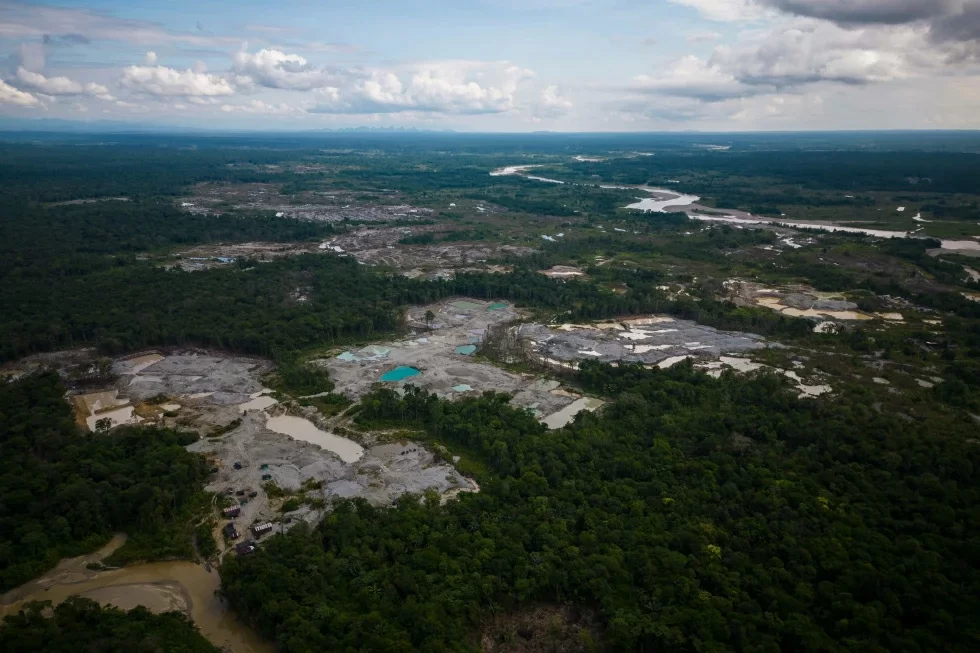
Among the major seizures, law enforcement agents confiscated over 280,000 cubic meters of illegally harvested timber — a volume large enough to fill roughly 110 Olympic-sized swimming pools. They also seized more than 195 tons of illegally extracted minerals, including gold, coal, iron and copper, along with heavy equipment used for unlicensed mining. In addition to targeting timber and mineral poaching, the operation rescued more than 3,000 live trafficked wild animals, and recovered the remains of at least 430 dead animals destined for the illegal wildlife trade. The rescued animals span a wide range of species, from snakes and birds to lizards and freshwater fish. The attached photo, taken near Paimado, Colombia, shows clear deforestation along the Quito River caused by unregulated illegal mining activity in the region.
Environmental crime has emerged as one of the most profitable illegal industries in the Amazon basin, driven by relentless global demand for gold, tropical hardwood, and exotic wildlife. Criminal networks often combine illegal mining, logging and wildlife trafficking, sharing cross-border smuggling routes and transnational financial networks to evade authorities. These groups frequently move people and contraband between national jurisdictions to avoid detection and prosecution, making coordinated international cooperation an absolute necessity to combat the threat, law enforcement leaders emphasize.
Operation Green Shield 2026 was coordinated from Bogotá, Colombia, by the International Initiative of Law Enforcement for Climate (I2LEC), an initiative launched in 2023 by the United Arab Emirates in partnership with the United Nations Office on Drugs and Crime. The organization’s core mission is to strengthen cross-border collaboration to disrupt and dismantle environmental crime networks.
This year’s operation builds on a similar successful coordinated campaign held in 2025, when four Amazon nations joined forces to share intelligence and launch simultaneous cross-border action against environmental crime. For 2026, Bolivia joined the partnership, expanding the operation’s reach into new areas of the basin.
Colonel Dana Humaid, director of international affairs at the UAE Ministry of Interior, noted that the operation’s outcomes demonstrate that joint collective action is far more effective at countering transnational crime than unilateral national enforcement. The total estimated value of all seized contraband from the operation exceeds $280 million, according to official estimates.
General William Oswaldo Rincón Zambrano, head of the Colombian National Police, underlined that the operation proves that shared intelligence can be translated into coordinated, impactful enforcement action across multiple jurisdictions. His Peruvian counterpart, General J. Manuel Cruz Chamba, reiterated that environmental crime does not respect international borders, so sustained cross-border collaboration is an indispensable tool to protect the Amazon ecosystem.